
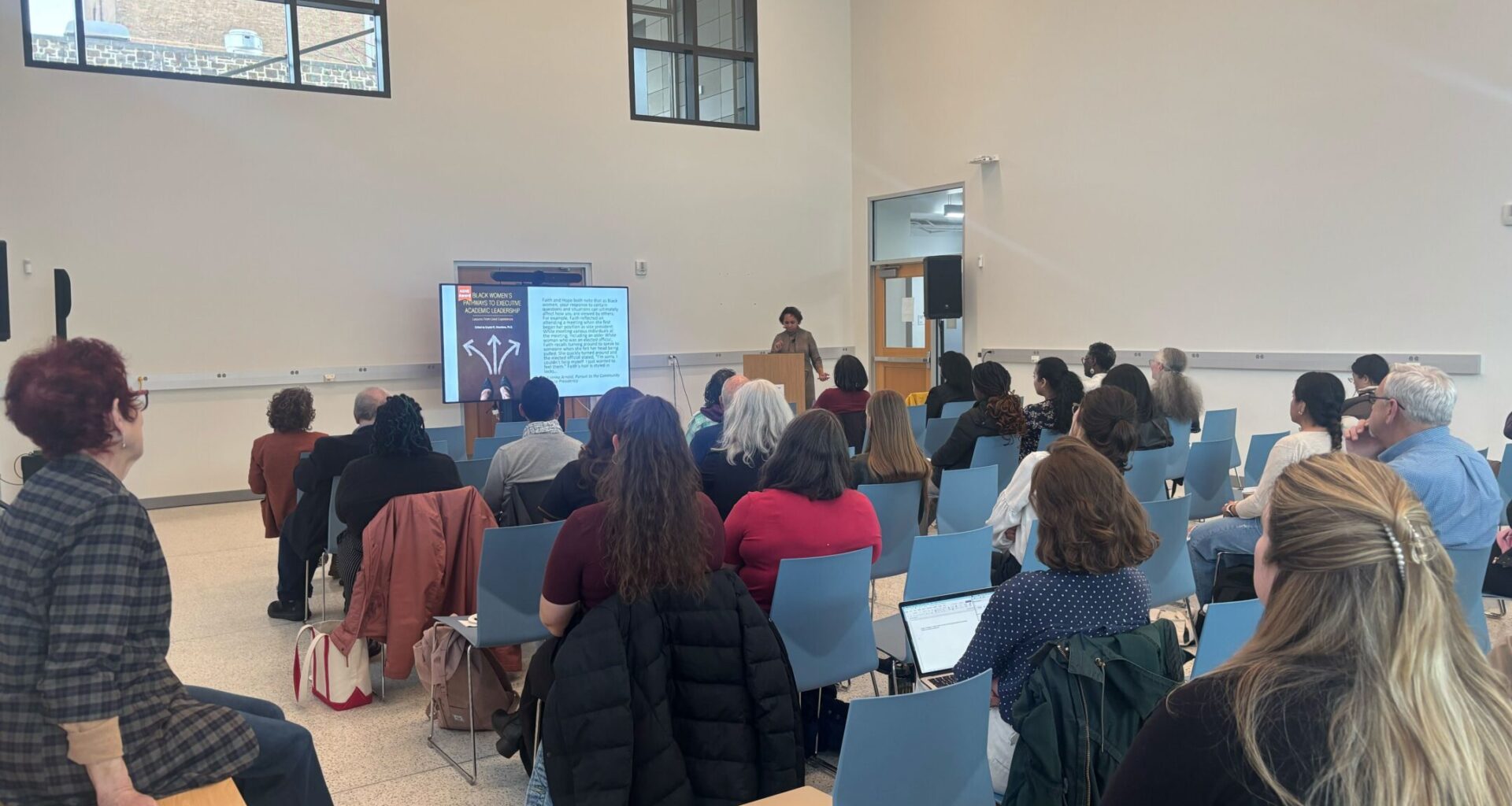
On March 30, Lehigh’s Library and Technology Services hosted Crystal Chambers, a professor of educational leadership at East Carolina University, for a discussion titled “Climbing Ladders: The Meritocracy Myth in Academia.”
Chambers’ work focuses on race, gender and intersectionality. During the talk, she shared insights from her latest book, “Black Women’s Pathways to Executive Academic Leadership: Lessons from Lived Experiences,” which documents the journeys of Black women in higher education.
She discussed the persistent barriers Black women face in advancing their careers.
Chambers said despite strong leadership ambitions, Black women are less likely to be promoted, supported by managers or given access to senior leadership. She also said racial and gender bias continue to limit opportunities and reduce representation at higher levels.
“If we truly believe in merit, then when a woman is clearly qualified, give her the chance,” Chambers said. “Don’t let bias or informal dynamics block her.”
During the talk, Chambers said real progress will require more than “surface-level allyship,” calling for structural change to create equitable pathways for Black women in leadership.
Chambers also discussed the “glass ceiling,” a sociological phenomenon in which invisible barriers prevent minority populations from advancing. She said these obstacles are often reinforced by persistent stereotypes about Black women that shape how their leadership and abilities are perceived.
Even when demonstrating strong leadership qualities, Chambers said Black women are often judged differently than their peers.
“I speak with confidence and intensity,” she said. “It’s my natural way of communicating. Yet that style is often misread as intimidating.”
She said these interpretations lead to fewer promotions, less advocacy from managers and a continued lack of representation in higher-level positions.
Vera Fennell, a political science professor at Lehigh, shared her own career journey and the challenges she’s faced as an African American woman.
“As a professor, I’ve experienced some of the things (Chambers) talked about — at different points in the trajectory: as an undergraduate, a graduate student, a postdoc, and now as the faculty,” Fennell said. “It’s pretty common. It’s a real thing.”
Fennell said she was particularly struck by one of the more unexpected ideas raised during the discussion: the importance of including dissenting voices in conversations about diversity, equity and inclusion, noting she’d never considered the value of having anti-DEI perspectives involved in shaping those ideas and found the concept surprising.
Chambers also discussed the gap between perceived and actual allyship in the workplace.
According to a survey conducted by Lean In, more than 80% of white employees identify themselves as allies to people of color. However, according to the same survey, fewer than half of African American women report having strong allies at work.
In a slideshow, Chambers said this disconnect highlights a critical issue: support is often claimed but not consistently experienced. Without active advocacy, mentorship and inclusion in the leadership network, allyship remains largely symbolic rather than impactful.
For some students in attendance, Chambers’ discussion resonated across racial and cultural lines, particularly for young women navigating male-dominated spaces.
Emily Lin, ‘29, a business analytics major who attended the lecture, said she related to some of the experiences Chambers described, despite not being a Black woman. She said although the experiences of all women of color aren’t identical, many of the struggles Chambers describes felt familiar.
As an Asian woman, Lin said bias can appear in different ways. She said although Asian women are often seen as hardworking and capable, they’re also viewed as “not necessarily leaders,” which can make advancement more difficult.
“A lot of women of color share similar struggles in male-dominated fields like feeling underrepresented, judged differently as leaders or not having the same access to mentorship,” she said.
While other women of color may face more direct bias that questions their abilities, Lin said these experiences point to a broader issue — the challenges women of color continue to face in accessing leadership roles.
Chambers ultimately called for a reimagining of traditional leadership structures, emphasizing that progress will require intentional change. By addressing bias, increasing access to leadership and prioritizing meaningful allyship, she said institutions can begin to create pathways where women of color aren’t only included but also able to lead on their own terms.
“There’s more than one way to lead,” she said. “I’ve built my own model — finding alternative paths to influence and outcomes, even when the door to formal titles isn’t open.”