

Scranton City Council received some pushback Tuesday on its proposal to ban kratom, a botanical native to Southeast Asia, and derivative products sold in stores in forms that include vapes, powders and capsules.
On Monday, four council members — Patrick Flynn, Mark McAndrew, Sean McAndrew and President Tom Schuster — and Lackawanna County District Attorney Brian Gallagher held a media event at the Lackawanna County Courthouse announcing that council intends to prohibit in the city the sale, possession, distribution and manufacturing of kratom and its derivatives.
The substance is legal in Pennsylvania and is commonly used to treat pain, coughing, diarrhea, anxiety and depression, opioid use disorder and opioid withdrawal. It is not approved for medical use by the U.S. Food and Drug Administration.
An initiative led by Flynn, a proposed kratom ban would take place via enactment of two nearly identical ordinances: one addressing adults and the other regarding minors. The ordinances on council’s agenda for introduction Tuesday night drew both support and opposition from members of the public. While some residents applauded Flynn and council for taking the step, others opposed to a ban said they rely on the kratom products for pain relief and other health reasons.
Council voted 4-1 on introduction of each ordinance, with Councilwoman Jessica Rothchild casting the lone dissent both times. Saying she was kept out of the loop by her council colleagues on the proposed ban, Rothchild said it was only on Sunday night that she learned about the news conference scheduled for Monday morning to announce the proposed ban. She did not have enough time to reschedule work to attend it or review the kratom issue and legislation.
Most legislation comes from the administration of Mayor Paige Gebhardt Cognetti and the city Law Department. When council generates legislation, council usually would first discuss it as a body beforehand in a caucus work session or in one-on-one conversations to avoid violations of the Sunshine Act regarding discussions or deliberations by a quorum (majority) of council members outside of official meetings, Rothchild said. Then, the council solicitor would work with council on writing the ordinance and send out a draft for conversation and any changes prior to introduction.
“I believe this is best practice, but this did not occur in this case,” Rothchild said. “I have an issue with how this issue was handled in the first place.”
Rothchild said no other municipalities in the state have enacted a citywide or townwide kratom ban, and bans that do exist involve synthetic versions. At least three bills pending in the state Legislature would involve bans of synthetics, and by people under 21, and have enforcement done by the state Department of Health, Rothchild said. The council ban appears to be more of a general ban, and she thinks city legislation should more closely mirror the state bills. Noting a ban was not discussed with the Cognetti administration or city Police Department, Rothchild asked her council colleagues several questions, including what research was done and how a ban would be enforced.
“I don’t disagree with banning synthetic kratom and keeping the people in Scranton safe from harmful substances,” she said. “We just need to be more thoughtful in this legislation and how it should be carried out.”
Flynn and three other council members defended the legislative process. Flynn said he had researched the issue for months and worked with council Solicitor Tom Gilbride, Gallagher and members of the recovery community on the initiative.
“I did my due diligence on this. I apologize if it didn’t come to you soon enough,” Flynn told Rothchild. “There is currently no meaningful regulatory framework governing these products. Kratom is being sold in gas stations, smoke shops, convenience stores, in a wide range of forms — powders, capsules, extracts and increasingly potent concentrates. There are no consistent manufacturing standards, no uniform labeling requirements and no clear dosing guidance.”
Flynn also stressed a ban would be “civil in nature, not criminal.” The penalties of a $300 fine and up to 90 days in jail “are strictly civil, similar to other local regulatory” penalties, and a ban would not create criminal charges for individuals, he said. “This has not and has never been about criminalizing individuals. It is about regulating the sale of a product that operates in a regulatory gray area,” Flynn said.
Councilman Sean McAndrew said, “Knowing Pat and knowing DA Gallagher, they would never put something in front of us if they didn’t do their research and felt strong about it, and Mr. Gilbride as well, I believe helped out.”
After council’s meeting Tuesday, The Times-Tribune asked Schuster if the gathering of the four council members at the courthouse news conference Monday amounted to a violation of the Sunshine Act. Schuster said no, as “Yesterday’s (Monday’s) action was limited to announcing council’s intent to introduce the legislation. Formal deliberation occurred today,” during council’s meeting Tuesday.
On Wednesday, Flynn also said the gathering of the foursome Monday regarding proposing a kratom ban did not amount to a Sunshine Act violation of a quorum outside of an official meeting. He had done all the legwork himself, he said.
“We didn’t deliberate together on that or anything else,” said Flynn, who was elected to council last year and was seated in January.
Flynn also said he aims to have council amend the ordinances to remove the penalty of potential jail time, to ensure the public realizes this is a civil issue, not a criminal one.
“My intent is not to criminalize addiction,” Flynn said.
Regarding not approaching the mayor or administration beforehand about a ban, Flynn said, “This is something that I’ve been passionate about for a very long time. Could I have maybe gone about it a different way? Sure. Lesson learned.”
In a statement issued Tuesday to The Times-Tribune, Cognetti said, “We support any proactive measure aimed at reducing access to a substance that remains largely unregulated and insufficiently studied, particularly for the sake of the young members of our community. Addressing issues concerning our youth has been a priority of our administration.”
The kratom ordinances written by Gilbride were patterned on a city ban of bath salts in 2011, Flynn said.
The ordinances would come back for advancement on second reading at the next weekly council meeting on Tuesday at 6:30 p.m. at City Hall. If advanced, the proposed ordinances would come back for a third vote on adoption at a future council meeting.

Vehicles are parked in front of the Scranton Smoke Shop on Biden St. in downtown Scranton Wednesday, April 8, 2026. (SEAN MCKEAG / STAFF PHOTOGRAPHER)
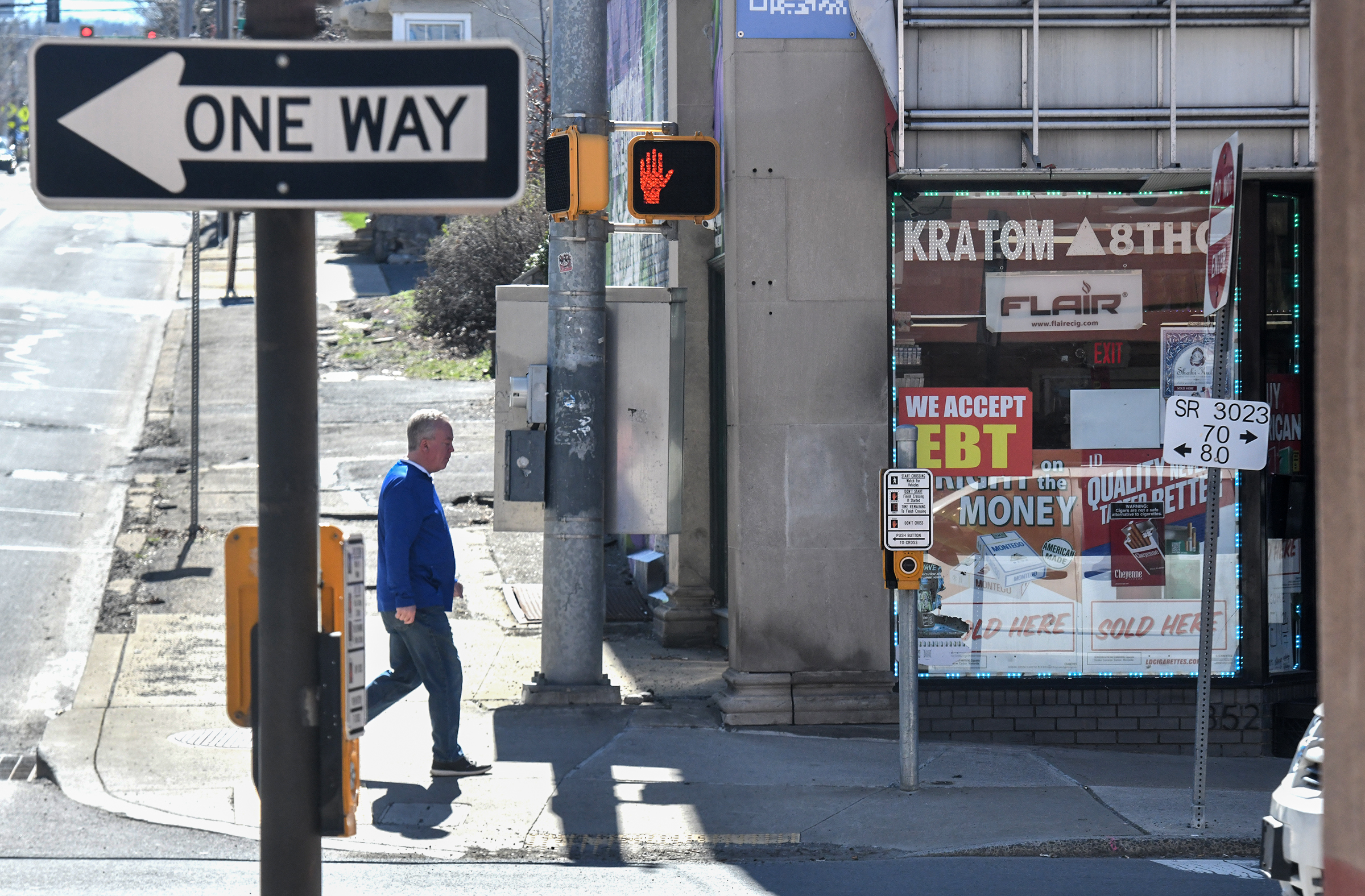
A pedestrian walks past a convenience store that sells kratom on Adams Ave. in downtown Scranton Wednesday, April 8, 2026. (SEAN MCKEAG / STAFF PHOTOGRAPHER)

Scranton City councilman Pat Flynn speaks during a press conference in the foyer of the Lackawanna County Courthouse in Scranton Monday, April 6, 2026. Standing behind Flynn are, from left, Owner and CEO of the Friendship House Joe Van Wie, Lackawanna County District Attorney Brian Gallagher, Scranton City council president Tom Schuster, Scranton City councilman Sean McAndrew and Scranton City councilman Mark McAndrew. (SEAN MCKEAG / STAFF PHOTOGRAPHER)
Show Caption
1 of 3
Vehicles are parked in front of the Scranton Smoke Shop on Biden St. in downtown Scranton Wednesday, April 8, 2026. (SEAN MCKEAG / STAFF PHOTOGRAPHER)