
My interest in hawthorn trees was sealed when I learned how butcherbirds impale their prey on the tree’s long, sharp thorns. Driving the captive bodies of insects, snakes, and rodents through a rigid spike is a brutal way to kill for food, and an extremely evocative image. The black and white butcherbirds and the spike-covered hawthorns deserved a second look.
I learned about this behavior from an Illinois conservationist named Susan Kleiman while we were hiking through a tallgrass prairie preserve. I was getting a lesson in the work of restoring eastern grasslands, which often requires cutting trees. But in one hilly corner of the preserve, she’d made the decision to leave a clump of hawthorns. Eastern grasslands were historically intermixed with trees and shrubs and so this choice was well within the prairie palette. She also did this to provide for the needs of the butcherbirds—northern and loggerhead shrikes—which hadn’t been observed on the preserve in quite some time.
A few hours later, at lunch with Kleiman’s colleagues, a man asked if we had seen the shrike that had been spotted near the hawthorns. Was he serious? As far as I knew, he wasn’t aware of our earlier conversation, nor of the intent behind Susan’s sparing of the hawthorns. Rarely do management decisions result in such immediate results. Surely this was just a lucky coincidence, but it happened just like that. I thought it was marvelous.
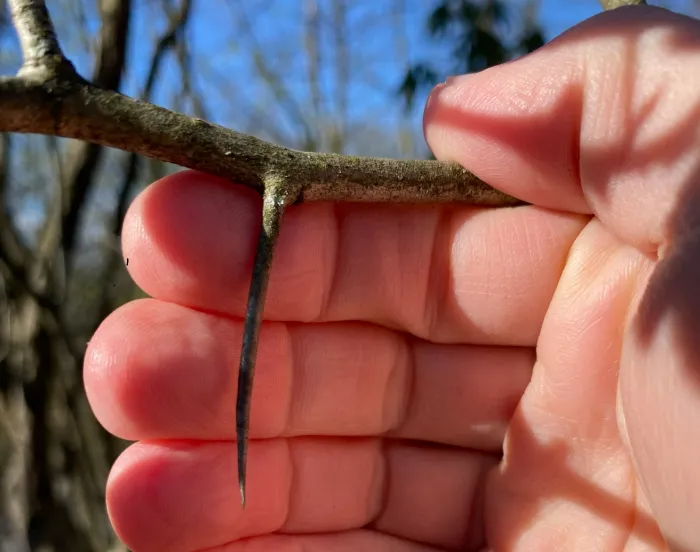
Northern and loggerhead shrikes use the thorns of hawthorn trees to impale their prey, while other birds find refuge in the trees’ dense tangles of branches. Photo: Andrew Moore
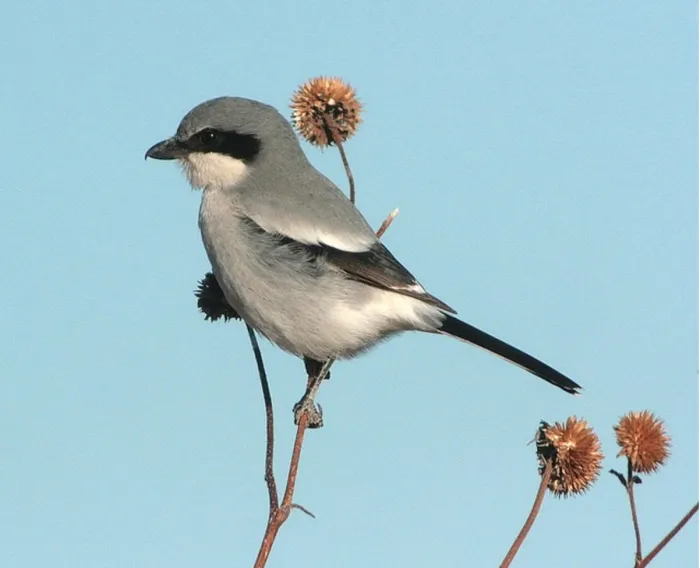
In Pennsylvania, the loggerhead shrike is an endangered and protected species. Photo: Roger Baker/USFWS
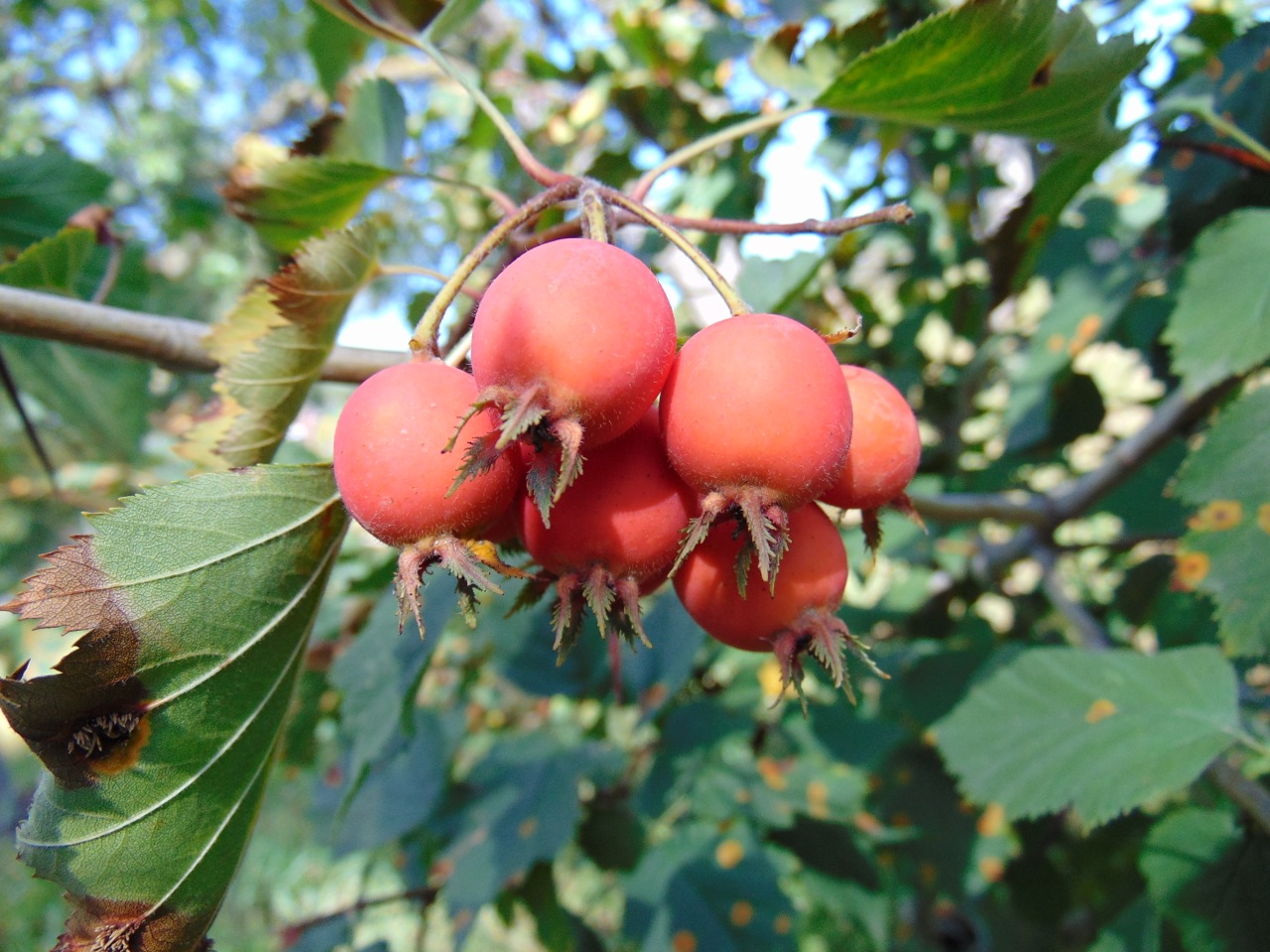
I was primed for an interest in hawthorns back home in Pittsburgh because I stumbled into the Pennsylvania Natural Heritage Program’s fascinating 296-page Allegheny County Natural Heritage Inventory. I was looking for information on my neighborhood’s urban park. Established in 1894, Riverview Park spans 291 acres, and ecologically speaking, much of it is in rough shape. To my surprise, I found an entry for the Riverview Park Natural Heritage Area—a location defined by the Natural Heritage Program as supporting “rare plants or animals, exemplary ecological communities, and Pennsylvania’s native species biodiversity.” This park was home to a population of the Pennsylvania (or Red-fruited) hawthorn, Crataegus pennsylvanica, a globally vulnerable species.
I learned that, historically, the Pennsylvania hawthorn was known to have occurred naturally in just a few states, from Delaware through Pennsylvania, and west to Ohio and West Virginia, as well as southern Ontario. It is a tall, arborescent hawthorn, larger and statelier than many other haws, with large leaves, and large, bright red fruits. Yet its occurrence in my neighborhood park is remarkable, considering the amount of disturbance and degradation the area has endured for more than two centuries. As Jessica McPherson, a botanist with the Western Pennsylvania Conservancy, told me, “There are no other globally rare plant species I can tell you about that are predominantly in urbanized landscapes as this one is.”
In other words, ecologically sensitive species should not be found, much less thrive, in the heart of our post-industrial urban matrix, and yet, here’s one that did.
At least, that’s a best guess about the status of this special hawthorn population. Despite its global rarity, you could count on the fingers of one hand the number of people who spend any time studying this native species. I had certainly never heard of Crataegus pennsylvanica, and as I was soon to understand, neither have most Pittsburghers, even devoted naturalists and tree enthusiasts like myself. Most folks in Pittsburgh have no idea that this species is in our “backyards,” so to speak. When I shared this hunch with Bonnie Isaac, the collection manager for the Carnegie Museum of Natural History’s Section of Botany, she took the notion a step further. “Most people don’t want them in their backyards,” she said. “I know several people who have cut hawthorns down because of the thorns. Landowners in general don’t like things that will puncture tires or feet.”
While this bias against spiky, thorny things is strong, it is not the main reason the Pennsylvania hawthorn is so little known. After all, we know a honey locust with its two-inch spikes when we see it, and we place thorn-covered roses at our backdoors. The main reason is that hawthorns are not just thorny, they’re tricky, too.
Crataegus is an extremely difficult genus to identify down to the species. There are numerous species, they often hybridize, and some of them reproduce through a process called apomixis, which is an asexual process of cloning through seeds. In order to even make an attempt at identification, one needs to see not just leaves and bark, but also the flowers, and sometimes the fruit, too. Many botanists, if not most, find hawthorns puzzling and too complex and so we have collectively brushed them to the side. “It’s a hawthorn,” they say. “I’m not really sure which species… but watch out for those thorns!”
Consider the hawthorn entry from the famous A Peterson Field Guide to Eastern Trees: “These plants, though distinctive as a group, are virtually indistinguishable as species except by a few botanists. Frequent hybridization and great individual variation confound accurate identification.” The book’s author goes on to say that Crataegus specialists don’t even agree on the validity of all identified hawthorns, and that the number of species ranges from 100 to 1,000. “In this volume, therefore, no attempt is made to differentiate between the many species,” the author explained.
But this disinterest wasn’t always the norm. A century ago, botanists were not so dismayed by hawthorns. They responded to this wild diversity and complexity not by throwing up their hands in disgust, but rather by naming every hawthorn with any slight variation as a unique species. (They may have been a little too enthusiastic about naming species at this point.) There was then a flurry of hawthorn activity, and Allegheny County was a hotspot. The type locality for Crataegus pennsylvanica, which is where the plant was first and formally described by a botanist, is Stowe Township, just across the Ohio River from Pittsburgh’s Northside. Many early records of this species are from Pittsburgh. “Of the nearly 40 species of hawthorns known from Pennsylvania,” said Bonnie Isaac, “almost 30 of them are known from Allegheny County.”
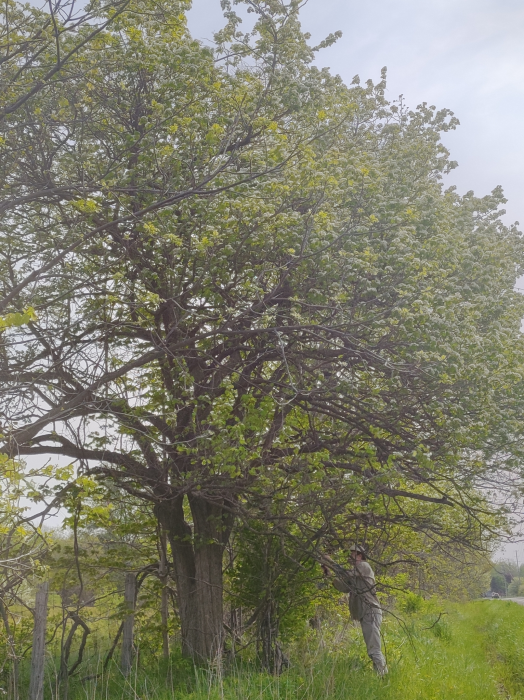 Hawthorns, including this large specimen of C. pennsylvanica, were historically abundant along the edges of farm fields. Photo: Marc-Aurèle Vallée
Otto Jennings, the renowned Pennsylvania botanist who made his career at the Carnegie Museum of Natural History, collected many records of Crataegus pennsylvanica in Allegheny County, and specifically from Riverview Park, in the early 20th century. He noted that his wife “made excellent jelly from the fruits of this species” and that “It bears the largest fruits of any of our hawthorns and the trees themselves rank with C. punctata as our largest.” It occurred “On moist slopes in various places in the Pittsburgh district,” including Riverview Park. (Schenley Park, in the city’s East End, is likewise home to hawthorns.) Jennings’ specimens are still kept at the museum in Pittsburgh, and the progeny of those trees, if not a few old trees themselves, still occur in the landscape.
But the trees might as well have been dust-covered specimens in a museum, as far as the public was concerned. Hawthorns soon fell out of favor. Rather than reveling in its diversity and complexity, in the genus’ propensity to hybridize and reproduce in unique ways, botanists shied away from this puzzle, just as homeowners shied away from its thorns.
Scott Schuette is the botany program manager for the Pennsylvania Natural Heritage Program at the Western Pennsylvania Conservancy. He grew up in Illinois, and thought of Crataegus as a grazing indicator, because they were always in the fencerows and old ag fields. “I always thought of them as kind of a weedy species, and didn’t really think too much about their conservation,” he said. “They are a conservation concern, but we don’t know much of anything about them. For just lack of, neglect, essentially, lack of putting time into them.”
The Pennsylvania hawthorn is distinct
For the past thirty years, botanist Ron Lance has been one of the exceptions. “Some botanists want to ignore them,” Lance told the Botanical Society of Western Pennsylvania in 2020, “What got me into them was the fact that no one else was into them.” Hawthorns are an enigma, he said, particularly in the East, where their complexity has for some reason dissuaded research rather than invited it.
Though he’s often leading the charge, Lance is not entirely alone. A “secret hawthorn society” has quietly been working away on questions of hawthorn reproduction and taxonomy, and this research has led to a fair amount of agreement over which specimens are in fact valid species. This is especially true with Pennsylvania hawthorn. “These seem to be actually one of the more easier to identify, to get a good handle on it,” Lance told me. “Pennsylvanica is distinct.”
The difficulty of late has been finding hawthorns at all, particularly the historic populations. “You go to the place where they were found a hundred years ago, and you don’t find them anymore, they don’t turn up elsewhere,” Lance said. “So we’re stuck with having these old names and specimens.” Without living specimens, advances in modern genetic analysis, which help to solidify species status, aren’t much help.
Here, again, pennsylvanica is an exception. The trees are long-lived. Lance knows of one tree that’s at least 85 years old and over a foot in diameter. Pennsylvania hawthorns can often grow to 25 feet. In 1997, botanist James Macklin came back through Riverview Park and found C. pennsylvanica on a north-facing slope, in roughly the same area as Otto Jennings had ninety years earlier. Based on these records, botanists with the Western Pennsylvania Conservancy established the park’s Natural Heritage Area.
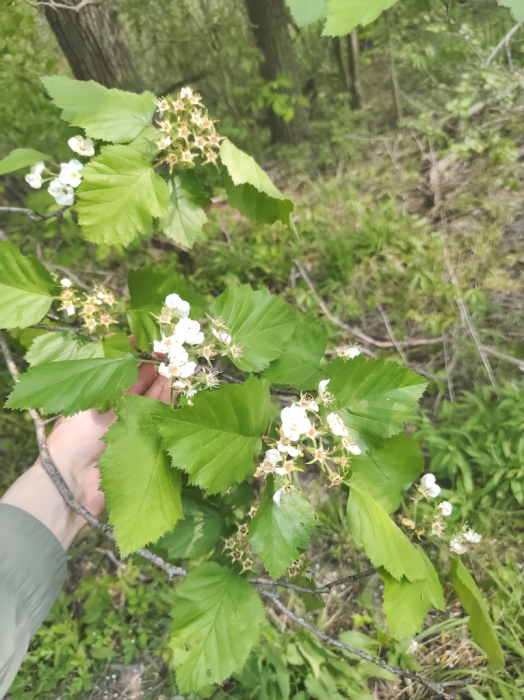 Leaf shape and flower structure aid in the identification of Pennsylvania hawthorn, a distinct species. Photo: Marc-Aurèle Vallée.
Questions and concerns remain
There is a possibility that Pennsylvania hawthorn, though it has a restricted range, is not quite so rare as the records indicate. It might turn up in more locations, if more botanists were out there looking for it, and if more hawthorn sightings were correctly identified to the species.
Its longevity in Pittsburgh’s parks is also testament to the toughness of these scrappy little trees. “For a hawthorn population to persist for over a century is considered unusual,” McPherson said. “Our theory is that the park basically maintained that open habitat that it needs, because that’s what urban parks are, they’re mixes of forests and woodland and shrubland landscape. So that’s maybe why it was able to persist.”
Like all living things, however, pennsylvanica is not indestructible. And if hawthorns are declining nationwide, something similar could be happening to Pittsburgh’s C. pennsylvanica populations. In Riverview Park, it’s unclear if there is sustainable regeneration of young trees for the population to persist for years to come. Elsewhere, introduced invasive species are quickly proliferating in the habitats that would have historically been the hawthorn’s niche. Are these conditions preventing pennsylvanica from establishing in new areas of the county? Since no one is keeping tabs on these hawthorns in any official capacity, no one knows. The wooded slopes of Riverview Park are also prone to landslides. When hillsides are reclaimed and graded by contractors, C. pennsylvanica is not replanted. Nurseries do not grow this species, and plantings in the park often include non-native trees. All of these factors could be putting pressure on hawthorn populations.
“There’s been so many unknowns about this one that it’s sort of not risen to the top,” said Rachel Goad, a WPC botanist based in Harrisburg. The conservancy’s botanists are now part of a regional Crataegus Working Group, but their conservation work is as full as ever. To put the conservation of rare plants in context, there are 30-40 globally rare species in Pennsylvania. The state’s official rare, threatened, and endangered plants list is over 500 species. Meanwhile, C. pennsylvanica isn’t afforded any state or federal protections. Local parks agencies and their partners aren’t explicitly required to safeguard the trees, and most folks don’t have a good idea where these specific hawthorns occur.
Pittsburgh Botanic Garden to use prescribed fire in its meadow, a first for Allegheny County
Citizen scienc and hawthorn awareness
To give a final illustration of just how little this species is understood, and how rare it may be, consider some data from the citizen science project iNaturalist: the flowering dogwood (Cornus florida) has over 47,000 observations on iNaturalist; Pennsylvania hawthorn (Crataegus pennsylvanica) has just 43. iNaturalist estimates it has more than 4 million users scouring the landscape for plants.

The top identifier of Pennsylvania hawthorn on iNaturalist is a biologist and Ph.D. candidate at the University of Montreal named Marc-Aurèle Vallée. Of the 43 observations recorded on iNaturalist, Vallée has verified 23. In October of last year, I sent Vallée a picture of a flowering hawthorn I’d encountered in Riverview Park’s Natural Heritage Area. “This is indeed C. pensylvanica,” he wrote back. “Note the very deeply laciniate sepals, the very light salmon-colored fresh anthers, and the very hairy inflorescences.” The white flower, and its pollen-covered stamens, looked like pennsylvanica, and only pennsylvanica.
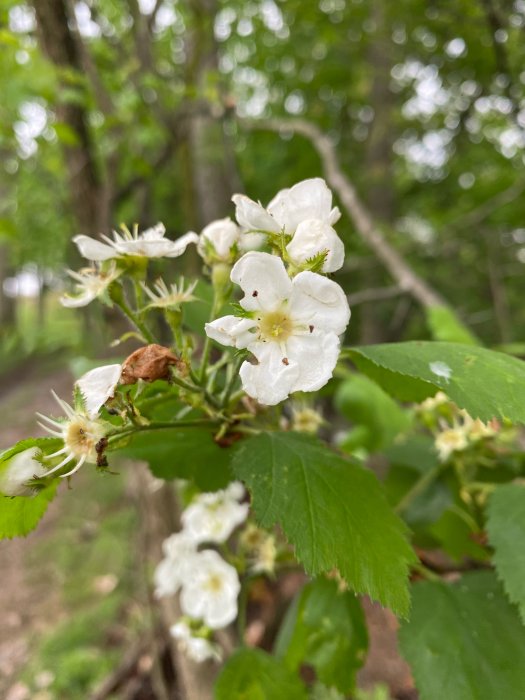 These flowers, observed in Pittsburgh’s Riverview Park, were identified as C. pennsylvanica by botanist Marc-Aurèle Vallée. “Note the very deeply laciniate sepals, the very light salmon-colored fresh anthers, and the very hairy inflorescences.” Photo: Andrew Moore
Earlier this year, I invited Vallée and two colleagues from the University of Montreal, Étienne Lacroix-Carignan, who studies the taxonomy of Crataegus in Quebec, and their advisor, Étienne Léveillé-Bourret, curator of the Marie-Victorin Herbarium, to come to Pittsburgh to help identify hawthorns and collect specimens for their ongoing identification work. The botanists have also offered to provide a hawthorn identification workshop at Riverview Park’s Arbor Day Celebration (scheduled for April 19, which should be right around the peak of hawthorn flowering).
Hopefully, the weather cooperates, and our timing is right. “You need flowers,” Léveillé-Bourret told me recently from his office in Montreal. “Most of the year, they’re just an enigma. And you can really study them only a few weeks every year. And that’s part of the fun as well, for me, because it’s sort of an event. When they’re in flower, I’m happy, and then two weeks later, that’s it.”
Hawthorns aren’t just a botanical puzzle, they’re also a critical component of functioning ecosystems, which brings us back to the butcherbirds. In the early 1900s, shrikes were observed occasionally in southwestern Pennsylvania. There were breeding records for shrikes in Sewickley, Homestead, and Greene County, Pa.; they also were known in Washington and Westmoreland counties. “Their home is in the thicket and the rude, bulky nest, fashioned of twigs, is generally hidden in a thornbush or other dense growth,” ornithologist W.E. Clyde Todd recorded in Birds of Western Pennsylvania. But these days, the birds are exceedingly rare, not just in Pennsylvania, but throughout the East.
The state of Pennsylvania now lists the loggerhead shrike as a species of concern, and the Pennsylvania Natural Heritage Program notes that the loss of early-successional habitats, where certain grasses, flowers, and shrubs like hawthorns thrive, is likely to blame. The U.S. Fish and Wildlife Service has considered listing the migrating subspecies as an endangered species. I’m under no illusion that if we planted more hawthorns in Pittsburgh, or paid more attention to the historic populations in parks, shrikes would suddenly appear like they did that day in Illinois. Migrating shrikes, like so many other birds and animal species, need not just the indigenous hawthorns of Pittsburgh, but entire landscapes.
Yet there are many other birds that make use of our local hawthorns. Indeed, hawthorns attract swarms of bees, beetles and flies that feast in their blooms each spring. Mammals eat its succulent fruits each fall. These interactions are likely part of the reason hawthorns persist in Pittsburgh at all.
The Pennsylvania hawthorn itself is also inherently worthy of existence and conservation, and the diversity and complexity of our native hawthorns ought not to be a source of frustration, but rather pride and joy. “I think it’s fascinating,” Léveillé-Bourret said. “And I think whatever some botanists may say about hawthorns—that they’re so difficult to study, that the species are undefinable—I think something that nobody can say is that they’re not diverse in morphology, in phenotype, in flowering period… and there’s beauty in the diversity of colors, shape, size, even type of growth… so all of that is worth preserving, and whether those are species or varieties of subspecies, I don’t really care. It’s the diversity in the end that we want to preserve.”