
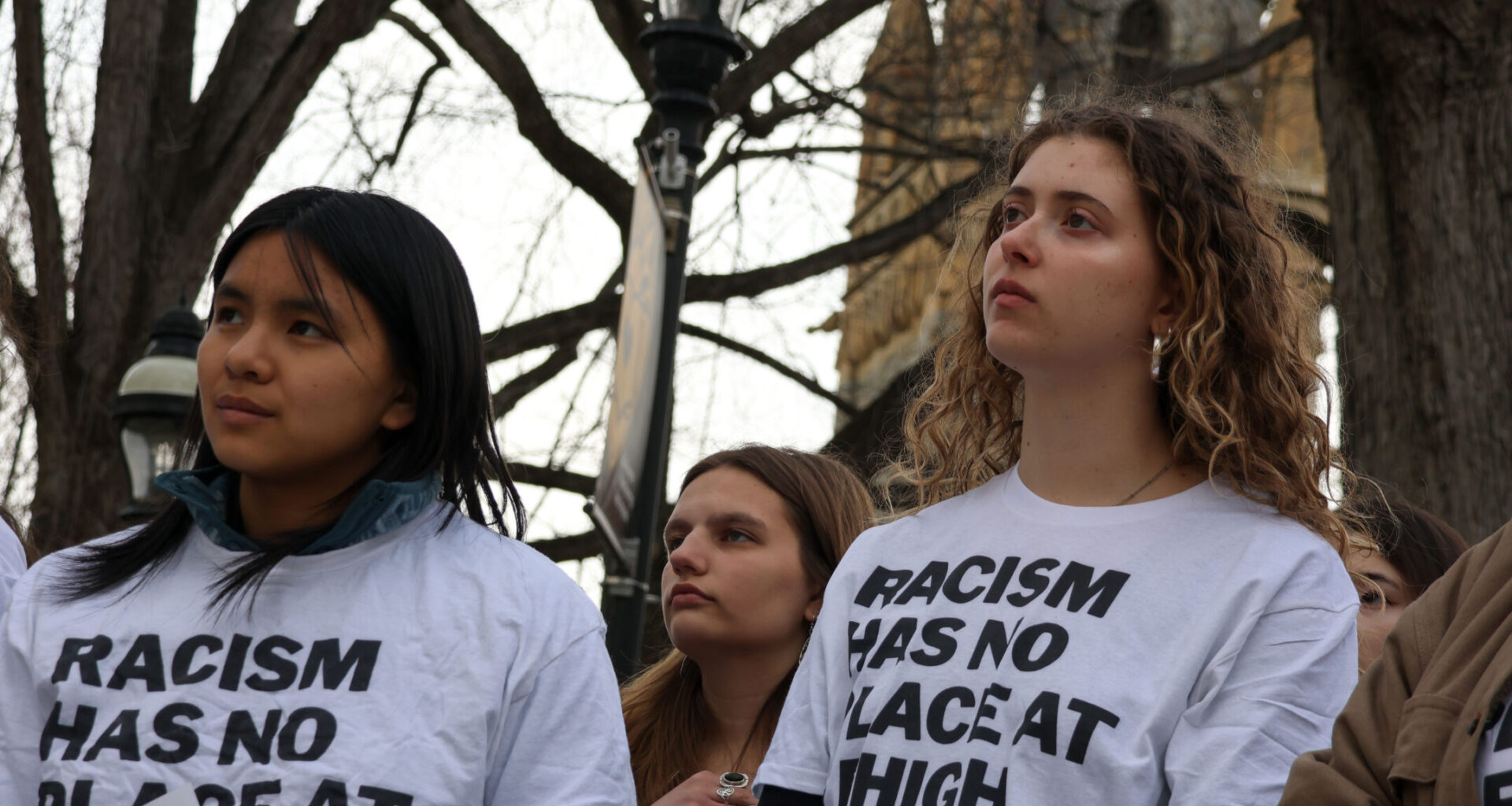
On Monday afternoon, more than 150 Lehigh students gathered around the flagpole in front of the Clayton University Center for a demonstration organized by the Black Student Union.
The crowd grew over the course of an hour as professors and students spoke out against racism on campus in response to recent events.
Attendees held signs condemning racism on campus, and some wore shirts reading, “Racism has no place at Lehigh.”
Black Student Union President Justin Burrell, ‘26, opened the event by welcoming attendees and introducing the first speaker, professor Kashi Johnson.
Johnson, chair of the theater department, said she’s served as the faculty adviser for Black Student Union for many years.
“I know (Lehigh),” she said. “I know it deeply in my bones what it feels like to live, to work and breathe here in a Black female body over time.”
Johnson said what’s happening on campus is painful and not new. She said she remembers how students step forward in the face of injustice, refusing to let it pass quietly.
“I am choosing to say plainly, we will not accept this,” she said. “Not now, not ever.”
Johnson concluded her speech by sharing words from poet, essayist and playwright Claudia Rankine.
Kaitlan Prioleau, ‘27, then took the stand, introducing herself as a multifaceted individual, but above all else, a Black student at Lehigh. To explain what that means to her, she read the poem “Black Sonnet” by Candace Williams with the crowd.
Prioleau was the one who saw and reported the second BORG incident this semester. She described the night she found it, explaining she was walking home after parking her car when she noticed blackface drawn on the jug.
“I didn’t quite realize what it was, and in the moment I actually thought I was dreaming because it was quite late,” Prioleau said. “There’s no words on it, just blackface. I was in shock.”
She said she didn’t know how to respond when experiencing a hate incident, so she chose to speak out.
Prioleau read comments posted under her Yik Yak post, which included a photo of the BORG and received mixed reactions.
One commenter suggested the BORG was planted by a Black student for attention. Prioleau clarified she didn’t plant it, while another comment suggested it would be best to leave it alone rather than make a “big stink.”
“I’m not making a big stink out of it,” she said. “I’m doing the necessary things to advocate for myself, to advocate for students.”
Prioleau said reporting situations like this is exhausting and overwhelming. She said she experiences stares, whispering and pointing on campus, but believes action is necessary. She added such events shouldn’t be happening on campus or anywhere in the U.S.
“It’s not just me,” Prioleau said. “I’m not (at) the forefront of this revolution, or whatever you want to call it — it’s all of us. It’s all students. It takes every single one of us.”
Prioleau concluded by encouraging students to remain motivated and continue advocating for change.
Mariana Roldán, ‘28, Student Senate diversity and inclusion chair, spoke next and shared the Senate’s demands for action.
Roldán said the first BORG incident was disheartening and that, following the Feb. 26 fireside chat with President Jospeh J. Helble, Student Senate began working toward a resolution.
A group of students representing various cultural organizations met with Roldán to address both short and long-term concerns with the administration. She said additional meetings followed as more students joined the discussion.
“It was a lot of very courageous students involved throughout leaderships in the Lehigh community, who all came together and discussed what we thought would be best for our colleagues, for ourselves and for our peers,” Roldán said.
She said after that process, the second BORG was discovered, creating a greater sense of urgency.
Roldán outlined proposed action, including strengthening the University Code of Conduct, implementing an advocacy committee and expanding education through measures such as anti-racial discrimination training.
She also said discrimination and bias workshops during first-year orientation should be expanded, and that a portion of Greek Prep should address institutional and historical racism within Greek life.
Roldán said Black students are disproportionately affected and that their experiences should be prioritized.
Burrell then spoke, reflecting on his first year at Lehigh living in the McClintic-Marshall House, where he said racially charged jokes and comments were common.
“It’s hard to feel part of the Lehigh community when our experiences become the butt of the joke, whether it’s in person, in class or on anonymous vehicles such as Yik Yak,” he said.
Burrell said while these experiences are serious and accountability is necessary, he didn’t attend the demonstration solely to discuss pain.
“I found (Black Student Union) freshman year,” he said. “For the first time on campus I felt like I could be myself. No shrinking, no code-switching, no explaining myself — just myself. That’s what community actually looks like.”
Burrell encouraged students to speak up, emphasizing that their voice matters. He also highlighted the many organizations that support students of color on campus and reassured attendees that they belong at Lehigh.
“Community isn’t at its best in crisis,” he said. “It’s at its best when we love each other consistently.”
Henry Odi, ‘98, deputy vice president for equity and community, then addressed the crowd.
Odi apologized for the incidents of racism on campus, reiterating that they shouldn’t be happening.
“I believe in hope,” he said. “I believe that my voice should be heard. I believe in action.”
He reflected on his time at Lehigh, recalling past incidents that also happened in the McClintic-Marshall House, and the outcomes that followed, including the creation of Women’s Studies and African Studies programs.
“I could have decided to go elsewhere and run away from all of this,” Odi said. “I decided to stay, and I have work to do. I am reminded on a daily basis of the successes on this campus, and then the work ahead.”
Odi said the administration is listening to students’ demands but acknowledged that change will take time. He reaffirmed his commitment to advancing equality at the university.
He concluded with a reference to Psalm 23, inviting the audience to repeat a message of unity and affirmation.
“I am loved, I am able and I can make a difference,” Odi said.
Amayah Wade, ‘27, then recited the poem “Still, I Rise” by Maya Angelou.
To conclude the demonstration, Prioleau and Mia Miranda, ‘25, led the crowd in singing “Lift Every Voice and Sing” by James Weldon Johnson, often referred to as the Black national anthem.
After the song, attendees dispersed into smaller conversations. Many approached the flagpole to thank the organizers, Burrell and Prioleau, and express their support.