
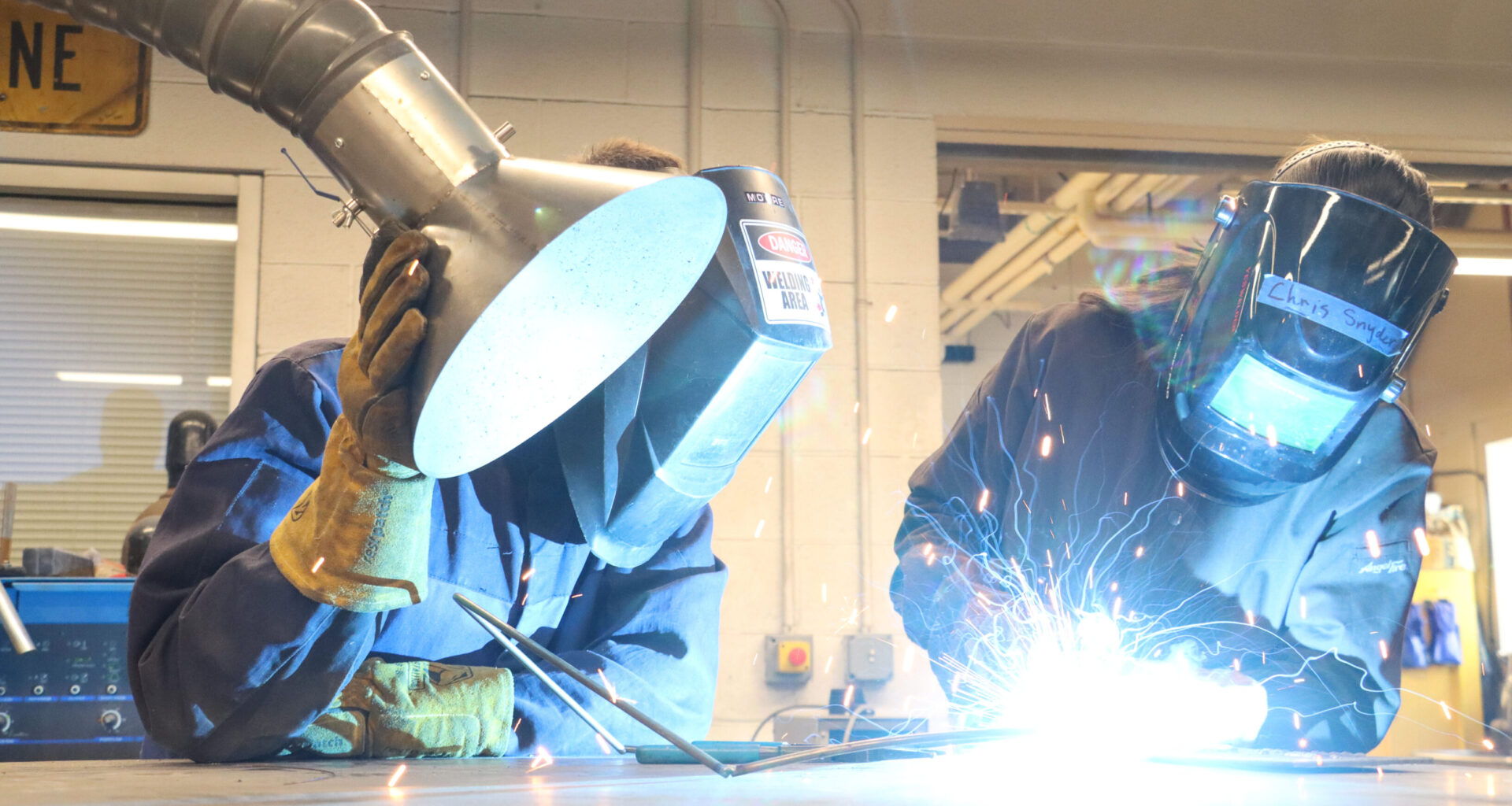
Behind the scenes of the Mountaintop Design Labs are manager Mike Moore, ‘12, and assistant manager Leila Ehtesham, who help students turn ideas into tangible projects while making the space feel approachable and accessible.
Moore said the Makerspace — which includes a woodshop, metal shop, laser cutters and 3D printing resources — serves students across all disciplines. On any given day, he said students from architectural, engineering, artistic and scientific backgrounds work side by side.
“One day I’m teaching architecture students how to build models, the next I’m working with a physics professor,” he said.
Moore said he oversees the lab’s day-to-day operations, from maintaining equipment to managing a team of student workers and supporting classes by teaching students how to safely and effectively use the equipment.
Ehtesham said she works alongside Moore to support student learning through courses, certifications and independent projects, with a focus on hands-on learning.
She said the lab accommodates a wide range of needs, whether students are completing class assignments, working on capstone projects or experimenting with new ideas.
“Someone can explain something to me several times, but until I actually do it myself, it doesn’t click,” Ehtesham said. “I try to step back and let students do it while I guide them.
While the machinery can be intimidating, Moore and Ehtesham said they use a structured approach to ease students into the process before they enter the shop. Through training videos and quizzes, students gain foundational knowledge before applying it in person.
“When they come into the shop, (students are) already primed with questions and some understanding,” Moore said. “Then they can focus on what the tools actually do.”
Despite their different approaches, Moore and Ehtesham said they share the same goal: helping students build confidence to create.
As a team, they aim to support students with different learning preferences.
“I think the best moment is when you see things click,” Ehtesham said. “(Students) start to enjoy working with the materials and let go of that hesitation.”
Moore said his interest in building began early, learning from his father’s “do-it-yourself” projects before studying mechanical engineering and architecture at Lehigh. After graduation, he said he was encouraged to apply for a position in the Makerspace and has worked there since 2013.
Ehtesham’s path was less linear. She graduated with a bachelor’s degree in fine arts from The New School in New York City in 2014, then worked as a gardener before pursuing a master’s degree in landscape architecture.
During graduate school at University of Virginia, in 2021, she said she rediscovered her interest in fabrication and began working in a university shop called “Fab Lab” near campus.
She said she wasn’t interested in pursuing a traditional landscape architecture firm unless it involved hands-on, design-build work, as she wanted to continue developing both her design and fabrication skills. She said she also felt ready to relocate and experience a new part of the country.
“I realized I liked working with my hands way more than sitting in front of a computer all day,” Ehtesham said.
Moore said he helped construct a Chinese-style pavilion on the South Bethlehem Greenway as a part of a student project, while Ehtesham said she contributed to building furniture for the Clayton University Center.
Moore’s and Ehtesham’s guidance has helped bring students’ ideas to life, including those of Shenandoah DeNardo’s, ‘28. She said she’s worked on projects including a skateboard with interchangeable wheels, a bathroom container for toiletries, a heart-shaped box and picture frames for Christmas gifts.
DeNardo said Moore and Ehtesham guided her through every step of the process.
Alexander Hernandez, ‘29, said the Makerspace environment is welcoming and collaborative.
“(Moore and Ehtesham) are very open to helping us, even if we forget how to do something,” Hernandez said. “There’s no judgment.”
Through guidance, patience and hands-on learning, Moore and Ehtesham have built an environment which aims to empower students to experiment, make mistakes and ultimately create with confidence.