Erie officials outlined an ambitious vision for the town’s future last Thursday during a State of the Town presentation, yet much of the evening left out key details that would determine whether that growth is financially and environmentally sustainable.
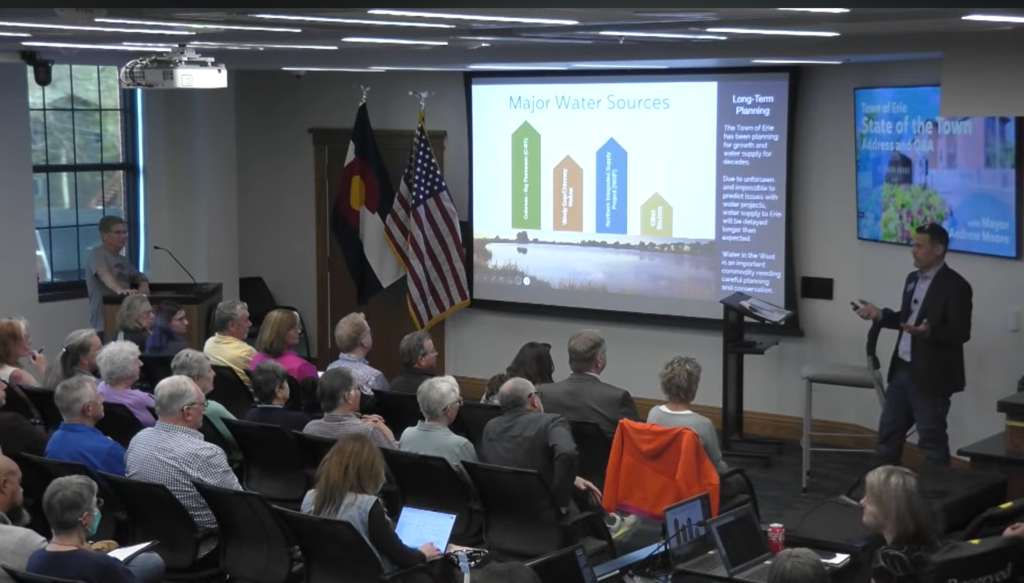
Colton Jonjak Plahn and Jillaire McMillan, candidates for state House District 19, attended to hear from residents. Councilmembers Baer, O’Connor, and Pesaramelli were in attendance, as well as Mayor Pro Tem Brandon Bell. Mayor Andrew Moore delivered a wide-ranging presentation covering development, infrastructure, water supply and economic planning before opening the floor to the audience.
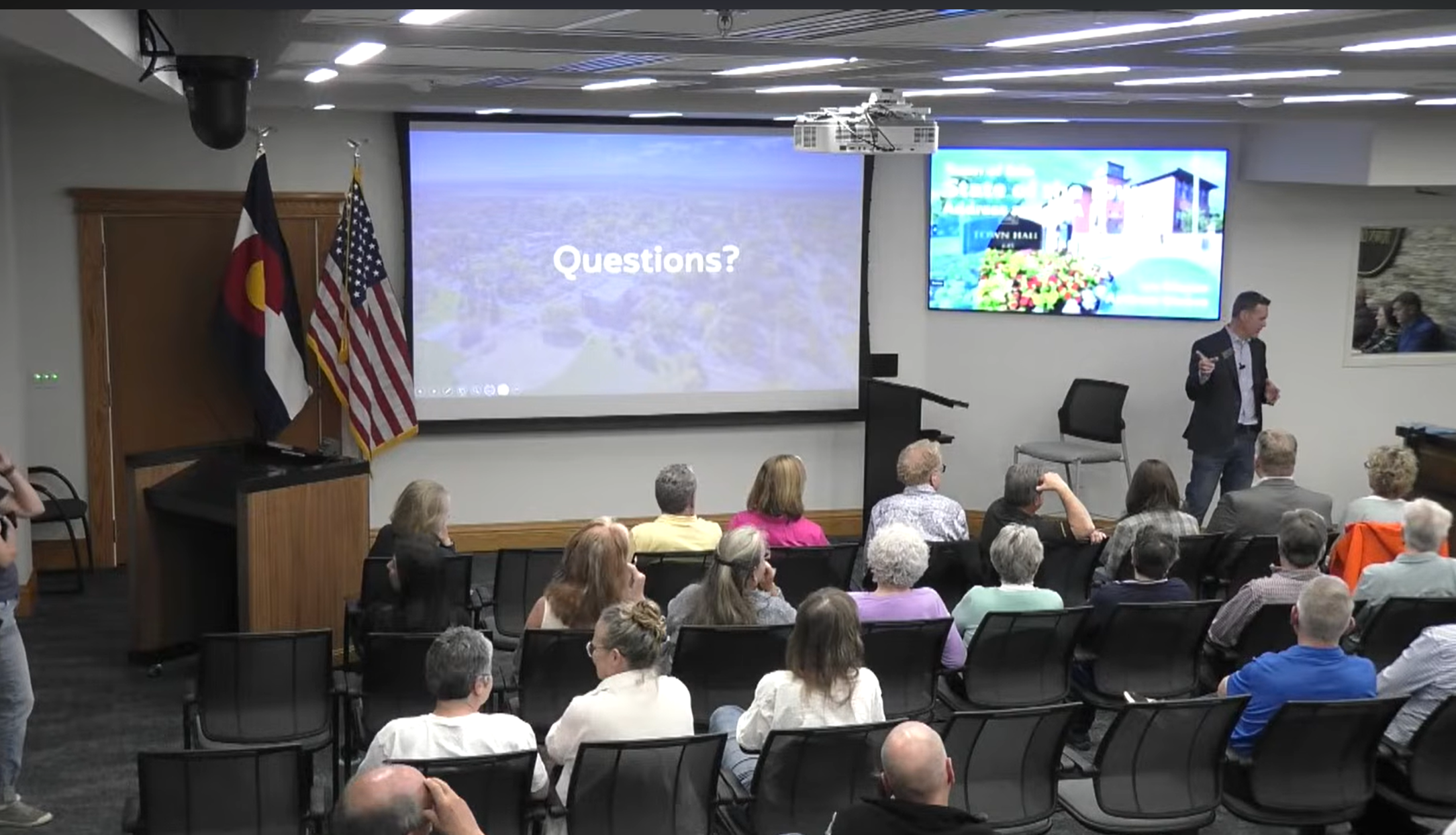
The audience’s questions, particularly around water supply, mineral rights, and infrastructure funding, quickly became the focus of the discussion, as residents pressed officials on decisions that could shape the town’s long-term trajectory.
Outside the event, roughly 25 residents gathered beforehand, some holding signs, protesting the lack of transparency surrounding mineral rights, recent land use decisions, and the firing of Town Manager Malcolm Fleming.
The meeting was undergirded with tension as the town faces differing visions on how to continue to develop.
Erie’s Growth and Home-Rule Governance
Many of the issues discussed at the State of the Town meeting were driven by Erie’s growth.
Erie’s population has grown rapidly over two decades. The town had roughly 1,200 residents in 1990 and about 8,000 by 2000, before expanding to more than 40,000 today.
Much of Erie’s current growth is tied to development agreements and approvals dating back years or decades, including large-scale projects such as Vista Ridge and Redtail Ranch. These “vested” contracts can legally constrain the town’s decisions on current and future development.
The town is now in its first full year operating under home rule, which expands local authority by allowing towns to create a charter, which is a local constitution. A home rule municipality can pass its own ordinances and determine governmental structure without needing state legislature to determine taxation, land use, and local regulations. Under home rule, council members are elected by district, while the mayor is elected town-wide.
However, home rule does not extend to key constraints shaping Erie’s future. Oil and gas operations remain largely regulated at the state level, while water rights are governed by Colorado law.
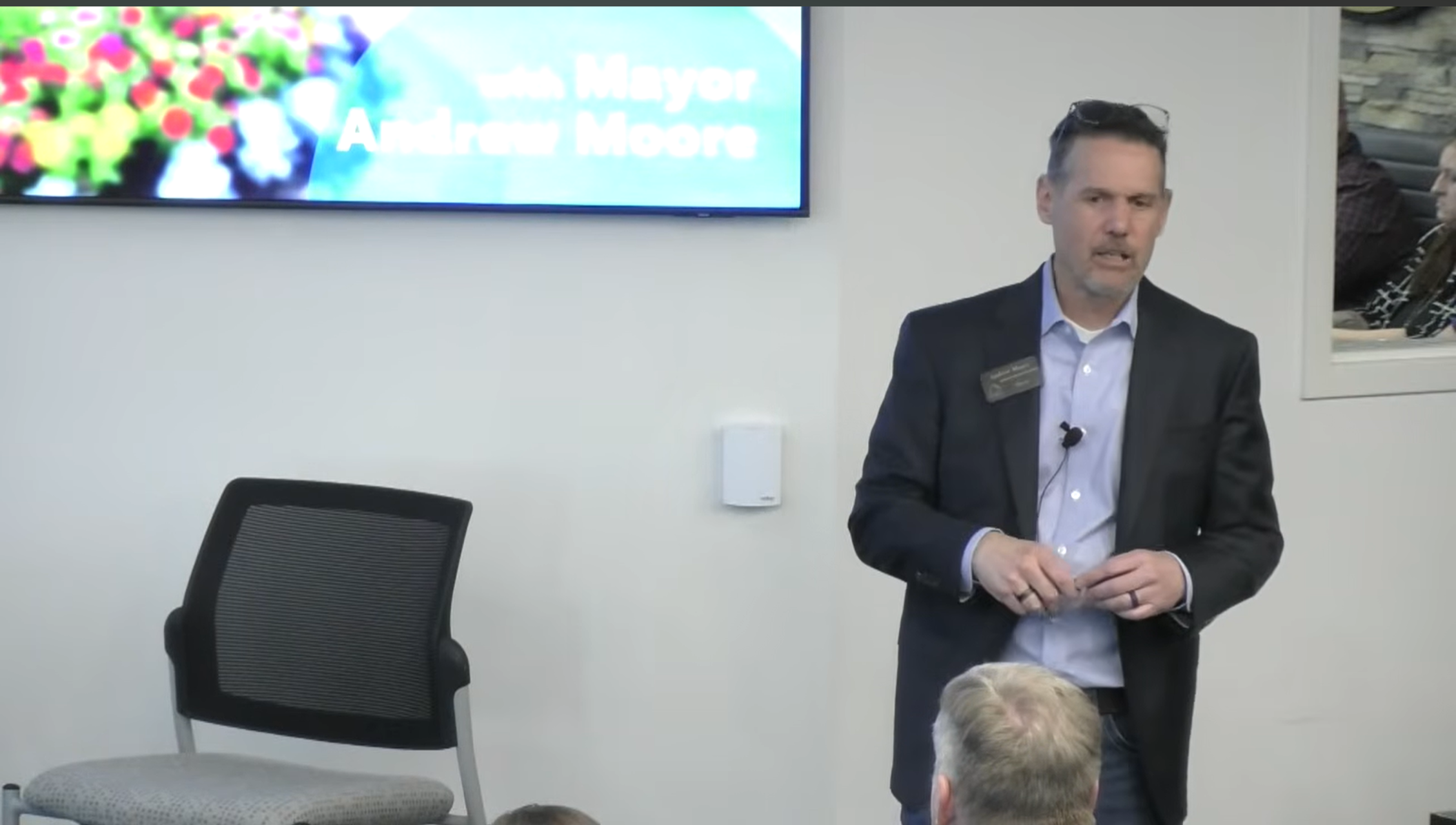
During the town hall, Mayor Andrew Moore cited the town’s recent community survey as justification for his approach to affordable housing, saying residents support it only under limited conditions.
“Affordable housing is important to us — so long as you don’t use Erie taxpayer money to subsidize it,” Moore said, adding that residents are open to projects funded through state or federal sources rather than local revenue. He framed the survey as a key tool guiding his decisions, describing it as evidence that town leadership is acting in alignment with public sentiment.
Former Mayor Justin Brooks disputed Moore’s interpretation.
“He made it sound like the survey results said that the town of Erie supports affordable housing as long as it doesn’t use taxpayer money. That’s not what the survey said at all,” Brooks said.
As previously reported and as seen in the survey, residents ranked affordable housing as among the town’s top priority.
Brooks added that this is not the first time that Moore has minimized or misframed what the survey demonstrated about a resident’s priorities.
Brooks noted, “Housing affordability is a top issue.”
Throughout the meeting, Moore’s perspective on growth was clarified as he argued that reaching a “critical mass” was key to attracting businesses and services.
“In a community, you’re really either growing or you’re dying,” he said.
Some residents questioned whether that approach is sustainable given infrastructure demands and resource limits, particularly water.
Mayor Claims Capital Needs Outpace Funding
One of the clearest claims made during the presentation was financial: that Erie lacks sufficient capital funding to meet projected infrastructure needs.
Mayor Andrew Moore told residents the town “doesn’t have enough money going in to expand our facilities to keep up with the growth” and warned Erie could struggle to “keep the niceties and the services” as it expands.
However, public budget records show a more complex picture. Erie’s adopted 2026 budget totals approximately $393 million, and the town maintains tens of millions in the capital improvement fund with a financial plan projected to remain structurally balanced through 2030.
Former Mayor Justin Brooks said the presentation of Erie’s capital improvement outlook overstated financial strain by omitting key context. According to Brooks, the town’s capital improvement fund has recently received significant investment, and the chart shown at the town hall did not account for millions in grant funding outside of the capital improvement funds that typically support large infrastructure projects.
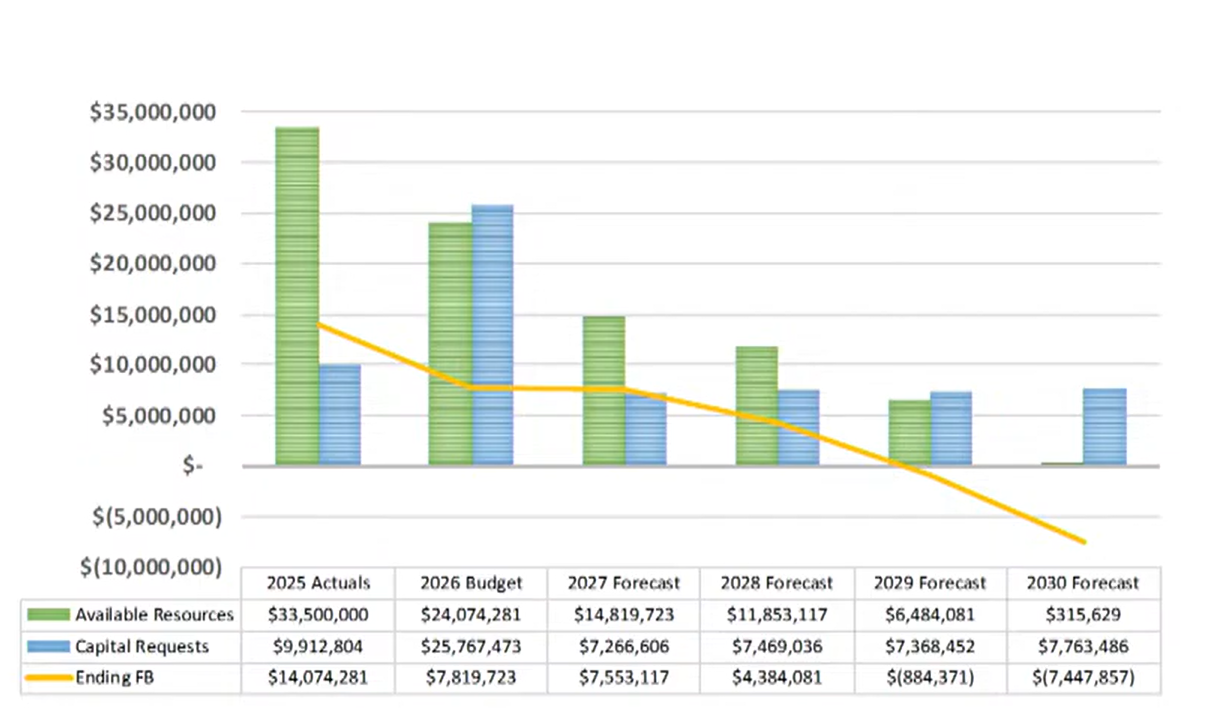
He also said some of the projects included in the projection were not formally adopted capital plans but preliminary or aspirational ideas, which could give residents the impression that the town is facing a larger funding gap than it actually is.
“I think it was misleading. He showed capital projects that are not officially in the plan. They’re just ideas,” Brooks said.
The funding challenges Moore presents might stem not from a lack of shovels, but from trying to dig too big a hole. While incoming revenue has remained consistent, the scale of planned developments has accelerated alongside the booming population. The big question is: Does Erie have the resources to sustain this rapid growth? Capital planning documents outline years of major projects, including water, transportation and public facilities, with hundreds of millions of dollars in costs that extend well beyond a yearly budget and must be funded over time through a combination of reserves, taxes, and development-related financing.
Another pressure stems from how growth is being financed. New development can generate long-term tax revenue but requires significant upfront investment in infrastructure. When developments fall short of covering their own costs, the difference is typically absorbed through public funding. In some cases, that investment reaches tens of millions of dollars — including up to $21.3 million in public support for the Erie Town Center project.
With this in mind, the town must be selective in which developments receive funding. Moore mentioned an idea for a new north–south roadway connection linking County Line Road to Airport Drive. The current road is a narrow residential street, surrounded by development and difficult to expand.
“What he’s describing is a $20 million road,” Brooks said, saying that it could cost millions to save only marginal travel time for a subset of drivers. With the risk of the costs falling on the taxpayer, developments receive significant public scrutiny.
Mayor Moore pointed to a gap between infrastructure needs and available funding, particularly for roads, public facilities, and recreation. What remains unresolved is how those costs will ultimately be distributed. Whether through taxes, existing revenue, or funds processed through the Urban Renewal Authority, the financial burden of growth may fall on residents, future development, or both.
Water Scarcity
Water supply remains one of the most pressing issues facing the town.
Erie’s primary water source is Lake Granby through the Colorado-Big Thompson system. While it currently meets demand, future supply remains uncertain as Colorado faces long-term drought conditions.
Two major projects intended to expand supply — Chimney Hollow Reservoir and the Northern Integrated Supply Project (NISP) — are part of large-scale regional water projects costing hundreds of millions of dollars, requiring participating municipalities to commit to long-term infrastructure and delivery costs. These costs are typically passed on through utility rates, development fees or other public funding mechanisms.
Residents repeatedly pressed officials on how continued growth aligns with water uncertainty.
“If there’s a water concern, why are we still building out?” one resident asked.
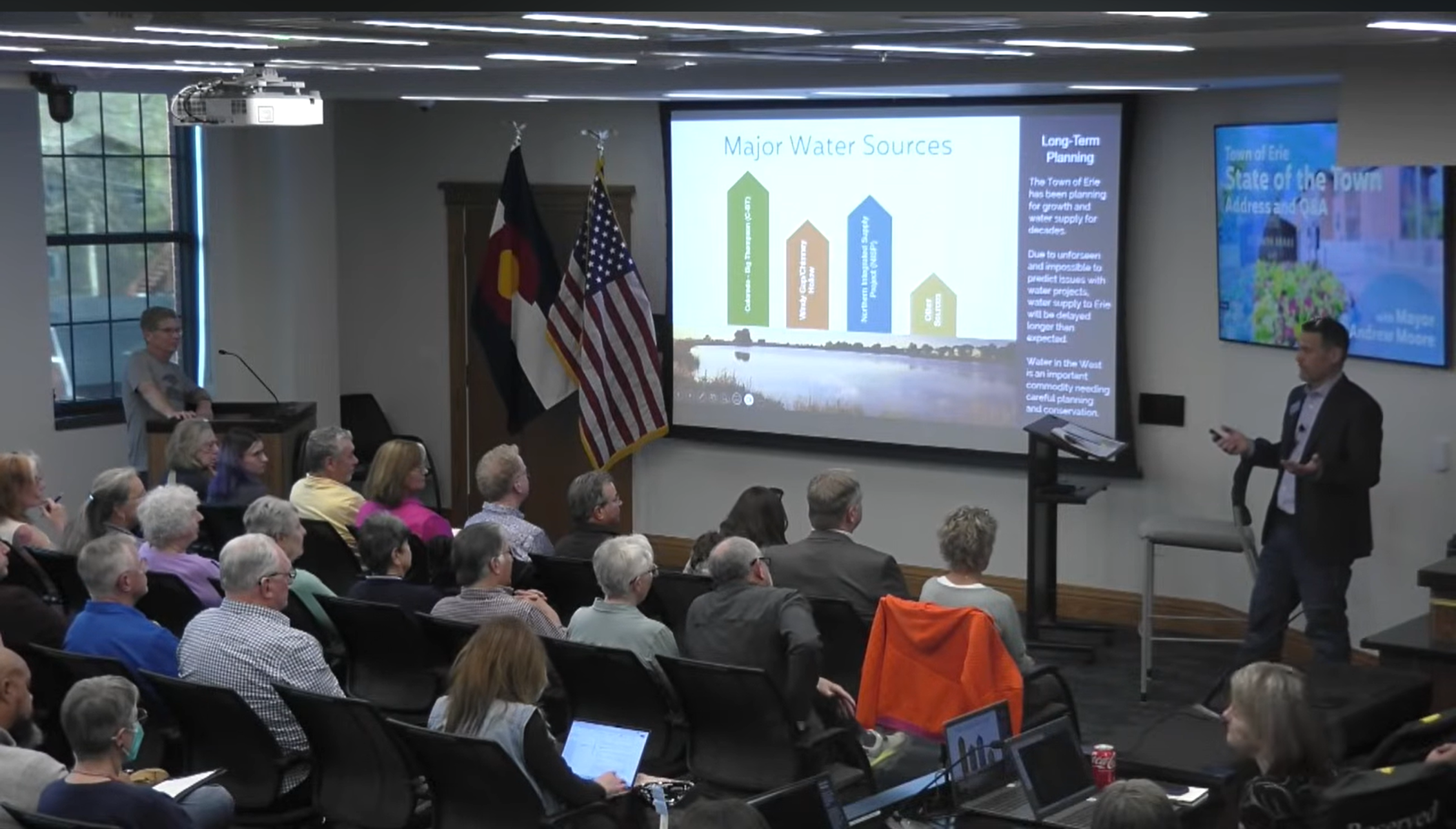
Moore responded, “I can say with all honesty, I don’t have a full answer.”
That admission leaves a central issue unresolved: whether sufficient water exists to support the town’s long-term growth plans, which has been a rising concern as Erie, along with the rest of Colorado, implement water restrictions.
Additional audience comments focused on groundwater impacts, private well users, and water use tied to oil and gas operations.
“I’m not prepared tonight to talk about wells in our town,” Moore stated.
As growth decisions continue, the town’s long-term water availability remains unsure, limiting the public’s ability to assess risk.
Mineral Rights and Transparency
The most contentious issue of the evening centered on the town’s mineral rights and ongoing negotiations tied to the Draco well site in Weld County. Previous reporting found discussions involving the mayor and outside parties had been underway since December 2025 before being disclosed publicly. These discussions included an offer from Civitas Resources, the same company operating the Draco pad.
While the Draco project itself has already been approved at the state level, Erie retains ownership over certain municipal mineral rights, which give the town leverage over how future oil & gas development proceeds.
While the town may not be able to stop the Draco Pad, Erie is not required to sell the mineral rights it still owns, which would open the door to more drilling in the future.
That leverage is at the center of the current debate within the Town Council. The mayor is exploring whether to sell or lease those rights, a move that could generate revenue but also eliminate the town’s ability to influence future drilling activity.
Residents also raised concerns about the town’s consultant, Matthew Owens of Alameda Mineral Advisors, who was the COO of Civitas Resources until 2023. Alameda Mineral Advisors’ compensation depends on completing a deal. Under the agreement, the firm is responsible for conducting market analysis, running a competitive bidding process, and negotiating deal terms. The contract allows for up to $4.5 million in compensation, including payments tied to the value of any resulting transaction. That creates a financial incentive for Alameda Mineral Advisors to complete a deal regardless of whether it’s in the town’s best interest.
Public safety was another hotly debated topic. Former Erie mayor Justin Brooks, speaking as a resident who lives near the proposed Draco site, challenged the assumption that negotiating with operators would improve safety.
Drawing on his experience in office, he said the town has limited input once drilling begins, noting that during his tenure “there were multiple […] spills, industrial accidents in town,” and that when they occur “there is very little that the town can do about shutting down the operations.”
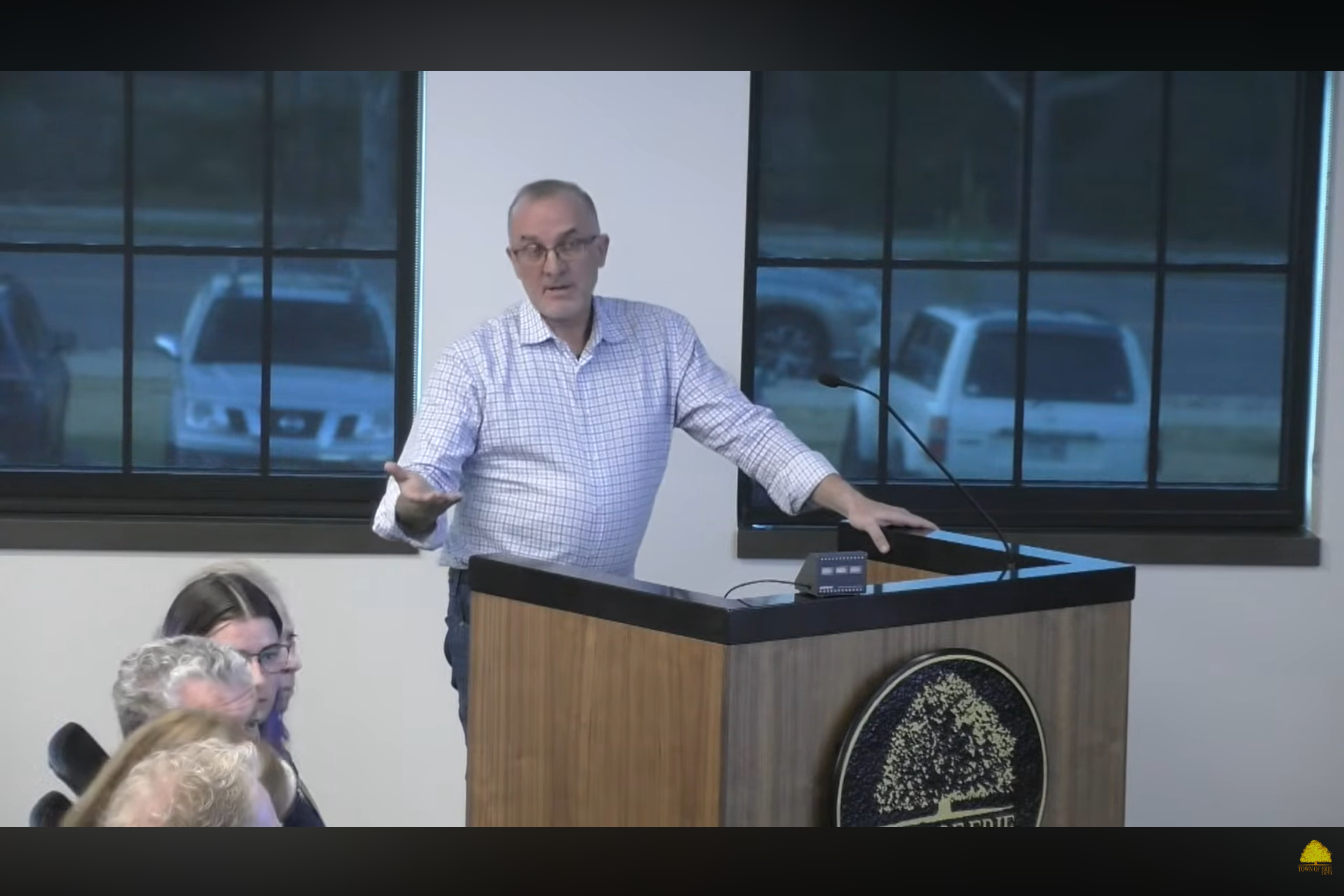
Erie Resident: “Then what are you selling?”
Moore had just clarified that he possessed “zero maps” for public disclosure.
Brooks warned that relying on cooperation from operators may not meaningfully reduce risk, calling the idea that the town could gain leverage over safety through a deal “a dangerous line of thinking.” He added that even when issues are identified, “it could be weeks before they fix it… it doesn’t necessarily mean that we’re going to be any safer.”
Oil and gas incidents remain relatively common across major producing regions. A 2024 analysis of state-reported data found at least 2,709 oil and gas spills across Colorado, New Mexico and Wyoming in a single year, totaling roughly 7 million gallons of liquid released into the environment.
In response, Mayor Moore said, “The reality is it’s about safety, and it’s about compensation. I cannot say anything more than that at this point.”
Former Mayor Justin Brooks strongly disputed that framing after the fact, arguing that selling or leasing additional mineral rights would not increase safety and could instead reduce the town’s control over oil and gas operations.
Brooks pushed back on Moore’s suggestion that negotiations could improve outcomes for residents, arguing that making concessions only benefits the operators.
“To clear the way for their drilling only helps them. It does not protect us,” he said.
He noted that the town’s regulatory authority is severely limited regardless of any agreement.
“The highest potential penalty we […] can impose for an industrial accident… is $1,000 a day,” Brooks explained, emphasizing that Erie lacks the power to shut down operations or prevent drilling directly. He concluded that “selling or leasing additional mineral rights will inherently make the town less safe.”
The town is expected to receive approximately $4 million from existing mineral leases once drilling begins, according to Moore, though details about timing and conditions were not fully disclosed.
Residents also expressed misgivings about transparency, particularly after Moore said the town does not have maps showing the extent of its mineral holdings.
“Then what are you selling?” one resident asked.
Residents repeatedly pressed for basic information, including valuation, deal structure, and whether the agreement would involve a lease or outright sale. Mayor Moore remained noncommittal on the details of the valuation and agreement structure
A public hearing is tentatively scheduled for April 21, though residents are concerned that a vote will be called without further input.
St. Scholastica and the Page property
Conversations surrounding the lack of transparency extended beyond mineral rights to the Page property near Coal Creek.
The timeline of how a proposed land swap involving St. Scholastica Catholic Church emerged has drawn scrutiny, particularly after reporting found discussions involving the mayor and outside parties had been underway for months without the knowledge of most of the Town Council. This information was acquired via a Colorado Open Records Act (CORA) request of the mayor’s emails, and Yellow Scene’s reporting of the issue was the first that other councilmembers had heard of a potential deal.
The property was purchased using a combination of open space tax revenue and federal pandemic relief funds through the American Rescue Plan Act, making it a publicly funded asset. Town officials initially indicated that ARPA funds used to purchase part of the site would need to be allocated toward affordable housing. That interpretation later shifted, with the mayor stating the funds could be used more broadly.
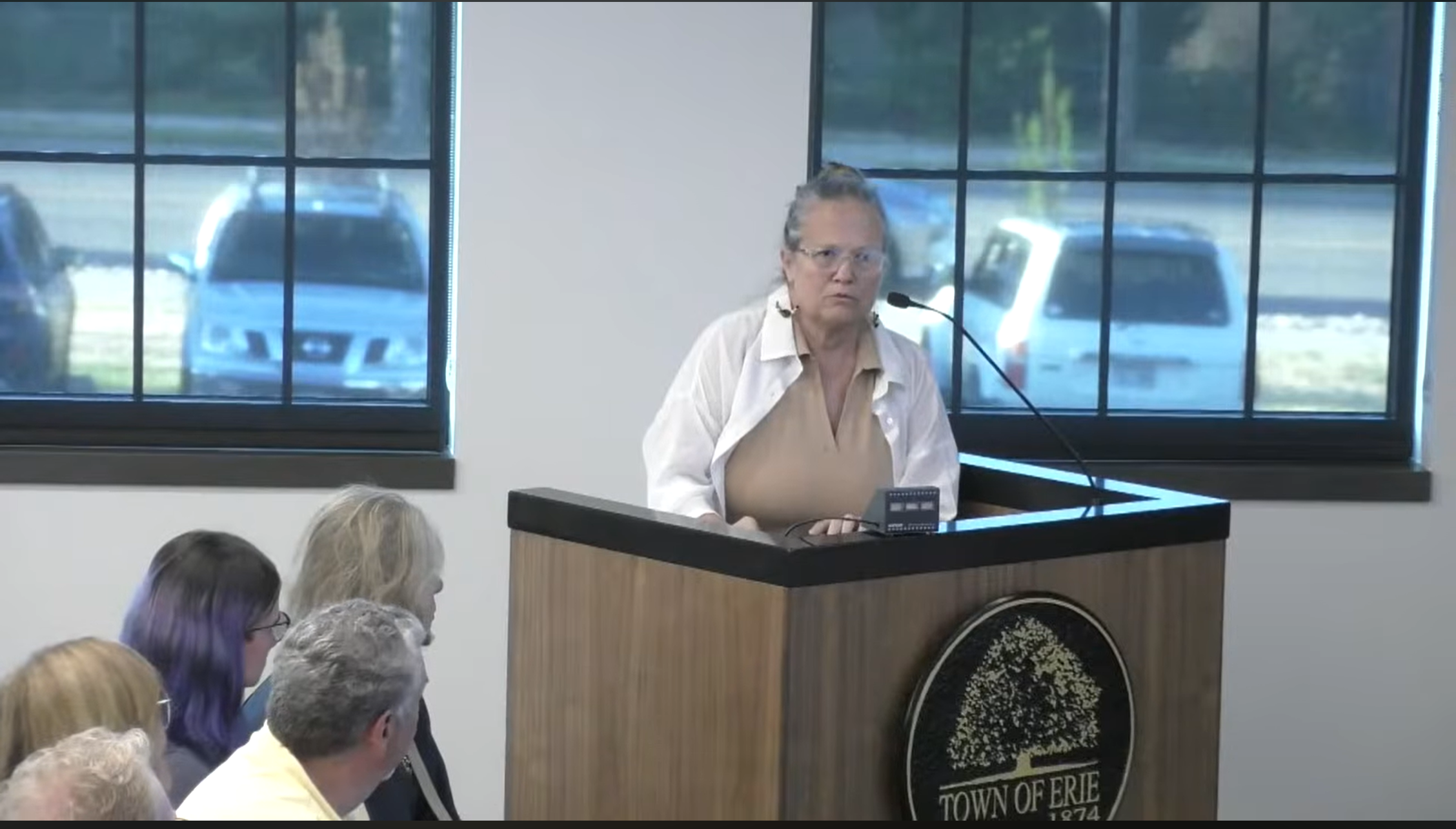
One resident, a nurse, questioned whether such a proposal would comply with federal restrictions on ARPA funds, saying she was “aware that ARPA monies […] cannot support religious and or religious-based anything,” and asking how the town could move forward if those funds were involved.
The mayor responded that any agreement would likely involve reimbursement or a land exchange rather than direct use of federal funds, but acknowledged the legal details had not been fully resolved.
A proposal introduced by Moore and state Rep. Dan Woog (whose name elicited booing from the audience) would relocate the church and partner with Catholic Charities to build affordable housing on the site.
Moore defended the process, describing the discussions as preliminary.
“Every idea starts somewhere,” he said, adding that proposals are often explored informally before being shared more broadly.
The situation has also exposed divisions within the Town Council, where several recent decisions related to development and mineral rights have split along a 4-3 vote.
Officials said any final agreement would need to comply with federal rules governing ARPA funds, though details remain unclear.
Elections and Planning Updates
Erie is preparing for municipal elections, with several council seats, including those held by Mayor Pro Tem Brandon Bell and councilmembers John Mortellaro and Brian O’Connor, up in November.
The town is also revisiting its comprehensive plan and Unified Development Code, which are the two primary documents that determine what can be built, where, and at what density. Back in October of 2024, Erie greenlit a new “Ellevate Erie” Comprehensive plan after a multi-year process. The plan increased allowable density and laid out a long-term vision for accommodating significant population growth, potentially doubling the number of homes over the coming decades.
Now a year and a half later, the council has already begun reconsidering aspects of those density assumptions and how they align with infrastructure, water supply, and community priorities. At the same time, the Unified Development Code, which governs what developers can actually build, has not yet been fully aligned with the 2024 plan, creating a gap between policy goals and enforceable regulations.
That combination of a newly adopted plan, ongoing reconsideration of its key elements, and an out-of-sync development code has introduced uncertainty about the town’s long-term strategy and what standards developers will ultimately be held to.
The mayor said the updates aim to align policy with long-term goals.
Looking forward
The meeting left Erie’s most significant decisions unresolved and obfuscated. By moving forward without disclosing vital financial and environmental data, the town is forcing a choice: residents must either accept the plans blindly or demand a more transparent process before the deals are finalized.
Like journalism like this? Consider becoming a sustaining supporter — and get our print edition delivered to your home each month.
Democracy needs journalism more than ever. For 25 years, we’ve told the truth without ever accepting quid pro quo. Your support helps us keep holding truth to power.