
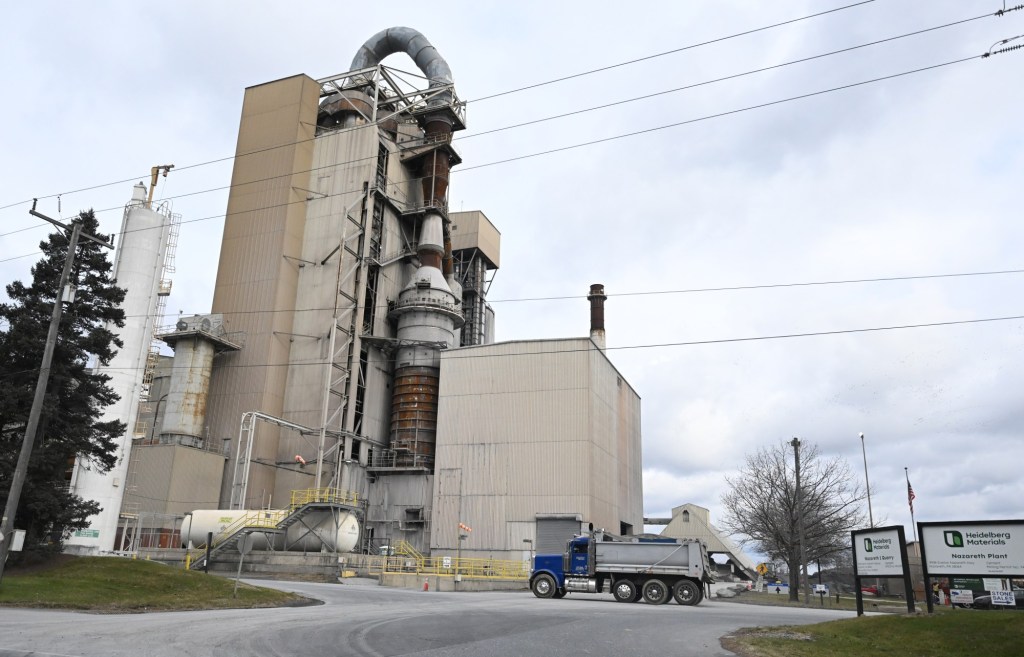
The cement industry has roots in the Lehigh Valley back to the 1870s. And while it continues to be a vital part of the region’s economy, the industry is facing potential bumps such as high interest rates and expiring infrastructure legislation — but also an effort by the region’s U.S. representative that could smooth out the way forward.
Companies including Heidelberg Materials, Buzzi Unicem, Amrize, Keystone Cement and Fuller Technologies maintain Lehigh Valley cement-related operations.
“Modern cement production started in the Lehigh Valley and it’s still an essential part of the construction and infrastructure in Pennsylvania and in that region, and it will continue to be,” said David Perkins, senior vice president for sustainability and public affairs at Heidelberg Materials, which has a manufacturing facility in Lower Nazareth Township along with quarries around the region.
“We as a company look at these investments that we make with the eye that we’re going to be in these areas for decades and for generations.”
Lehigh Valley Economic Development Corp. statistics show about 530 workers are employed in the region’s cement industry — 16.5 times more concentrated than the average U.S. region.
Last year, Fuller (when it was still part of FLSmidth) moved its operation that manufactures and assembles cement pneumatic transport equipment and serves as a distribution warehouse for replacement parts to a new building in Allen Township.
Pacific Avenue Capital bought FLSmidth’s cement business in June for $175 million, renaming it Fuller Technologies — in honor of the longtime Lehigh Valley company — and established its world headquarters in Hanover Township, Lehigh County.
“Fuller Technologies is proud to be a global company, while returning to its deep roots in Pennsylvania’s industrial heritage with the relocation of its headquarters to the USA,” Fuller CEO Dennis Cassidy said in February when the company announced it was hiring more than 160 workers. “The Lehigh Valley shaped our identity and capabilities, and we are proud to be a part of its future.”
There have been other recent significant changes in the local industry. Keystone Cement in East Allen Township was purchased by Virginia-based Titan America in January for $310 million, months after previous owner Giant Cement Holding was acquired by Heidelberg Materials and Keystone was spun off into a new company.
Holcim announced a year ago that it will spin off its North American cement business, including a Whitehall Township plant, into a company called Amrize, which is investing more than $700 million in U.S. operations to boost production capacity.
Industry experts in the Lehigh Valley and beyond are hoping for a productive 2026, but see a split between private and public demand, according to Brian Schmidt, part of the American Cement Association’s market intelligence team.
Heidelberg’s Perkins said uncertainty in Washington and other factors make the outlook a bit hard to predict.
“We are looking at this year with some caution, but there are some glimmers of optimism,” Perkins said. “There’s so much volatility on the political front that it’s very difficult to see what that’s going to look like.”
Here is what the industry is facing:
Up and down interest rates
Schmidt said high mortgage and interest rates have been a drag on the industry.
“We have seen a little bit of decline in cement consumption over the past few years,” Schmidt said. “And that’s really largely attributed to the high interest rates. Private construction is very interest rate sensitive, in particular residential.”
The high rates have slowed residential and private commercial construction. Residential housing accounts for about 30% of cement consumption, with a single-family home requiring about 20 metric tons.
Schmidt added that many people are still locked into their lower mortgage rates from the pandemic years.
“There’s little incentive for them to move,” he said. “That really kind of just created this sort of locking effect.”
The American Cement Association is looking forward to interest rates falling, something that financial experts are predicting for the course of this year. That would increase construction and release pent-up demand in the housing market.
Infrastructure
On the other side of the ledger, the $1.2 trillion Infrastructure Investment and Jobs Act of 2021 provided a significant boost for projects involving roads, bridges, and water systems.
There too, though, record construction inflation has somewhat eroded the “purchasing power” of that federal funding, Schmidt said.
Industry representatives are working to get the act reauthorized by Congress before it expires in September.
“Around a third of our production and our product goes into some form of infrastructure project,” Perkins said. “The Investment in Infrastructure and Jobs Act is going to expire and a big priority for us broadly as an industry is to get that reauthorization.”
“We’re really looking forward to and advocating for an infrastructure bill that’s kind of the same, similar in size and scope to [the IIJA],” Schmidt said.
Promoting and protecting domestic production
According to Schmidt, about 80% of cement is produced domestically, with the remaining imported, primarily from Vietnam and Canada.
Looking to boost a key industry in his Lehigh Valley district, U.S. Rep. Ryan Mackenzie recently sent a letter to President Donald Trump asking for an executive order to designate cement as a critical national security material. That would require federal agencies to prioritize the use of domestically produced cement in federal procurement and federally assisted infrastructure projects.
“It’s time to unleash the full economic potential of one of our nation’s most critical building materials,” said Mackenzie, R-7th District.
According to the cement association, Pennsylvania is the sixth-largest cement producer in the U.S. with more than 6,000 jobs and contributing about $5 billion to the state’s economy. The average salary in the state for a cement worker is $106,000.
A spokesperson from Mackenzie’s office said Monday that it has submitted the letter and is waiting for word from the White House.
Data centers and regulations
While housing projects are being held up by interest rates, other types of building plans are still being developed, such as warehouses and data centers.
Other industries have been onshoring or expanding in the U.S. and are building from the ground up. A local example is the $3.5 billion Eli Lilly and Co. pharmaceutical plant that will be built in Upper Macungie Township.
“Data centers, obviously, have been on fire over the past few years and there’s still a lot of growth trajectory there,” Schmidt said.
However, there is concern about keeping up with increased demand. Schmidt said there has not been a new greenfield cement plant built in the U.S. in at least 15 years because of regulatory hurdles.
Heidelberg Materials’ Perkins said projects in the U.S. demand 110 million-115 million tons of cement annually but the country only has the capacity to produce about 90 million tons, leading to a heavy reliance on imports.
“Over the last several years it has become increasingly difficult to expand and to add additional production capacity in the U.S.,” Perkins said. “Permitting has been a significant inhibitor for additional capacity investment.”
Sean O’Neill, the cement association’s senior vice president for government affairs, said the executive order could help clear some regulatory hurdles.
“This executive order calls for federal agencies to review their rules and regulations that hinder domestic cement production, such as those preventing the industry from using more alternative fuels, investing in energy and carbon reduction technologies,” he said.
The industry will also be looking at ways to innovate, such as using blended cements with materials such as fly ash and slag, and increasing the use of artificial intelligence at plants.
It’s a resource that will be mandatory in any development for years to come, Perkins said.
“Concrete is the second most utilized building material in the world behind water,” he said. “It goes into virtually every type of construction.”
Morning Call reporter Evan Jones can be reached at ejones@mcall.com.