
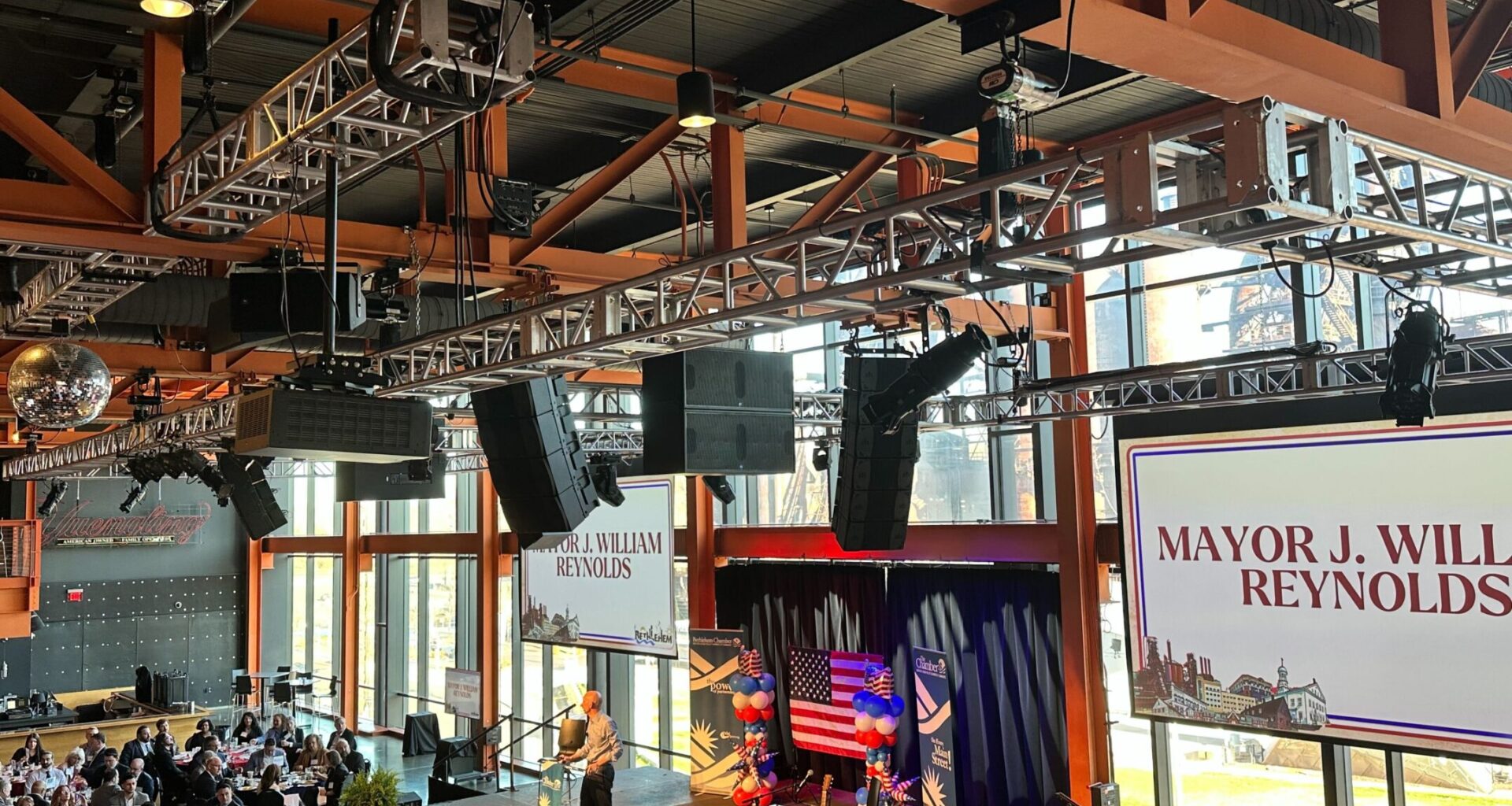
More than 300 people attended Bethlehem’s annual state of the city address on Wednesday, delivered by Mayor J. William Reynolds at ArtsQuest Musikfest Café.
The event brought together local politicians, business owners and residents. Representatives from Lehigh were also present, including President Joseph Helble and Provost Nathan Urban.
Fifty students from Freedom and Liberty High School’s marching band performed the national anthem to open the event. Following the performance, Reynolds, Tony Iannelli — president and CEO of the Greater Lehigh Valley Chamber of Commerce — and Laura Collins, director of community and economic development, addressed attendees.
In his remarks, Reynolds focused on Bethlehem’s pursuit of the American dream, the city’s financial recovery since the closure of Bethlehem Steel and the challenges that remain.
Having lived in Bethlehem his entire life, Reynolds said he’s witnessed the city’s economic growth firsthand. From 2008 to 2024, jobs increased from 28,323 to 41,380. The city has also avoided capital borrowings since 2019 and when adjusted for inflation, median household income has risen by $8,579.
“It is clear that the property value of the city of Bethlehem has continued to rise, and it has continued to rise because we have the safest city in Pennsylvania, a city that has more economic opportunity than anywhere else,” Reynolds said. “Our 2026 financial picture is really unmatched by any mid-sized city, not just in Pennsylvania, but across America.”
Although there have been significant financial developments in the past decades, Reynolds said there are still major challenges in the Bethlehem area that need to be addressed.
Despite this progress, Reynolds emphasized that significant challenges remain, particularly poverty, housing affordability and access to community spaces.
According to Census Reporter, the overall poverty rate in Bethlehem decreased slightly to 14.9% in 2024 from 15% in 2000. However, the poverty among residents under 18 has increased by 3.3% to 24%, while the rate for those over 65 has risen from 5.2% to 14%.
Reynolds said those numbers must decline, adding that meaningful change will require difficult decisions.
While economic development is widely supported, he said progress will involve actions many residents may resist, such as building houses in neighborhoods where it’s not currently welcomed.
Helble said he agrees affordable housing is one of Bethlehem’s most pressing issues. He pointed to Lehigh’s Pilot Project, which aims to revive alley houses in the city, as one way the university is contributing.
Wes Hiatt, an assistant professor of architecture and leader of the Pilot Project, said alley houses are small accessory dwelling units built on existing residential land and oriented toward alleyways rather than streets. He said they can expand housing availability while minimizing infrastructure demands.
“Housing is absolutely one of the most important issues to focus on, because it affects quality of life,” Helble said. “We want everyone who would like to be here and to build a life or career here to have the ability to live here.”
In recent years, Lehigh’s growing student population has increased pressure on local housing. Companies such as Amicus Properties have purchased rentals previously owned by local landlords, marketing them to students and raising costs.
That shift has had a ripple effect across the housing market, making it more difficult for some families to afford living in the area.
Helble declined to comment on Amicus but said Lehigh is working to expand on-campus housing. The university plans to break ground on a new undergraduate residence this fall, with occupancy expected by fall 2028.
Sara Satullo, Bethlehem’s deputy director of community development, also spoke at the event and highlighted the city’s five-year plan, Opening Doors: Strategies to Build Housing Stability.
She said 465 mixed-income housing units are expected to be built by September, up from the originally planned 120. The increase was made possible by a $4.5 million land donation from Lehigh Valley Industrial Park in 2024 and $16 million in federal tax credits this year.
Another focus of the administration is the “40 in 10” park plan, which will invest in all 40 of Bethlehem’s parks over the next decade. Reynolds said parks, like public schools, are essential community resources.
“(Parks) are for everyone,” he said. “No matter if you’ve been here for a week or you’ve been here for 50 years, they’re a place for us to share, and they’re a place for us to build connections and build empathy with each other.”
The city is also advancing plans for a community center in South Bethlehem in partnership with United Way of the Greater Lehigh Valley and the YMCA.
At a public meeting in January, officials estimated the project will cost about $15 million to build, with an additional $2 million annually for maintenance.
“These projects could not happen without state and federal grants because of hardship,” Satullo said. “Our affordable housing finance system is broken. Affordable housing, paradoxically, is the most expensive and complex housing to build in America.”
The Cathedral Church of the Nativity on the South Side is also working to address housing needs by converting two properties it owns into six apartment units designed by Lehigh architecture students.
“Reducing (Bethlehem’s poverty and housing statistics), in many ways, is going to be more difficult,” Reynolds said. “It’s going to require (city residents) to change our identity and the way we think about success. If we’re going to solve these numbers and be true to the American dream and be true to the opportunity that so many of us have been offered, we have to change the way we think.”
Bethlehem Police Captain William Audelo, who attended the event, said he’s a product of the American dream.
“My father came here from Mexico and he was not a legal resident,” Audelo said. “He didn’t get his citizenship until I was about five. He had a ninth grade education, and I was the first person born in (the U.S.) from my dad’s side of the family. Flash forward a couple of years, and I have a master’s degree. I served in our military and I’ve been serving as a police officer for the better part of two decades, so I live the American dream everyday.”
Helble said Lehigh supports the American dream by expanding access to education for students from low-income backgrounds.
A first-generation college student himself, Helble said he attended Lehigh with financial aid.
“I think we can support the American dream by doing everything we can to make a Lehigh education accessible to the country’s talented and the world’s talented (people), regardless of background,” he said. “That’s through recruiting broadly, it’s through financial aid, it’s through all the things that we are doing to ensure every student can access all that higher education provides.”