

Numismatic value might not be a well-known phrase for most people, but for avid coin collectors, being able to measure it is essential.
In laymen’s terms, it measures the worth of a coin beyond its stated face value or base metal content. Melt any coin down, it is still worth its weight in silver or gold. But kept intact, its value on the open market far exceeds what is tangibly available based on intangible things like rarity and historical significance.
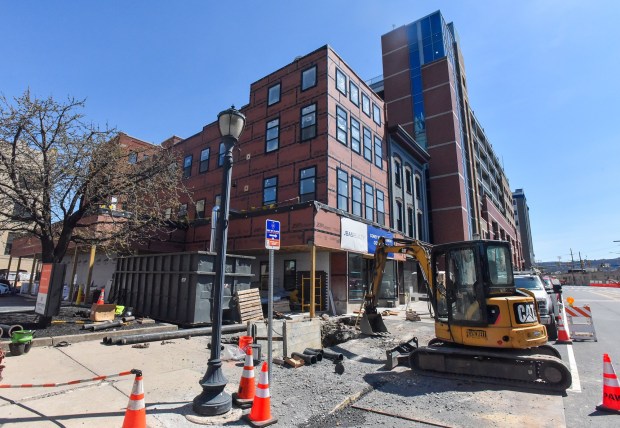 Crews continue work on the Coney Island Lunch building on Lackawanna Ave. in downtown Scranton Thursday, April 9, 2026. (SEAN MCKEAG / STAFF PHOTOGRAPHER)
For John Basalyga, there’s a sort of numismatic value in restaurants, too.
In 2023, Pete and Bob Ventura — the former owners of the landmark Coney Island Lunch hotspot that delighted generations of Scrantonians and visitors to the city’s downtown with its signature Texas wieners — came to Basalyga hoping he’d have interest in purchasing both the property and the legendary restaurant they closed in preparation for retirement.
The renowned area developer saw plenty of potential to rekindle a long-established dining experience. Basalyga’s JBAS Realty purchased the property for $300,000, renovated it and plans to soon reopen Coney Island Lunch along with several apartments above it and an ice cream shop.
“My interest piqued. I was like, ‘We can’t let Coney Island (Lunch) shut down,’ ” Basalyga said. “I mean, it has been in Scranton for over 100 years. It’s an iconic place. It’s a landmark. It makes the downtown better, in every which way.
“It was important.”
In doing so, Basalyga didn’t just expand his area dining empire. He also lived the dream of many an area resident and Northeast Pennsylvania foodie.
Real estate listings have been dotted over the past handful of years by commodities that tug as much at the heartstrings of area natives as they do tease the pocketbook. Several well-known, long-established and flavorfully unique restaurants with reputations that burst past the borders of neighborhoods to which they became synonymous and become regional favorites have been dangled on the market for the highest bidder.
In the last few years alone, several community-defining pizza restaurants — Maroni’s Pizza House in West Scranton and downtown Scranton staple Pizza By Pappas in 2021, and Salerno’s Cafe in Old Forge last year — were placed on the market and sold. Maroni’s and Pappas hit the market with asking prices that exceeded $1 million.
Maybe, seeing those listings made some admirers of those establishments even wonder about possibilities of getting in on the action.
“What if … I could just buy the recipe?” many pondered wistfully, be it for Maroni’s unique cheese blend and peppery pizza sauce, Pappas’ grinders or Salerno’s famed pizza crust.
When negotiating with the Venturas to buy Coney Island Lunch, Basalyga admitted getting the recipe for that famous chili sauce included was an important part of the deal.
Calculating how much of the asking prices are attributed solely to the value of the recipes that shaped those restaurants has long been a tempting task and interesting topic of discussion among customers who pine to make their favorite pizza sauce, burgers or fried chicken from the comfort of their own kitchen.
For businessmen and restaurateurs like Basalyga and brokers who sell restaurants, it’s not quite so straightforward a process.
On their own, recipes practically never receive a set price in these transactions, according to Steven Farrell, the chairman and CEO of Classic Properties, which sells residential and commercial properties at six offices scattered throughout Lackawanna and Luzerne counties and the Poconos.
“Recipes are really just part of the deal,” Farrell said. “Really, what they’re doing is, they’re buying the name. They’re buying the reputation, and the financial history, of the company.”
Assets and goodwill
For Robin Gagnon, pricing an established restaurant is akin to a math problem, and she has come as close to mastering it as anybody.
Along with her husband, Eric, Gagnon co-founded We Sell Restaurants about 20 years ago. She said they intended to establish their business as restaurant brokers in Atlanta, but found there was such a need nationwide for the expertise that they expanded. Now, Gagnon said, We Sell Restaurants has grown into the largest restaurant brokerage brand in the country, carrying in the range of $600 million in listing inventory, and 1,300 listings for sale on their website.
As is the case on the local market, pricing a restaurant for sale nationally does not include a specific valuation of an individual recipe, Gagnon said. After all, the recipe is a major part of the business as a whole. For instance, the value of Col. Sanders’ “secret recipe” for fried chicken is considered “nearly immeasurable” and is said to be stored in a vault not because it is tasty, but because it is the foundation of the KFC franchise.
Valuing restaurants essentially starts with math. A recipe, Gagnon said, is an asset of a business, developed over time, and there is always some sort of return on those assets as part of any sale of that business.
However, there are caveats, situations where a crude valuation of those individual assets does come into play at times. One of those times comes specifically when an owner wants to sell the restaurant but keep the recipes out of the transaction.
“Really, then, you’re just selling used equipment,” Gagnon said. “We look at, what is the business actually producing on a seller’s discretionary earnings basis? So in that case, we don’t add something back on, but definitely take it away if there’s no recipe, or if you want them to change the name (of the restaurant). Because at that point, it’s not the same restaurant anymore.”
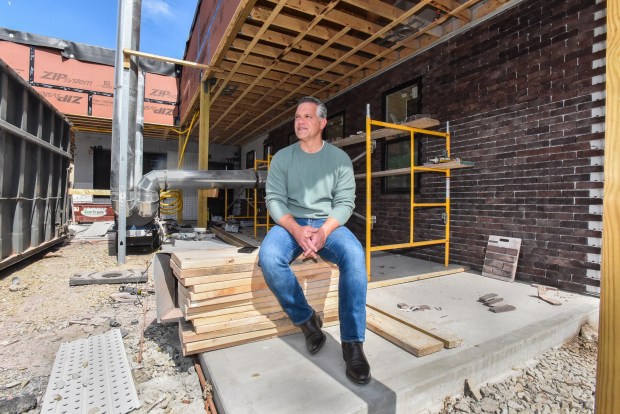 Real estate developer John Basalyga poses for a photograph at the site of the Coney Island Lunch building on Lackawanna Avenue in downtown Scranton Friday, April 10, 2026. (SEAN MCKEAG / STAFF PHOTOGRAPHER)
For example, without the recipe for the chili sauce, Coney Island Lunch isn’t Coney Island Lunch.
Basalyga knows there is more to a restaurant than the recipes behind it.
His ventures throughout the region have often been focused on well-known area brands. He renovated and reopened the Farr Street Tavern, synonymous with Scranton’s Tripp Park neighborhood, preserving both the original building and the recipe for the establishment’s beloved chicken wings. He also purchased The Stegmaier, striving to maintain the name and history of one of Wilkes-Barre’s most renowned buildings.
“Whenever I look at buying a business or starting a new restaurant or whatever it may be, I look at what the existing was,” Basalyga said. “Coney Island Lunch always had a solid reputation. People loved it. It was sort of like the Geno’s and Pat’s (Philadelphia cheesesteak) rivalry, with the two Coney Islands. And, I like that. It’s a story to tell, a great story. Being that the business was so good, there was no reason to rebrand it, change the name, do anything they weren’t really doing. Just upgrade the facility and do the things I do well.”
Recipes go a long way toward building that, he said. So does history.
While Farrell points out that inquisitive buyers looking to purchase recipes a la carte when their favorite restaurants go on the market hoping to franchise them nationally is not unheard of, Gagnon added that a recent trend is making the opposite true. Some longtime owners negotiate to keep distribution rights to sell products like pizza shells or their family’s secret sauce recipes at local grocery stores after their restaurants sell, creating a trickier valuation process for new owners.
“If you have something like that, it definitely then starts to look like a little bit different of a business model,” Gagnon said. “There are so many ways you can approach it.”
The real recipe for success
Every corner of the internet is littered with copycat recipes.
They likely exist for the signature gnocchi dish at the local Italian place, or for the chili sauce at the hot dog stand that hits just the flavor profile you might want. There are even a few for anyone who wants to mimic The Colonel’s fried chicken.
But they never seem to overtake a good takeout order from the pizza shop, or a visit to the restaurant that means so much.
“As the world has gotten more and more and more technical over the years, you can still have that one pizza joint — you go, you hang out, you get a slice, you’re with your friends, you’re having an adult beverage — where all is right in the world, where your phone is down and you’re in a moment,” Gagnon said. “There has been a lot of conversation and research around that. People start to feel, especially in a world where they work from home, very, very disconnected. But where do you feel very connected? In a social atmosphere. In a restaurant, eating, talking, sharing moments with people.”
That’s why one aspect of valuing restaurants often overlooked in relation to recipes is the institutional knowledge of the people who established the place as a destination to begin with, or kept it going as one.
Each restaurant uses different kinds of equipment in unique ways, which also bring value in those transactions. But often, a guarantee of months of help and guidance from previous owners is as key a factor as anything in creating value for an on-the-market restaurant.
“Honestly, there are very few pizza guys in the world who you see rolling the dough, throwing it, putting it in the oven, coming in early and standing over sauce, simmering it for hours,” Farrell said. “The good ones make very good money, because they are essential to the business.”
The recipe is words on a paper.
The popularity of an establishment typically pivots on all the factors that make that recipe work: A chef for whom those combination spices and herbs is a labor of love, a kitchen run with precision and expertise, and an atmosphere that keeps customers wanting more.
The value of a restaurant is in the money it can make. But the money is in the magic the establishment creates. And the magic is in the feeling that so often can’t be replicated outside of the building’s walls. Recipes have monetary value only in their ability to create those feelings and memories.
Especially in this food-crazy region, iconic restaurants established as pillars of their communities don’t get that level of respect — or value — without great recipes, or a whole lot of other things.
“If you had (crappy) pizza, there wouldn’t be a line out the door of the restaurant during Lent,” Farrell said. “Recipes are part of a restaurant’s larger equation. They are a part of the success of a business, and that’s really what matters most for value.”