
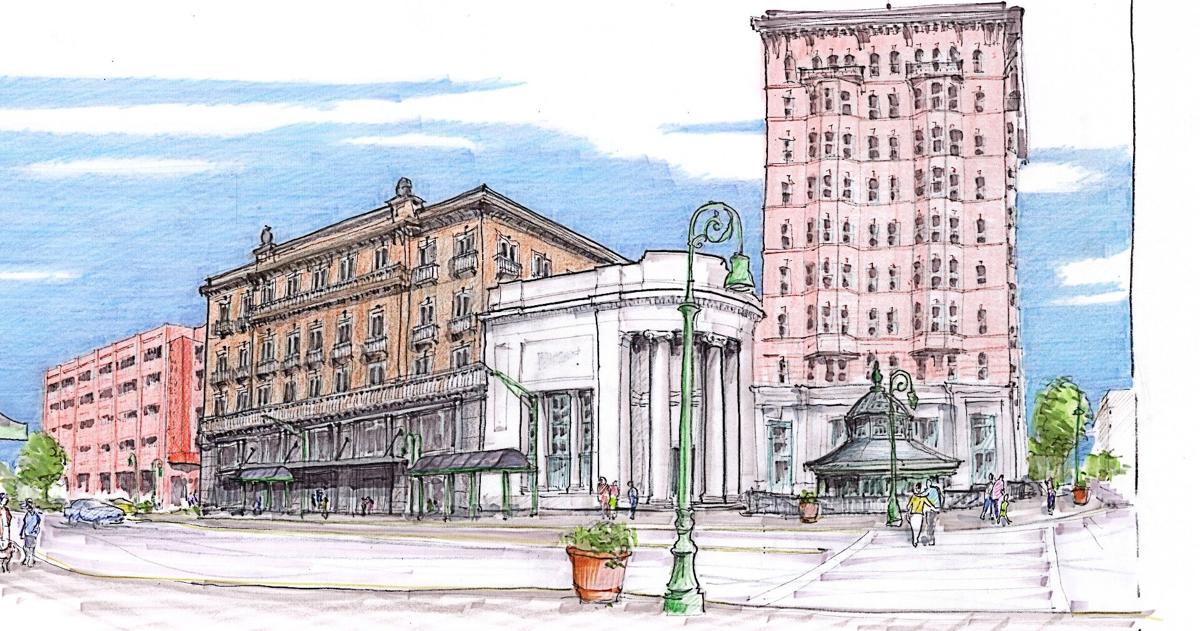
READING, Pa. – Reading City Council voted Monday night to approve the sale of historic and iconic Penn Street buildings to local developer Alan Shuman.
The agreement of sale will be for the sale of 431 and 437 Penn St. and 443 Penn St., the Colonial Trust Company Building.
The sale will be to Callowhill Project LP, Colonial Development LP and Colonial Expansion LP, which are entities that belong to Shuman.
The total purchase price is $5.7 million, but the city will receive $4.1 million in cash and $1.6 million in loan forgiveness from various loans made to Shuman that assisted him with restoring the Abe Lincoln building to its 1930s grandeur.
The loan forgiveness was approved in a separate resolution.
Shuman owns the Abe Lincoln building.
Community Development Director David Barr said the collection of the Penn Street properties was acquired by the city in 2012, shortly before the city entered Act 47 for financially distressed cities.
That caused the city to defer much-needed maintenance to protect the buildings.
“Now that we are selling the buildings and taking a different direction, we have to recognize that there are tens of millions of dollars of deferred maintenance that reduces the effective value,” Barr said. “In order for the city to sell them, we need to effectively add money to the deal to help incentivize.”
Barr said the total redevelopment project will cost $52 million and will come from various sources, including $19 million from CRIZ (City Revitalization and Improvement Zone) funding, which will come from future tax revenue that will be generated by the properties.
A rendering of the 5th & Penn redevelopment project.
“That 1.6 million (dollars of loan forgiveness) allows Mr. Shuman to then borrow that money against the equity on the Lincoln and put that back into the building investment,” Barr explained. “If we weren’t finding these diverse sources of funding, there would be no way to basically pay for the tens of millions of dollars of deferred maintenance that have gone on over these last 14 years.”
Councilmember Jaime Baez Jr. said he had reserves about the loan forgiveness because it sets a precedence, but he supported the deal, saying that this opportunity may not come again.
“I’m looking long-term when I’m placing my vote this evening,” Baez said.
Councilmember Chris Miller said council realizes these are very prominent buildings in the heart of Reading.
“And I think over time, we have realized how much that makes an impact on the surrounding properties and the perception of the city,” Miller said. “If we’re talking about making an investment, I think this is an excellent choice.”
Councilmember Raymond Baker said it is important to note that Shuman is not telling City Council a story and then disappearing into the night.
“You look across this town, and there’s the Shuman Development Group rehabbing buildings, so I’m happy to support this,” he said.
“If we are going to revitalize Reading, you’ve got to start in the downtown,” Baker added. “And if you had to pick a spot that is the center of where Reading is, it is Fifth and Penn. Having an entire block that is dilapidated paints a poor picture of the city.”
Council President Donna Reed said Shuman has saved so many buildings from destruction.
“I give him credit for everything he’s done,” she said. “I’m really happy to support this, and I’m glad he stepped to the plate.”
Reed said Shuman has shared his plans with council in closed door executive sessions and that he will be invited to an upcoming council meeting to make a public presentation on the redevelopment project.
FirstEnergy Stadium property expands
Also Monday, council approved an agreement of sale for the purchase of 2040 Centre Ave., a former bank building in front of FirstEnergy Stadium, for $505,000.
Council also approved amending its lease with the stadium by adding the parcel to the stadium property, which is city owned.
James Schlegel, chair of the stadium commission, said the commission has had its eye on the bank building for a very long time.
“There’s been opportunities in the past, but never a good one,” Schlegel said. “If we don’t do it now, I’m not sure when there will be opportunity that would come about again.”
Schlegel said no specific plans have been made for the property, but one idea could be to create a gateway to the city coming from the north to identify Reading as Baseballtown.