
Have a question about Philly’s neighborhoods or the systems that shape them? PlanPhilly reporters want to hear from you! Ask us a question or send us a story idea you think we should cover.
Corporate investors in Philadelphia are most active in predominantly Black and Hispanic neighborhoods with cheap real estate, and often operate as landlords instead of house flippers or developers, according to research from the Reinvestment Fund.
The report, released Monday, focuses on single-family homes sold between 2017 and 2022, the last year for which data is available. Emily Dowdall, president of policy solutions at the nonprofit, said the data highlights the potential pitfalls of these purchases, which accounted for about a quarter of all single-family home sales. This includes the potential for decreased affordability and “crowding out” first-time and lower-income homebuyers.
Philadelphia’s homeownership rate is about 52%, according to The Pew Charitable Trusts.
“Because affordable home ownership has been such an important part of Philadelphia’s identity, it does, in a sense, lead to a bit of an identity crisis of what kind of city are we if we’re not offering that upward mobility or just even generational stability for folks to own a piece of their neighborhood,” Dowdall said.
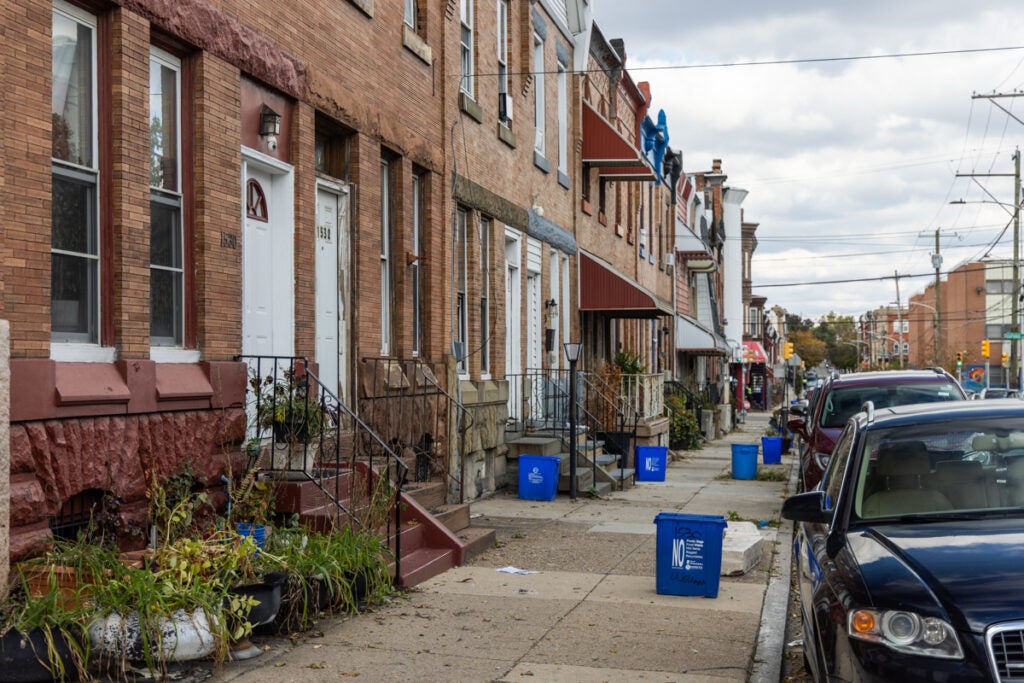 Homes in the Brewerytown section of Philadelphia. (Kimberly Paynter/WHYY)
Previous reports investigated where corporate investors are buying single-family homes, how much they typically spend acquiring those properties, and how active they are in the city’s housing market. But this is the first report to identify these investors and detail what they’re doing with properties they’ve purchased, typically through a limited liability company.
The research, conducted in partnership with Rutgers Law School, found that large and small investors were more likely to have code violations than homeowners. Large corporate investors were also more likely to file for an eviction compared to smaller investors.
Researchers defined small investors as companies that purchased fewer than 100 properties.
“This is by no means all investors, but there are some investor models that heavily rely on evictions and filing evictions just to collect rent,” Dowdall said. “Once a person has one eviction, it can be really destabilizing for a lot of other reasons — financially and in their life in general.”
Evictions typically make it harder for tenants to secure safe and affordable housing in the future because, at the moment, that record cannot be sealed. And all things being equal, a landlord is more likely to reject someone with a filing on their record, even if it didn’t result in a lockout. In Philadelphia, Black mothers are the most likely to face an eviction.
‘We are struggling to hold the line’
Rodney Willis, a former mortgage banker and landlord, has lived in Cobbs Creek for decades. For most of that time, his neighborhood saw little to no private investment, even as nearby parts of West Philadelphia did.
That’s no longer the case, and it’s instilling panic that his neighborhood, long a bastion of Black homeownership, will change for the worse.
Just in the last 18 months, Willis has watched eight properties on sale on his block. That type of activity, he said, has the power to disrupt the community’s fabric forever.
“When homeowners are not the majority, a lot of things start to go sideways,” Willis said. “We are struggling to hold the line.”
Fellow block captain Vandelyn Waring is worried the corporate investments in her neighborhood will decrease affordability and increase property taxes, potentially displacing longtime residents and creating a barrier for others.
“The interest in Cobbs Creek is a great thing , but it is a problem for residents who have been here for a very long time and even newer working class, middle class individuals who want to live here and can’t afford to live here,” said Waring, a Philadelphia native who moved to Cobbs Creek about six years ago. “It’s extremely heartbreaking to see what is happening.”
Across the city in Brewerytown, renter Claire Newsome is wary that corporate investors are driving discontent among her neighbors. She said these landlords are less likely to be invested in the community’s well-being and more likely to poorly manage the properties.
The combination, she said, sits at the heart of the complaints tenants lodge against their landlord, who are often more difficult to get in touch with than small landlords.
“There’s a level of accountability that’s removed from when you have one person who is managing a couple properties themselves,” said Newsome, equitable housing lead at the Brewerytown Sharswood Neighborhood Coalition.