
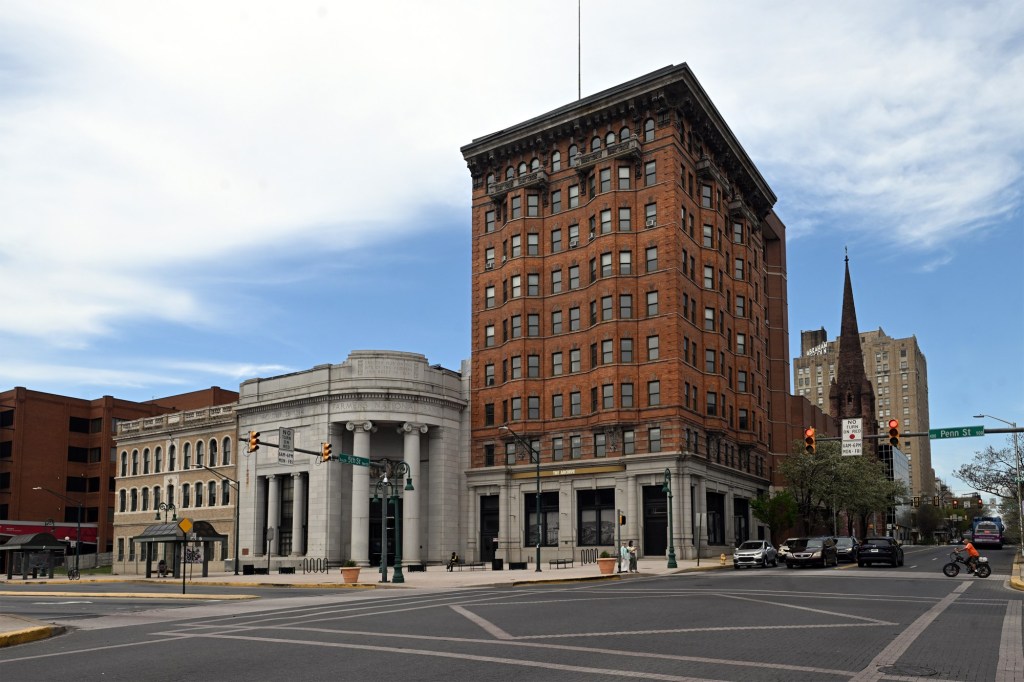
Reading officials say the sale of long-vacant downtown buildings will clear the way for a major redevelopment project at Fifth and Penn streets.
City Council at its regular meeting Monday unanimously approved the sale of a string of long-vacant properties in the 400 block of Penn Street.
The agreement authorizes the conveyance of properties at 431, 437 and 443 Penn St., along with adjacent parcels, to entities affiliated with local developer Alan Shuman.
The total purchase price is $5.7 million, structured in two parts: $4.1 million to be paid in cash and $1.6 million in the form of loan forgiveness tied to Shuman’s earlier restoration of the Abraham Lincoln building, 100 N. Fifth St.
The deal represents a turning point for buildings that city officials say have sat largely dormant for more than a decade and require extensive rehabilitation.
“These buildings … have tens of millions of dollars of deferred maintenance that reduces the effective value,” Community Development Director David Barr said.
Barr said the city acquired the properties in 2012 just before entering Act 47 financial distress, forcing officials to defer upkeep. As a result, he estimated roughly $20 million in repairs may now be needed.
“In order for the city to sell them, we need to effectively add money to the deal. We need to help incentivize,” Barr said.
The broader redevelopment is expected to cost about $52 million, funded through a mix of public and private sources, Barr said. Those include City Revitalization and Improvement Zone, or CRIZ, revenue, state grants, city-backed loans and private investment.
“Of the $52 million that it will take to do this entire project, $4 million will come from the city itself,” Barr said. “This is money that Mr. Schuman is paying us for these properties that we’re going to loan him back for the work.”
As part of the transaction, council also approved a separate resolution authorizing the release of about $1.6 million in loans tied to the Abe Lincoln project.
“We are not forgiving the Abe loan,” Barr explained in a phone call Tuesday. “We are leasing the Abe loan, moving it to the Penn Street properties and then forgiving it.”
Barr described that component as one piece of a larger financing structure.
“That 1.6 million allows Mr. Shuman to then borrow that money against the equity and put that back into the building investment,” he said.
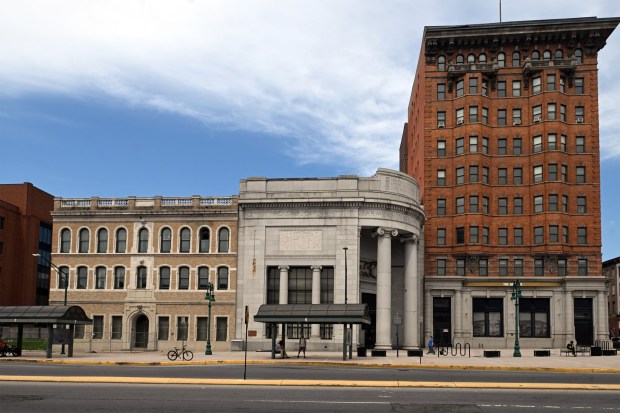 Reading officials say the sale of properties in the 400 block of Penn Street represents a turning point for buildings that have sat largely dormant for more than a decade and require extensive rehabilitation. (Bill Uhrich – Reading Eagle)
Councilman Jaime Baez Jr. acknowledged concerns about setting precedent but ultimately supported the deal.
“I feel like it sets a precedence,” Baez said, “but I also understand the long-term opportunities that this is going to provide. I’m looking long-term when I’m placing my vote this evening.”
Council members repeatedly emphasized the importance of redeveloping the highly visible properties at the city’s core.
“I think all of us realize these are very prominent buildings right in the heart of the city,” Councilman O. Christopher Miller said. “If we’re talking about making an investment, I think this is an excellent choice.”
Councilman Raymond Baker echoed that sentiment, noting the visual and economic impact of the site.
“If we’re going to revitalize Reading, you’ve got to start in the downtown,” Baker said. “Having an entire block that is dilapidated paints a poor picture of the city.”
He and other council members also pointed to Shuman’s track record of restoring historic properties across the city as a factor in their support.
City officials said the project is expected to bring new housing, commercial space and increased tax revenue once completed. Barr said the redevelopment would ultimately return the buildings to productive use and generate new economic activity.
Council President Donna Reed said Shuman will be invited to present detailed plans publicly at a future meeting.
“I give him credit for everything he’s done,” Reed said, noting she and Shuman have had their differences in the past. “I’m really happy to support this, and I’m glad he stepped to the plate.”