
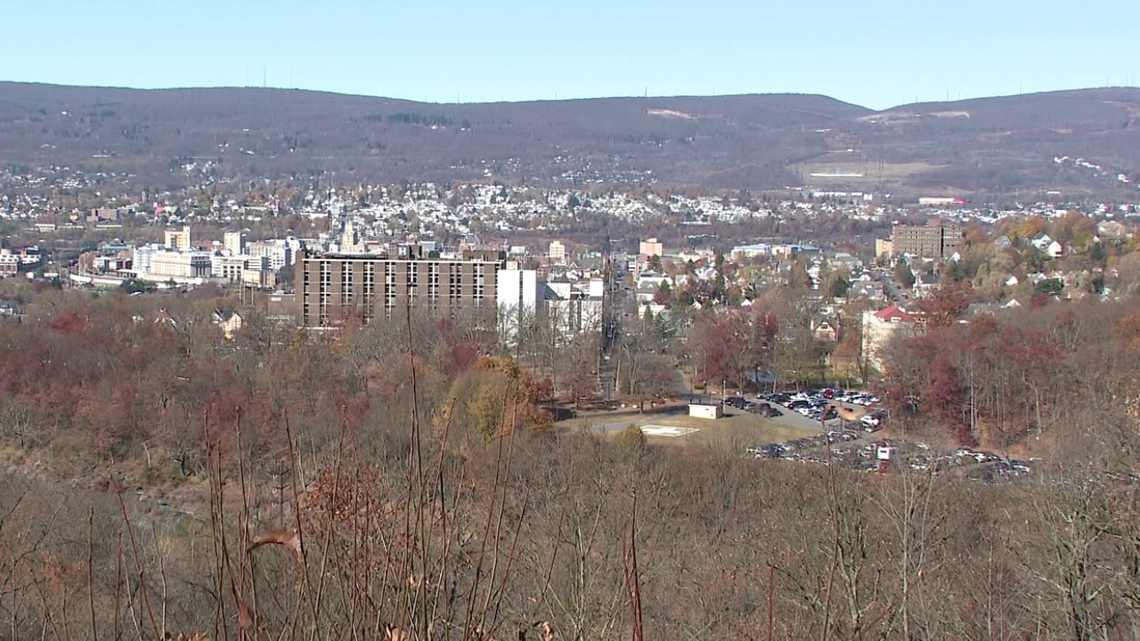
A Wilkes-Barre think tank reports that Lackawanna County faces a housing crisis as costs outpace incomes.
SCRANTON, Pa. — A new report from a Wilkes-Barre-based think tank found housing costs in Lackawanna County are sharply outpacing household income.
The 227-page report, authored by the Institute for Public Policy and Economic Development, said a dearth of post-pandemic new construction and declining listings are driving a housing pinch that puts county residents at an “inflection point,” county leadership said Wednesday, requiring a cohesive strategy to remedy.
“What this says is pretty simple and really sobering,” Commissioner Bill Gaughan said at a public meeting on Wednesday. “Lackawanna County’s housing market is at a breaking point. For decades, it was affordable, and that was a strength, but that reality is changing.”
The report found that decades of population decline suppressed housing demand and stabilized long-term prices. That started to slightly shift at the beginning of the decade, and it put new pressure on an “aging and constrained housing stock.” The population growth of a few thousand people and limited new construction helped drive up home prices, straining households — homeowners and renters alike — of modest and meager means. It’s a trend evident in neighboring Luzerne County and across Pennsylvania.
Here’s some of what the Institute’s report found:
Much of the county’s housing stock was built before 1960, which means that costs tied to energy efficiency, deferred maintenance, and health concerns, like lead abatement, add up and can exceed what many households can finance. So homes that may appear affordable are actually still out of financial reach.The average value of a home in Lackawanna County has gone up by $100,000 since 2010. Nearly everyone, regardless of income, is spending more of their paycheck on housing than 25 years ago, but it particularly hurts those who make less. Of the renters earning between $35,000 and $49,999, nearly half spend at least 30% of their budget on rent.Interviews with realtors show that first-time homebuyers in the area often struggle because issues with old homes frequently prevent them from securing mortgages, since insurers will not underwrite deteriorated properties. Meanwhile, new construction is unaffordable because builders must price new homes high to break even. That pushes those existing properties into the hands of cash investors, rather than owner-occupants, and reinforces a cycle of disrepair and investor concentration.Out-of-town buyers and investors, particularly from New York, compete to buy homes to convert into duplexes and triplexes. That contributes to rapidly rising rents.
The report’s authors offered recommendations to help alleviate the issue. That included simplifying local zoning to make it easier to build new single-family homes, reinvigorating property tax deferment programs for homebuilding, and establishing new mission-driven funding sources for housing development.
At a commissioners’ meeting, Gaughan urged the creation of a housing task force made up of municipal leaders, developers, non-profits, lenders, major employers, and planning professionals to try and address the issue.
“I’m not saying no one is addressing this, but we need to get one coherent strategy together,” Gaughan said.
Read the full report below: