
The question of whether Lehigh County should enter into an agreement with other counties to create a regional youth detention center has been on the table for nearly two years, yet some are complaining that the plan is being decided too quickly.
The 20-year agreement is scheduled to be voted on by county commissioners April 20.
People who are in the trenches of juvenile court and would make the final decisions of which children would be sent to the proposed Southeast Youth Detention Agency in Berks County, say the agreement makes sense.
“We’re not talking about kids who are doing retail thefts or vandalism. These are the most serious types of offenders,” Lehigh County President Judge Doug Reichley said. “Potential homicides, firearms offenses, sex offenses. I would ask you, if these were adult offenders under the same kinds of offenses, would you not think we’d be putting them in jail pending any bail resolution?”
But some folks in the community and government say the proposal feels rushed.
“It does feel like it’s being forced and pushed on us. Like, we’ve got to make a decision right away. But I refuse to believe there’s not alternative plans,” county Commissioner April Riddick said.
Juvenile justice
Of the approximately 400 youths who pass through Lehigh County’s juvenile court system each year, less than 2% require detention in a locked facility. By law, court officials must look for alternatives to confinement first — probation, house arrest and group homes are among the options.
But when a judge determines that a youth poses a risk to public safety, has a high likelihood of fleeing, or hasn’t complied with prior court orders, these teens must be locked up while they wait for adjudication, the juvenile court equivalent of sentencing.
Under the proposed agreement, four partner counties — Lehigh, Berks, Dauphin and Lackawanna — would each pay one-quarter of the Bern Township facility’s operating costs and construction debt. The center would have 40 beds, with 10 assigned to each participating county. Planners estimate the center would cost about $10.5 million a year to operate, with each county responsible for about $2.6 million.
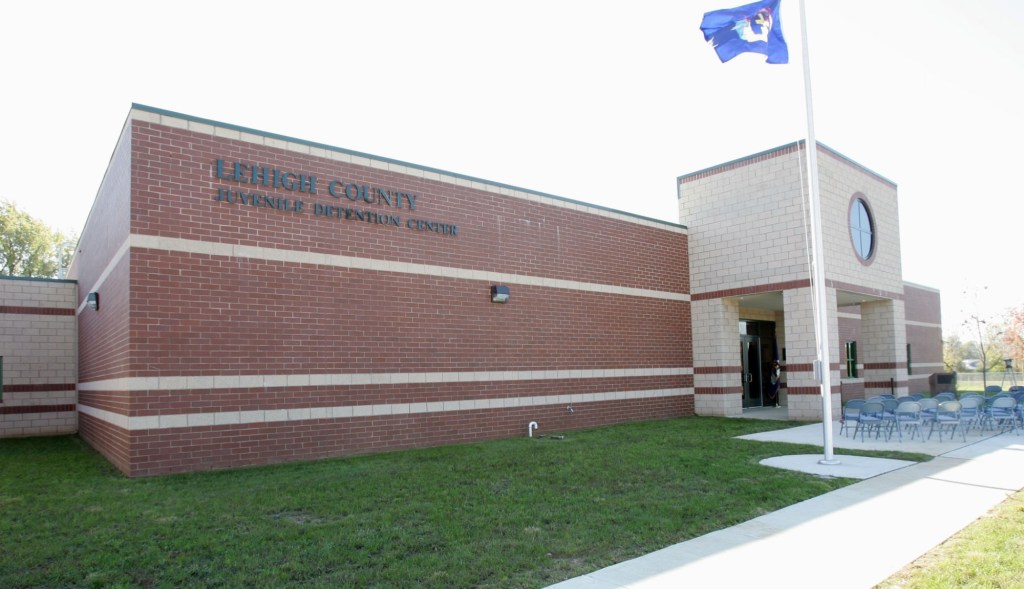
Lehigh County does not have its own juvenile detention center. A 48-bed facility that opened in 2005 in South Whitehall Township was mothballed in 2014 due to declining need. Teens who must be detained are now sent to detention centers in other counties and states, with the county paying up to $600 a day for a bed in those facilities.
While there hasn’t been a large spike in juvenile crime over the last decade, the number of available places to put teens who need to be locked up has dropped sharply. Between 2006 and September 2021,15 youth detention facilities ceased operations, according to the Pennsylvania Juvenile Court Judges’ Commission.
Abraxas Youth & Family Services in Berks County, one of the facilities Lehigh County contracted with, is the subject of several lawsuits alleging abuse. Lehigh no longer sends youths there.
Those in favor of partnering with the three other counties to launch a regional detention center cite a reduced cost to taxpayers as one of the deciding factors. Fewer youths in beds, coupled with high overhead costs, makes operating a detention center too costly for any one county, they say.
“Regionalization is the way to go,” county Commissioner Dan Hartzell said. “Is this going to be a cakewalk for the next 20 years? No. When you’ve got four separate counties working together, there’s going to be speed bumps. But I think everybody is on the same page of being earnest and trying to work together, as fairly as possible.”
According to the Juvenile Court Judges’ Commission, admissions to secure juvenile detention centers dropped 55% between 2018 and 2022, with 42% of that decrease occurring from 2019 to 2020. The decline was due to a variety of reasons, including greater use of detention alternative programs and COVID. When schools are closed, less juvenile crime is reported.
At the same time, changes to the juvenile justice landscape, including the 2021 federal Juvenile Justice and Delinquency Prevention Act, which banned the practice of holding some young offenders in adult jails, made the need for secure youth facilities more pressing.
As of April 2023, there were 13 youth detention facilities in the state, with only six of them open to placements from all counties. All of the facilities were short staffed, the Juvenile Court Judges’ Commission found. Add to this a call for detained youth to be held as close to their families and communities as possible, and state officials began a push for regionalization in 2022.
Reichley, in his address to the Lehigh County commissioners last week, said having 10 beds available at the proposed regional center in Berks would solve a lot of problems for juvenile court staff. He described a recent case where the closest bed available for a teen accused of a violent assault was in Chester County, but the juvenile acted up so badly during the admission process that the facility refused to take him.
The judge oversaw a hearing last week in which a teen was accused of sexually assaulting another child in his home, where multiple minors lived.
“So what am I supposed to do at that point? Send this individual back into the home because there’s no where else to place him?” Reichley asked.
The prison dilemma
Kevin Miller, Lehigh County’s chief juvenile probation officer, said these are weekly dilemmas facing judges and juvenile probation officers.
“This has been the best plan that I have seen where I can sleep at night,” Miller said. “With this plan, we are putting our kids in a safe, secure environment.”
Defense attorney Ettore Angelo disagrees, and asked the commissioners to postpone their decision until the affect on juveniles and their families could be studied, and the cost of the project analyzed.
“Is it fiscally prudent to enter into a 20-year contractual obligation that will affect our children long after many of the officials supporting it have left office?” he asked.
Angelo also complained that the plan would mean sending detained juveniles so far away from their homes that their families wouldn’t be able to visit.
“Poor people cannot travel,” Angelo said. “And they need to be near their children. Their children need to be near them at this desperate time when they’re in custody. “
Several members of Promise Neighborhoods of the Lehigh Valley also spoke out against the plan at the commissioners meeting last week, urging the board to postpone the vote and consider less-restrictive options.
“I’m going to say I kind of resent the false choice that’s been made. It’s either release dangerous kids, or send them off an hour and a half away,” member Sharon Finnegan said.
Other community groups support the plan. Luis Perez, a former juvenile offender who often works as a liaison between detained youths and law enforcement through his Allentown nonprofit, Reciprocity, said a secure facility like the one proposed in Berks is needed to keep accused juveniles safe while they move through the system.
“Just to kind of paint a picture here, we had a kid that was arrested with an AK-47,” Perez said. “He was lying to the courts and would not tell them where he got this gun from.”
Perez said he spoke to the teen while he was in detention. The teen finally opened up because he felt safe from the people who had put the gun in his hands.
“There was a local organization that was involved with some risky situations that provided the opportunity for that kid to get that gun. He would not have spoken before that, but he did because he was there.”
At the Lehigh County commissioners meeting last week, several board members said the length of the contract gave them pause.
“So, we’ve been talking about this for a long period of time, but the reality is that the plan that is before us, we’ve only seen for a little over a week. And that plan, I think, has raised a lot of questions,” Commissioner Jon Irons said. “This was never talked about as entering into a 20-year financial agreement.”
Commissioner Sarah Fevig agreed.
“The 20-year commitment is really, really hard,” she said. “I think if this was a five-year plan, that would give us the flexibility as a county to really look at alternatives and develop something new.”
Other commissioners said they supported the agreement. Commissioner Ron Beitler, answering critics who decried sending children far from their homes, noted that the facility would be an hour or less drive from anywhere in Lehigh County. He reminded the panel that some female juveniles are currently being sent to Ohio because there are no closer facilities.
“We’re talking about the safety of the children, and the safety of their families and the safety of the communities around them. And also, inevitably, the safety of the children themselves, protecting them from themselves,” Beitler said.
Commissioner Antonio Pineda, one of the sponsors of the bill, urged his fellow board members to approve the agreement. The partnership would give Lehigh County’s juvenile justice system more control over local youths’ care, he argued.
“The current system is unacceptable, Pineda said. “This will guarantee beds for a need that has been very consistent over the past decade plus a known, safe location, in addition to having not only detention, but also treatment for the juveniles. A no vote on this agreement continues a status quo that is clearly unacceptable.”
Reichley and Miller were part of a blue ribbon panel tasked with coming up with the regionalization plan. Kevin Barnhart, Berks County’s chief operations officer, was also on the panel. Berks would oversee most of the day-to-day operation of the center.
Barnhart said the facility would provide detained juveniles with medical and dental care, therapy and programs. It would have a board with members from all the counties overseeing operations and keeping an eye on spending.
He also said he was offended by assertions that any of the counties involved were entering into the agreement for the money.
“This is not Kids for Cash,” he said, referring to a 2009 Luzerne County juvenile detention scandal that ended with two judges jailed for taking kickbacks from private detention centers. “This is about doing what’s right for the kids in four counties.”