
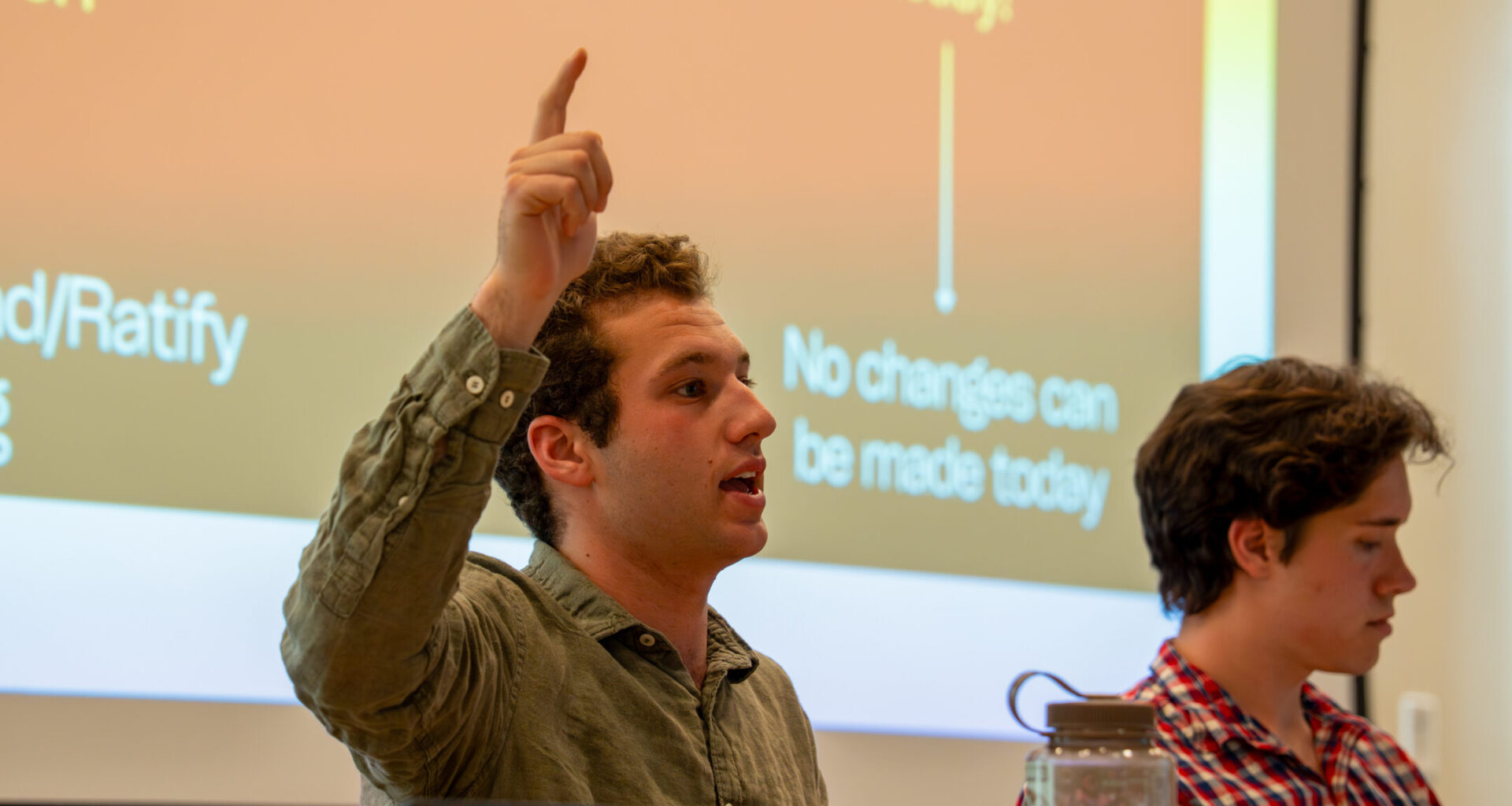
On Tuesday, the Student Senate discussed executive board elections, voting procedures, the potential disbandment of the club and the creation of a new constitution at its weekly meeting.
The meeting began with updates on campus events from each of the eight committees: Allocations, Bethlehem Outreach, Global Affairs, Diversity and Inclusion, Facilities and Services, Health, Safety, and Wellness, Public Relations, Sustainable Development Goals and Student Outreach.
Senators then transitioned to appointments and elections for executive board positions for the next year.
Student Senate president Edward Lopez, ‘27, announced Raquel Romero, ‘27, as chair of club affairs, Edward Grinnan, ‘29, as chair of student outreach and Elias Lowrey, ‘29, as chair of academic affairs. Lopez said all of the positions were uncontested.
Senators also held an election for chair of student rights, with Ibtihal Gassem, ‘27, and Jazeera Avila, ‘29, as candidates. Avila was elected.
In her speech, Avila discussed her desire to advocate for student voices during a “DEI crisis on campus” and her ambitions to better connect Lehigh students with the surrounding community.
Avila said given Lehigh’s impact on housing in Bethlehem, street cleanliness and economic discrepancies is important for the university to acknowledge its role.
“We exist within Bethlehem and we must show up for it,” she said. “And actively work to strengthen our relationship within our communities, whether that means building relationships with local students and supporting community initiatives.”
Following the election, senators discussed whether voting should follow the rules outlined in the official Student Senate constitution or the precedent set by the club’s bylaws.
Although the constitution requires three-fourths of total elected representatives to pass a motion, the Senate has been allowing two-thirds of members in attendance to decide.
After discussion, a majority of senators opposed keeping the current process of requiring two-thirds of those in attendance.
Leading up to a vote on potential dissolution, Drew Smith, ‘27, current Student Senate vice president of internal affairs and incoming president, gave a presentation outlining the implications of the decision.
Smith said he supports dissolving the Student Senate and believes the organization needs reform to regain confidence of students and administrators.
“I don’t think anyone is really happy with us,” he said. “The administrators come to us with rubber stamps and they do not want our input before that. Students think that we don’t do much and from everything I have pointed out, what we do, we don’t do well.
In a 10-minute presentation, Smith outlined several issues facing the Senate, including funding limitations.
He said the Senate’s budget can’t adequately support both a growing number of student organizations and academic departments, citing the orchestra as an example. They proposed cutting funding to academic departments to better support clubs.
Smith also said the Senate needs to consider the legality of its responsibilities and actions, referencing issues surrounding a proposed Turning Point USA chapter.
He said students seeking to create a TPUSA chapter emailed the Senate, stating that if they didn’t receive an explanation for their initial vote, they would report the Senate to the dean of students for violating bylaws requiring a formal reason for denying a club.
Although the dispute was resolved, Smith said it highlighted potential risks.
“At this point we are reminding people of Oberlin College,” he said. “Oberlin College Student Senate passed a resolution that resulted in a $31 million dollar lawsuit. My purpose of being here is to imagine what the administration would do if Turning Point says that we are in violation of not just our bylaws but our constitution.”
Smith emphasized the need for internal change, offering academic credit to senators, creating a new constitution, improving election procedures and restructuring allocations and committees.
At the end of his presentation, a slide displayed the words “Same name?” in red text, highlighting the possibility of renaming the organization.
Smith suggested a new name, such as the United Student Government, to signal that the organization is taking reforms seriously.
Some senators disagreed with aspects of Smith’s proposal. While some, like Grinnan, supported internal changes, they questioned whether a name change would be meaningful.
“(Even if) there is a negative connotation associated with the name, I think we should keep it,” Grinnan said. “It is more important to have structural changes.”.
Lopez also said he doesn’t believe a name change would be as impactful as structural improvements.
“I don’t think the name change is going to do much,” he said. “I think the issue is people within (Student Senate) not being empowered or trained or knowledgeable about what they can do. I feel like future Senate executive boards and administration boards can do more at letting senators know (what they can do) and guiding them.”
Senators then discussed a draft of a new constitution, including whether the president, vice president and treasurer should be allowed to hold executive positions in other clubs.
The next Student Senate meeting will be held on April 21 at 4:30 pm.