
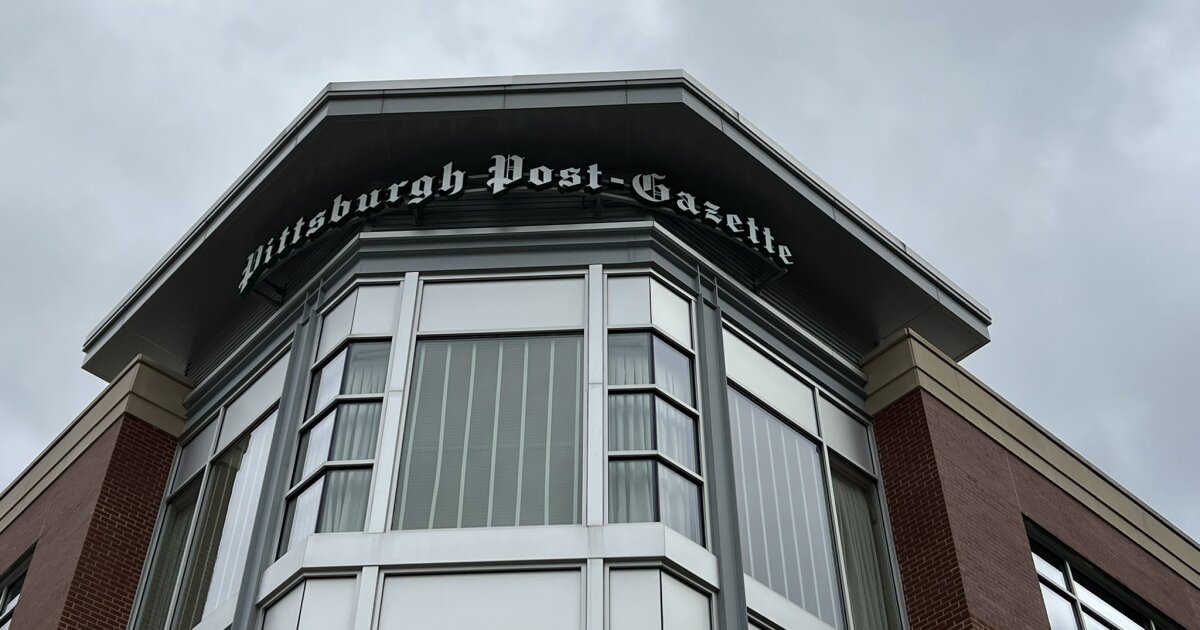
Following a three-year-long strike, bitter feuds with management and an announced closure of their workplace, members of the Newspaper Guild of Pittsburgh say they are tentatively hopeful that the Pittsburgh Post-Gazette’s new ownership marks the start of a better era for labor relations at the paper.
But they still have some major questions about what comes next.
“ How many of my colleagues are gonna have jobs at the end of this? How many are they gonna keep? Is it gonna be a union shop, where workers have a voice?” asked Steve Mellon, a member of the union’s health and welfare committee who has worked as a photographer at the Post-Gazette since 1997.
The Maryland-based nonprofit Venetoulis Institute for Local Journalism, which announced its acquisition of the paper this past Tuesday, has indicated it will shrink the newsroom’s current staff. According to an email obtained by WESA, reporters at the paper were instructed to resubmit their resumes and re-interview with Venetoulis representatives. Many of those interviews took place on Friday.
“ I was optimistic when I heard that it was a nonprofit, they had a history of producing good journalism,” Mellon said. “But I’m a realist, and I always wanna look under the hood and see what’s actually there, see what’s going on. I’m still optimistic, but I don’t wanna be played. I want us to do our due diligence here.”
Andrew Goldstein, the union’s president, says he too is “cautiously optimistic” about the Post-Gazette’s future, but that he’s still looking for some answers, especially with regards to how Venetoulis will interact with the union. The new owners are working with union representatives to schedule an upcoming meeting between the two parties.
“ We want to move forward in obviously a much better way than the situation has been over the past decade or so at the PG,” Goldstein said. “ We’re eager to start a fresh and productive bargaining relationship with the new ownership … We look forward to getting off on hopefully a really good foot in the very near future here.”
Because Venetoulis is only purchasing the assets of the Post-Gazette, it is not required to assume the contracts of the Block family, the paper’s embattled previous owners. The union will need to bargain for a new contract once the sale is in effect. Whether the union remains the official bargaining representative of the new workforce depends on whether the majority of staff retained by new ownership are members of the bargaining unit, as opposed to management or non-covered employees.
The Venetoulis Institute did not respond to WESA’s request for an interview.
On Friday morning, the Post-Gazette’s union encouraged supporters in an email to sign onto a petition advocating for “a robust staff[,] local coverage at the PG and good-faith bargaining with us.” They said they plan to share the results of the petition at their first meeting with management.
“ This all depends now on what the new owners wanna do and whether they wanna cooperate and move forward,” said Joe Pass, longtime lawyer for the Newspaper Guild. “I would suspect that’s what they’ll wanna do. I would hope so.”
Legal uncertainties remain
But the original labor battle also isn’t over yet. On the same day that the Venetoulis Institute announced it would purchase the Post-Gazette, the Blocks filed an appeal to the U.S. Supreme Court of the U.S. Court of Appeals for the Third Circuit decision requiring them to pay back several million dollars in wages and costs passed on to workers and restore the previous contract.
The Supreme Court previously rejected a request by the Blocks to stay the original Third Circuit ruling ordering the company to reinstate benefits. In fact, that court decision appeared to be the impetus for the Blocks’ initial decision to close the paper earlier this year.
Goldstein said the legal proceedings could slow the process of paying the workers the money they are owed.
“Our legal advice has been that, like everything else they’ve tried to do, this is unlikely to succeed,” Goldstein said. “And the unfortunate thing here is that, even though this appeal doesn’t legally stay the Blocks’ obligation to pay back workers, this will likely lead to just a further delay of workers being made whole.”
“We did not appreciate this happening on the same day that they made the sale announcement. But that’s how it happened,” he said.
In the meantime, even as sale proceedings continue, Mellon says the union is still continuing efforts with their own initiative to explore a future for Post-Gazette journalists beyond the Block family. The union started the Pittsburgh Alliance for People Empowered Reporting (also called PAPER) this past January to investigate possible models to continue reporting after the initial closure announcement.
Mellon says the group has since raised money, held town hall meetings and researched alternative publication and ownership models like multi-stakeholder co-ops, where ownership is spread between community members and workers. They also invited local community members and leaders to participate in the discussion process.
“ Even if [Venetoulis] comes in and and creates a wonderful newspaper, there are gonna be spaces that they can’t be in,” Mellon said, especially as the Institute hints at layoff plans at the Post-Gazette.
The newspaper changing hands, he added, doesn’t necessarily improve its relationship with the local community, or protect against future big power swings. He pointed to other instances, like that of the Washington Post, where a wealthy buyer has purchased a news outlet and then made major cuts or changes. A more cooperative model, he said, could help prevent that kind of unilateral decision-making ability from accumulating in the hands of a single monied leader, as well as strengthen ties between the paper and the community.
“ I think PAPER shows that it has an ability to engage in communities in real ways … become stakeholders with them, and partner with them,” he said. “I think that affects coverage. It affects understanding of the community among the reporters and whoever guides the journalists and whoever guides that publication. I think that’s gonna continue to have value no matter what.”