
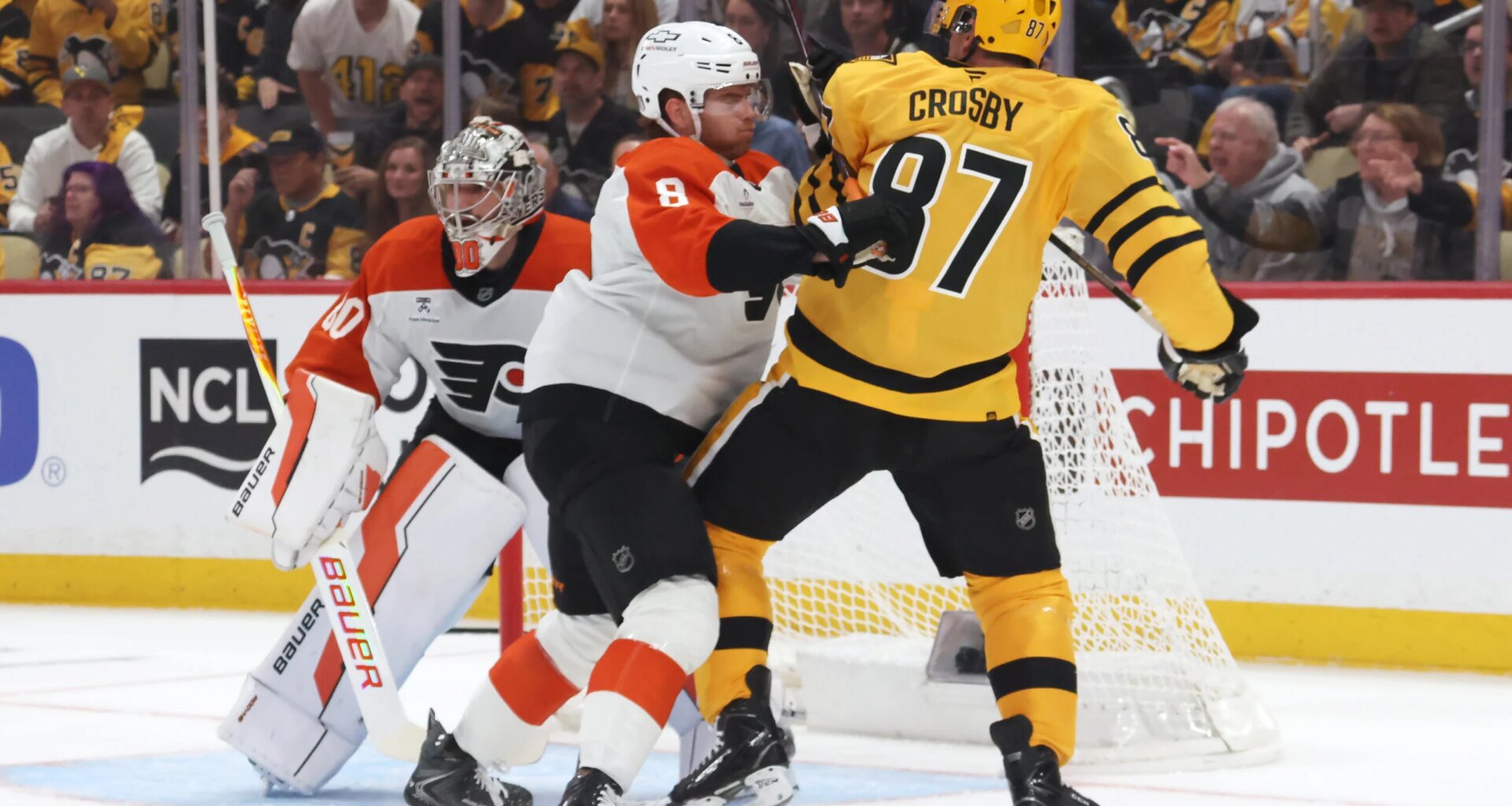
Chaos. Interference. Cross-checks, turnovers, and heart-pounding crowd energy. Yet it was ultimately a disappointing performance by the Pittsburgh Penguins (0-1), who never engaged their best attributes, and the Philadelphia Flyers (1-0) seemed to borrow a trick or two from their rowdy heritage, as the two offensive teams instead engaged in a dirty slog up and down the ice that produced only 37 total shots.
It was the first Stanley Cup playoff game for the Penguins in four years, and the first for the Flyers in six. It seemed like the Flyers came prepared for a low-event game and adapted to it much better than the Penguins. The Flyers clogged the ice for a 3-2 win in Game 1 at PPG Paints Arena, and lead the best-of-seven series 1-0.
The Penguins were terminally mired in the Flyers’ neutral zone trap, frequently chasing their own mistakes, and the Flyers’ clog became the Penguins’ cage from which they never broke free.
“They make it hard. I think that’s part of their game–They’ve been doing that for a while. They have numbers back, and they can make it difficult,” said Penguins coach Dan Muse. “I think we got away from the things that worked. Part of that was intensity. Everything was ramped up here in the place playoffs, but they’ve been doing that. They’ve been playing that way now for a while, so that it shouldn’t come as a surprise.”
Muse’s postgame analysis starkly differed from his Saturday morning optimism. The Penguins coach addressed the things the Penguins needed to be successful in his first playoff series, and his hopes were for that connected, puck support game.
“I think for us, just building our game. I think especially in Game One, it’s getting to that point where that connection is there, in all three zones, for us controlling the things that we know we can control within our game,” said Muse. “And I think building piece is important. You don’t go out there and try to win the game in one shift, in the first shift. It’s just about having that patience for us to be able to establish our game.”
Instead, the Penguins were obtusely stubborn. Defensemen charged into the teeth of the Flyers’ trap. Forwards cut toward the middle into multiple defenders, and the turnovers mounted at the worst spots on the ice.
“I think we tried to go through the neutral zone with control, trying to get through the line with control,” said Kris Letang. “I think, especially in the second period, we kind of got away from our game of putting it deep, trying to grind them down low. I think we need to focus on that a little bit more.”
Evgeni Malkin agreed.
“It’s what we talk about. We should play our game. We lost a little control in the second period, and we started fighting. This is what they want. We know it’s a tight, physical game, but we need to play better,” Malkin said. “Our blue line, we should control the puck a little bit, play deeper and focus more behind the net. We gave them so many chances.”
Connection. Simplicity. The Penguins had little. By the end of 60 minutes, they had plenty of frustration.
It took until later in the second period for the Penguins to create sustained offensive zone pressure with a palpable element of danger. At 15:51 of the second period, Evgeni Malkin finished an extended sequence begun when Sidney Crosby showed the power of countless offseason squats and held off two defensemen to maintain control of the puck behind the net.
As the game progressed, the Flyers evolved from their 1-1-3 structure into something that looked and felt like a 1-4 trap. For the Penguins, it might as well have been a venus fly trap.
However, the Penguins’ defensemen were an adventure Saturday, but not the fun Kennywood sort of adventure. The Penguins defensemen far too many times made far too many brutal mistakes.
Fortunately for the home team, goaltender Stuart Skinner was brilliant in shutting down a trio of breakaways, a two-on-one, and several clean looks inside the dots from the wings.
After Malkin tied the game late in the second period, Game 1 was up for grabs in the third period, but the Penguins never grabbed it. Not even close.
Penguins Analysis
The Penguins were not able to get free from the clutches of the Philadelphia neutral zone traffic. Sometimes it was legal, other times it was extra-legal. The fault lies within the Penguins’ inability to adjust to the center-ice traffic and their stubbornness to adjust their game. There was plenty of interference (it was called twice, could have been a half dozen more), and credit to the Flyers for knowing how to gobble up the Penguins’ preferred attack.
It’s playoff hockey.
What the Penguins didn’t do in Game 1 will define Game 2. The Flyers will not change their approach–it’s a bit surprising how enormously effective they were, but it’s why they were one of the hottest teams after the Olympic break.
From a tactical standpoint, the Penguins desperately need to get the puck deep with possession. They need to play behind the Flyers’ defensemen and force the forwards to defend.
They also need to protect the pucks at the top of the zone. Their carelessness fueled the Flyers’ advantage and emboldened the Flyers to attack with more ferocity at the top of the zone.
And the most brutal but simple change for Game 2 is that the Penguins’ defensemen need to play better, in all phases. It was an awful night for several of the blue liners, including Sam Girard, and a frustrating night for Erik Karlsson. Even the generally reliable Parker Wotherspoon made a couple of mistakes to allow Flyers behind him for clear rips at Skinner.
Penguins Report Card
Crowd: A+
OK, I could have done without the “F*** You, Philly” chant. It was a bit too Philly for my taste, but you do you. The Pittsburgh crowd was unbelievably enthusiastic and engaged. There were a couple of moments in the game in which the players couldn’t hear the whistle, or at least acted like they couldn’t. Flyers defenseman Rasmus Ristolainen dumped Penguins winger Elmer Soderblom well after one of those whistles and earned a roughing penalty, which was ultimately harmless.
“A couple of times, you had to take a breath. The crowd was so loud, had so much energy,” Skinner said with a smile.
Make no mistake, Skinner loves the support he has received in Pittsburgh. It obviously tickles him to be so well supported. He notices you.
Team: D-
The team allowed four breakaways. A couple of odd-man rushes. And generated just 17 shots. Perhaps it was the Penguins’ depth, in addition to the goaltending, that kept the game as close as it was for the entirety of 60 minutes, but it was the Flyers’ game. The Penguins were never in control, nor the better team.
“We tried really hard, maybe too hard sometimes, and we just didn’t make the plays when they were there,” said Karlsson. “When they weren’t there, we still tried to make them, and that usually that doesn’t work out.
“It was one of those games–they played better than us today. They won Game 1. We’ll reassess tomorrow. Go through it. We’ve got smart people behind the bench and smart people in this room. We’re already excited for Game 2.”
Stuart Skinner: A
The big man delivered a big performance. It could have been–should have been a lopsided blowout loss. Skinner stopped the breakaways, controlled the rebounds, and kept the Penguins in the game. A stellar performance.
Bad Grades
Too many Penguins had subpar grades to list them all, and the stat sheet provides some dispute to the visually inadequate performances.
Sam Girard: The Penguins’ lefty defenseman was trying to skate away from trouble, but skated into it. He tried to charge ahead with the rush game, but turned it over. His mistakes and turnovers were far too many.
Erik Karlsson: The game went sideways for the straw that stirs the Penguins’ drink. He tried to lead the rush several times to see only Flyers surrounding him and be ensnared in the trap.
Anthony Mantha: The 33-goal scorer didn’t have any notable scoring chances, took two minor penalties that negated puck possession.
Egor Chinakhov: In his first playoff game, Chinakhov was not able to break free, but plowed ahead instead of chipping it forward. He did not get a shot on goal. His passes did not connect. He and Crosby continue to be ships passing in the night without much connection.
Tommy Novak: Zero shots on goal. None blocked. His puck touches were quite limited.
Good Grades
Fourth Line (Connor Dewar-Blake Lizotte-Noel Acciari): They were the Penguins’ best line and created the most offensive zone time because they did what the other lines could not: Get the puck deep and retrieve it. They battled and created more possession and loose pucks to keep the Flyers scrambling.
Elmer Soderblom: In a greasy game, he was one of the best Penguins forwards. He maintained possession and had three of the Penguins’ 16 even-strength shots on goal. He was an inch away from tying the game 1-1 in the second period as he took the puck off the wall straight to the net.
Kris Letang: This will be a controversial grade, but the PHN Report Card felt Letang did a lot of cleanup and kept his responsibility. His breakouts were as problematic as every other defenseman’s , and he, too, charged into the gale-force winds of the Flyers trap, but the cleanup efforts give Letang a good grade for Saturday.
Tags: Penguins Analysis Philadelphia flyers Pittsburgh Penguins
Categorized:Penguins Analysis