
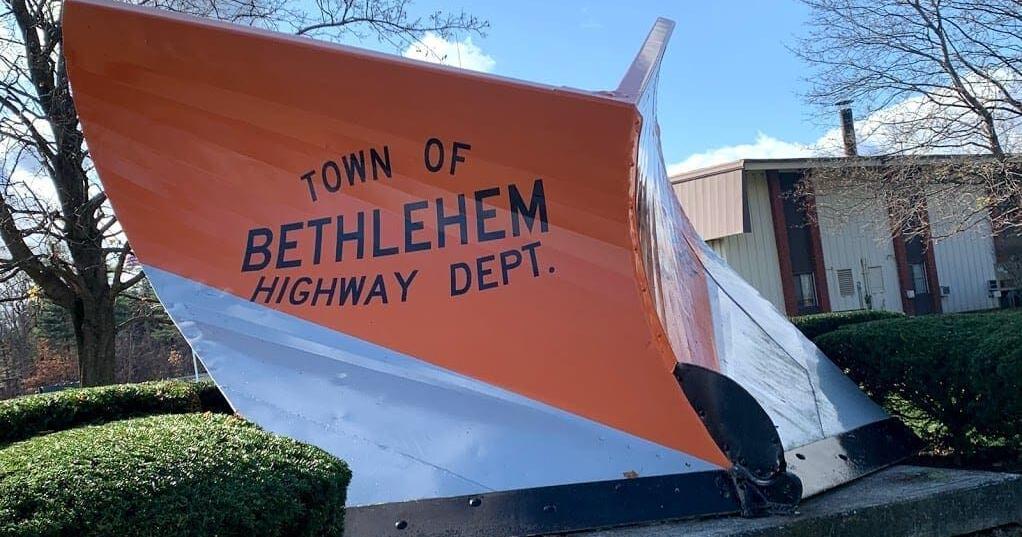
DELMAR– Town of Bethlehem Highway Superintendent Marc Dorsey won’t be making charges on the Town’s credit card any time soon, after having had his privileges suspended following a series of unauthorized charges relating to conference trips.
Town officials took the action after Dorsey took three months to repay the overages following notification.
According to e-mails and documents obtained by Spotlight News through a Freedom of Information Law request, the overcharges on Dorsey’s Town credit card, called a Purchase Card or “PCard”, stemmed from two 2025 events.
The first charge was for a $289 hotel room that exceeded the daily $110 allowance by $179 for Dorsey’s subordinate, Jason Hammond, to attend a May 2025 conference at the Turning Stone Casino.
The remaining charges occurred during a June 2025 trip to Ithaca when Dorsey and Hammond attended a highway conference. Dorsey charged $291.42 in overages and non-reimbursable charges.
Town Comptroller Michael Cohen first notified Dorsey by July 10, 2025 e-mail that those charges, including a $271.26 steak dinner for two with a $45.50 alcohol purchase, a separate $46.04 alcohol purchase, and overcharges for breakfasts and valet parking totaling $291.42, exceeded the Town’s reimbursement policies or, in the case of alcohol, are “non-reimbursable.”
Cohen asked, “Could you let me know how you would like to handle the $291.42 in overages and non-reimbursable charges?” He said the $179 overage from the May conference also needed to be addressed.
In an interview, Dorsey acknowledged that Town policy prohibits charging alcoholic beverages to the P-Card. He said one alcohol charge was from his hotel bar, which the waiter charged to his room and he could not reverse the charge.
He explained the other drinks charge was charged because the restaurant was busy and the waiter mistakenly included Dorsey’s and Hammond’s drinks on a single bill rather than giving Dorsey a separate check for them.
“Because it was so busy, he couldn’t take it off,” Dorsey said. He acknowledged he should have told the Town about the drink charge upon returning, but could not remember why he had not.
He also said, based on his experience in State government, the amount would be automatically deducted from his paycheck. “I should have had her [the waitress] do it, but I didn’t think it was a big deal. Just take it out of my paycheck when I get back.” He said did not intend for the Town to pay for the drinks.
Dorsey confirmed his annual 2025 salary was $120, 658.
On July 15, after receiving no response, Cohen sent two more e-mails to Dorsey, reiterating that several P-card charges exceeded the limit or were not reimbursable, and requesting payment. Dorsey either did not reply or responded that he thought the amount was being deducted from his paycheck.
On August 20, 2025, Cohen emailed Dorsey, again noting the outstanding $470.42, stating payment by personal check was preferred and asking for reimbursement by August 22. Cohen warned that if no payment was received by August 22, Dorsey’s P-card would be deactivated in accordance with the Town’s internal control procedures. Dorsey responded that day that he thought Cohen was deducting the amount from his paycheck and said he would get “the cash” to Cohen right away.
Dorsey made no repayment at that time.
At the end of August, Hammond repaid the Town $179 for the May conference hotel overage. Dorsey said Hammond, who reports to him, paid for the overage because Hammond wanted to go to the conference, went on his own, and booked the room himself (using Dorsey’s P-Card). He offered to pay the $179 for Hammond, but Hammond said “no, no, no”, he would pay it.
Dorsey ultimately repaid the Town on October 29 with a money order, one week after Cohen again demanded payment by personal check by October 24 and said that a personal check was necessary because of tax implications and a day after more e-mails about repayment.
In an interview, Dorsey initially said the delay in repayment was because he “lost track of time, was busy.” He then said he repeatedly told Cohen to deduct the amount from his paycheck, as the State does, and to create a repayment record.
Dorsey told Spotlight he is aware of the spending restrictions. However, he said, based on State service, one unused meal allowance could be applied to another as long as the total fell within the total daily rate. He said the June 3 Creola dinner “without the drinks, would have been within the day’s allotment or close to it at least.” The dinner charge was $271.26 or $225.76 without the drinks, but the GSA maximum for dinner (including tip) is $33/person, leaving a difference of $159.76 for the meal.
He also claimed that he could be reimbursed for any unused portion of the per diem amount, but he never requested that.
Dorsey also defended himself, stating this had never been a problem in the past several years he has attended the highway conference.
Dorsey’s P-Card Suspended
Dorsey said he learned his P-Card was suspended on October 1 when he tried to make a vendor payment. Dorsey called Cohen, who reminded Dorsey that he was told his P-Card would be deactivated on August 22, absent repayment. Dorsey told Cohen he would get “cash” to Cohen right away, but did not.
In mid-November, Dorsey inquired about his P-Card status. Cohen asked the board to decide. In mid-December, Dorsey again inquired.
Cohen said that since becoming a Town employee in 2010, he is unaware of any other department head’s P-Card privileges being suspended.
Town Supervisor David VanLuven said the Town has very strong fiscal policies and procedures in place. He said this situation demonstrates how well that system is working. “We have strict policies to ensure public money is spent responsibly and well,” he said. He called the P-Card suspension “appropriate.”
Board members David DeCancio and Tom Schnurr both supported Dorsey’s P-Card deactivation. “The proper use of the card comes with a responsibility,” DeCancio said. “Taxpayer responsibility is a serious responsibility and we have policies to protect the taxpayer.”
Schnurr agreed. “There were a series of expenses not in line with the policy, and at that point, the rules are the rules,” Schnurr said.
“There were rules clearly laid out in the policy as to what can be purchased and the limits on amounts and these were not followed,” Schnurr said. Schnurr pointed out that this was not a “one-time thing.”
In October 2021, the Town’s Ethics Board, after investigation of a complaint filed against Dorsey accusing him of twice receiving free truckloads of fill from a local developer, concluded that Dorsey had violated the town ethics code’s prohibition against receiving a gift of any value. The town board then directed Dorsey to cease receiving free dirt from the contractor.
Town board not reactivating
VanLuven said there are no current plans to re-activate Dorsey’s P-Card. “I haven’t heard any inclination from the Board to do that yet,” he said.
DeCancio saw no reason to lift the suspension unless it interfered with the department’s operation, which has not happened..
Cohen has increased the spending limit for another highway department supervisor from $500 to $1,000 to avoid operational issues. Dorsey’s spending limit was $2500.
Dorsey now says he “could care less” whether his P-Card is reactivated. “I want no part of it,” he said. He said he had been carrying his P-Card in his pocket for months without even realizing it had been deactivated until October 1.
VanLuven said the P-Card suspension was one of the few actions the board could take in this case. As an elected official, Dorsey does not report to VanLuven. VanLuven said, “It was frustrating to me that it was taking so long and took so many communications.”
Dorsey, for his part, attributed the situation to “politics” and called it a “headhunt.” He said the Town is “out to make a spectacle of this” and also said he and Cohen “do not get along.” He pointed to Hammond being treated differently from him. Hammond was never issued a P-Card.
Dorsey does not think this incident will impact his re-election. “I think what I have done for the Highway Department is over and beyond what any other superintendent has done who has sat in this seat,” Dorsey said. “ A lot of this is politics, but it shouldn’t be about politics.”
“At the end of the day, Marc Dorsey was elected by the residents of Bethlehem,” said DeCancio. “He has to go before them in an election and that’s a decision for the voters to decide.”
Meredith Savitt is a writer for Spotlight News