
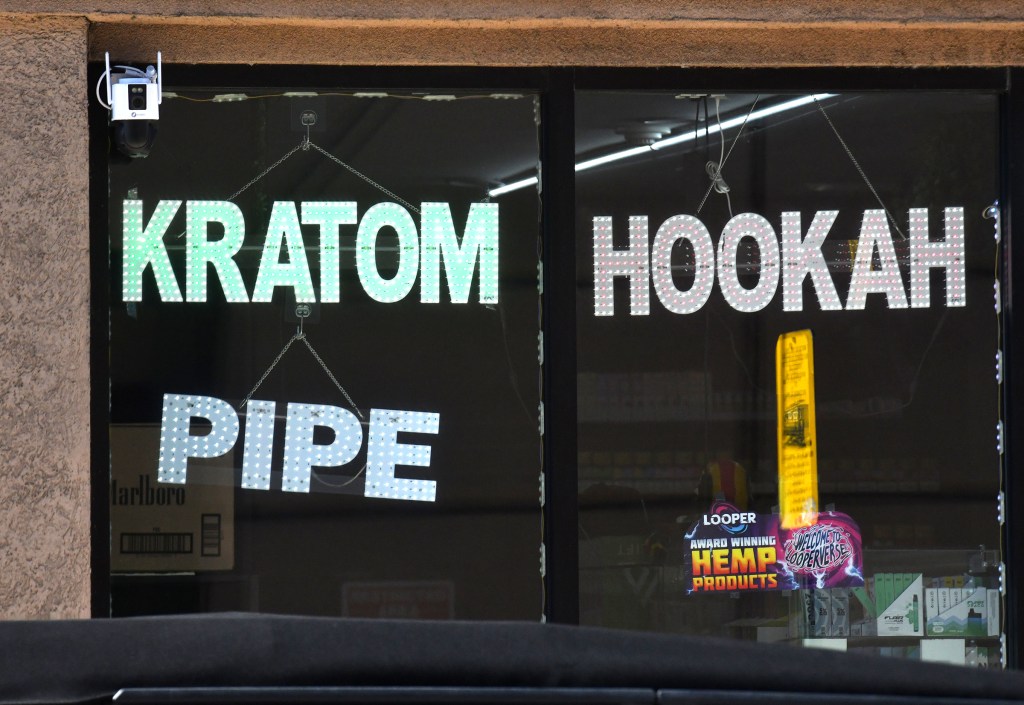
Scranton City Council on Tuesday unanimously delayed adopting a citywide ban on kratom on sales and possession of kratom, a botanical native to Southeast Asia, and synthetic versions sold in stores in forms that include vapes, powders and capsules.
The delay came a week after Mayor Paige Gebhardt Cognetti’s administration submitted to council a lengthy list of questions asking about the legal basis of such a ban, which was drafted by council without input from the administration, and how a ban would be implemented and enforced.
The leading proponent of a ban, Councilman Patrick Flynn, and council President Tom Schuster and council Solicitor Tom Gilbride met Monday with members of the administration, including city Solicitor Jessica Eskra, Deputy City Solicitor Mariclare Hayes, Police Chief Thomas Carroll and Public Health Coordinator Dr. Rachna Saxena, to discuss the proposed ban, Flynn said Tuesday during council’s meeting.
Flynn and Schuster both said they thought the meeting was productive and they came away amenable to a brief delay in the legislative process to fully address any questions and ensure the proposed banning ordinances are as strong as possible, according to an Electric City Television simulcast and video of the meeting posted on YouTube.
It became clear that another conversation would be needed to continue the discussion, Flynn said, so he made motions Tuesday to table the two ordinances that would establish a ban. One ordinance addresses adults over 21 years old, while the other ordinance references those under 21.
“When we move forward we have an obligaiton to make sure these ordinances are as strong, as clear, as effective as possible,” Flynn said. “In an effort to make these ordinances as strong as possible and address any concerns, I will make a motion tonight to table, to allow these conversations to continue. What I will not do is allow this to become an indefinite pause. I will not allow these conversations to become a delay tactic. The work must continue and it must continue proactively.”
Schuster agreed.
“As long as I feel this effort is sincere and the effort is to move this forward and to strengthen this ordinance to pass it in the end, I’ll continue to work through this process,” Schuster said. “I do think a lot of the processes that there were questions about are already existing. So I do feel strongly that this is going to pass, (and) we’ll give it a brief pause. But I just wanted to reiterate as long as these efforts are sincere, we will take this route.”
Councilwoman Jessica Rothchild, who at the prior two weekly council meetings unsuccessfully tried to get the ordinances tabled for further review, said she was glad to see the tabling occur to address questions.
Council then voted 5-0 – with Schuster, Flynn, Rothchild, Mark McAndrew and Sean McAndrew all in favor – to table the two ordinances.
The issue of banning kratom generally has spurred support and opposition since Flynn, Schuster, Mark McAndrew, Sean McAndrew and Lackawanna County District Attorney Brian Gallagher on April 6 announced the proposed ban at a media event at the Lackawanna County Courthouse.
Opponents generally have argued that a total ban would take away pure-leaf forms of kratom that many people have found helpful for pain relief and other health reasons; and they generally do not oppose banning the much-stronger, addictive and potentially dangerous synthetic versions.
Council proponents of a total ban argue the city cannot distinguish between natural kratom or synthetic versions readily available on store shelves and – absent federal or state regulations that do not exist – the only option for the city to address a growing public health threat from synthetic versions is to ban all forms.
Cognetti administration questions
The Times-Tribune asked Schuster on April 15 for the questions from Cognetti’s administration to council submitted April 14 and he provided them to the newspaper. The lengthy list of questions were grouped in three categories, including legislative and procedural history, research and factual basis, and enforcement:
Legislative process & procedural history
• What legal authority does Council rely upon to regulate or ban kratom?
• Did Council analyze potential state law preemption, given kratom is legal in Pennsylvania? Was there any review of relevant Pennsylvania statutes (e.g., Controlled Substance, Drug, Device and Cosmetic Act)?
• What legal exposure and/or litigation risks did Council identify in its research? Did Council consider potential constitutional issues (due process, vagueness, equal protection)? Was there any analysis of whether the ordinance could be challenged as ultra vires?
• Were there any legal precedents, model ordinances, or examples from other jurisdictions used in the drafting process?
• Since the drafters of this Ordinance partnered with the District Attorney’s Office, can they share whether a county-wide ban is being contemplated by that Office? Or should we assume Scranton will be the only municipality in Lackawanna County with this ban? If there is not a county ordinance pending, will there be a county policy letter drafted prohibiting the possession / use of Kratom on county property? E.g. Courthouse, Trolley Museum, COLTS, Mine Tour, McDade Park, Government Building, etc.
Research & factual basis
• What specific research did Council rely upon to support the ban? Please provide any expert opinions, peer-reviewed studies, guidance from federal agencies such as the FDA, DEA, etc., local statistics, input from advocacy or community groups or organizations, proposed federal and/or state legislation, etc.
• Was there any engagement with vendors or manufacturers of Kratom products? What consideration was given to individuals currently using Kratom for medical or therapeutic reasons?
• Did Council review how other municipalities regulate kratom? Are there Pennsylvania municipalities with similar bans?
• Why did Council choose a ban over regulation (e.g., age restriction)?
• Did the Council consider regulating age of purchase, labeling, or sales restrictions instead of a complete ban?
• Please identify all parties with whom City Council consulted in the crafting of these Ordinances, to include: Scranton Police Department? City Administration? Lackawanna County? Lackawanna County District Attorney’s Office? Public health officials?
Enforcement
• How does Council intend for the ordinance to be enforced? Which entity is responsible for enforcement (police, code enforcement, health department)?
• If police are involved: Will appropriate policies, resources, and/or training be identified and allocated to law enforcement regarding this legislation?What is the funding source of such training?
• If non-police enforcement: What inspection or compliance mechanisms exist?
• What evidentiary standard is required to prove a violation?
• How will kratom be identified/tested in the field? What testing facilities have you identified to perform substance testing for materials seized?
• Can the ordinance be enforced in state or federal buildings/property?
• Are there exemptions (e.g., research, personal use, existing inventory)?
• Does the ban apply to both personal and commercial possession?
• What if a commercial truck driver that has a shipment of Kratom is driving through Scranton?
• Please elaborate on the penalties to be imposed (civil fines, administrative sanctions, criminal penalties)?
If civil: What is the fine structure? Is there a progressive penalty scheme?
If criminal: What statutory authority permits criminalization at the municipal level? What due process protections are included (notice, hearing, appeal)? Which tribunal adjudicates violations (magisterial district judge, administrative board)?
• Is there a mechanism for appealing citations or enforcement actions?