
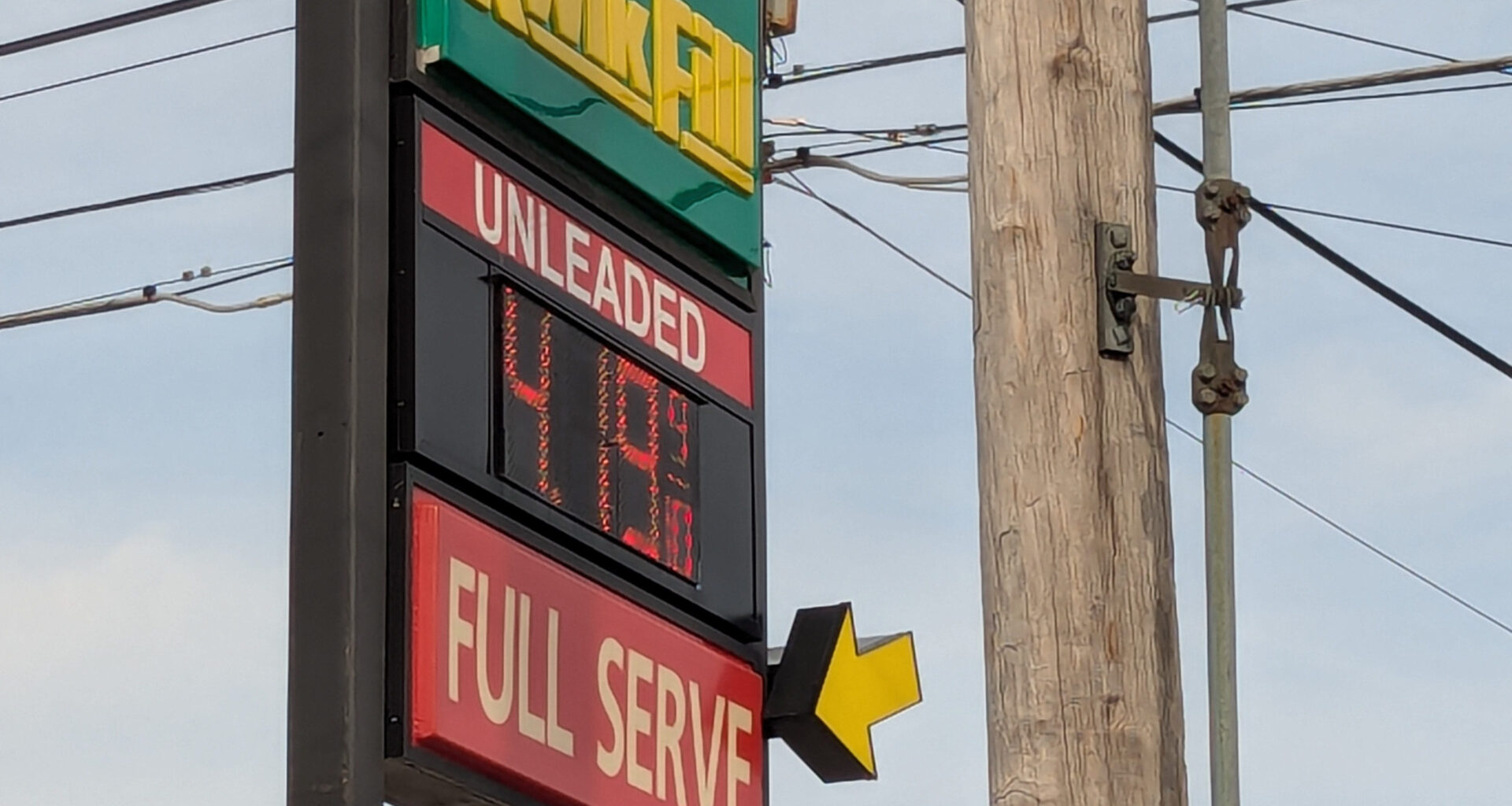
The average price for a gallon of gas in Pennsylvania has dropped for the second straight week, falling from $4.13 to $4.10 a gallon, according to motor club AAA.
But that price is still higher than the national average of $4.10 a gallon, and nearly a dollar more than the $3.12 a gallon Pennsylvanians were paying for gas when the US and Israel went to war with Iran on Feb. 28.
Gas prices also remain higher than any time since the spring and summer of 2022, when gas surpassed $5 per gallon due to Russia’s invasion of Ukraine and lingering pandemic disruptions.
At $4.29, Warren County currently has the highest average price for a gallon of gas in the commonwealth.
Montour County has the lowest average cost, at $3.85 a gallon. Montour is one of just six Pennsylvania counties with an average gas price of under $4.00 a gallon, along with Bucks ($3.96), Carbon ($3.99), Lehigh ($3.99), Northumberland ($3.93) and Union ($3.94).
Here’s a breakdown of the current average gas cost per gallon in Pennsylvania’s top 10 metro areas, with last week’s prices in parentheses:
Advertisement
Allentown-Bethlehem-Easton: $4.01 ($4.04)
East Stroudsburg: $4.03 ($4.06)
Erie: $4.23 ($4.29)
Harrisburg-Carlisle: $4.15 ($4.15)
Lancaster: $4.14 ($4.13)
Philadelphia: $4.04 ($4.09)
Pittsburgh: $4.13 ($4.16)
Reading: $4.13 ($4.16)
Scranton-Wilkes-Barre: $4.12 ($4.16)
York-Hanover: $4.11 ($4.11)
How is the war impacting gas prices?
In response to US and Israeli attacks, Iran effectively closed the Strait of Hormuz, through which 20% of global oil passes. Concerns about how long disruptions could last for the production and transport of oil and natural gas in the region, and the possibility of even more, are what’s driving the higher prices.
Iran fired on three ships in the Strait of Hormuz and seized two of them on Wednesday, intensifying its assault on shipping in the key waterway a day after President Donald Trump extended a ceasefire while maintaining an American blockade of Iranian ports that began last week after peace talks to end the war failed.
The standoff over Iran’s closure of the strait and the US blockade raised doubts about when or if talks would resume to end the crisis.
How Pennsylvania lawmakers are trying to ease pain at the pump
Pennsylvania has the fourth-highest gasoline tax in the nation, at 57.6 cents per gallon, and the highest diesel fuel tax at 74.1 cents a gallon.
State and federal gas taxes provide more than 70% of the state’s highway and bridge funding. Some of that money goes to municipalities to support locally owned roads as well as the Pennsylvania Turnpike and the Pennsylvania State Police.
Last month, state Sen. Lisa Boscola (D-Lehigh), proposed a 60-day suspension of the state’s gas and diesel taxes to help ease the burden of high prices on businesses, workers, and families. A similar effort failed in 2022, when legislators responded to a spike in oil prices following Russia’s invasion of Ukraine.
Advertisement
The legislation would allow for the use of bonds to cover lost revenue from the gas tax so that the State Police and ongoing infrastructure projects won’t be disrupted.
State Rep. Abby Major (R-Armstrong/Westmoreland), has taken it a step further, calling for a six-month state gas tax moratorium, starting June 1, that would require retailers to reduce prices at the pump for both gas and diesel by the current state gas and diesel tax rates, so that consumers see the benefit and not wholesalers.
When gas prices jumped just after the war began, Democratic state Reps. Joe Ciresi (Montgomery) and Jim Haddock (Lackawanna/Luzerne) called on Pennsylvania Attorney General Dave Sunday’s office to investigate gas price gouging, alleging that prices started rising in Pennsylvania “as soon as the first bomb struck in Iran,” even though gas flowing at the pumps then had already been paid for.
Why is Pennsylvania’s gas tax rate so high?
Pennsylvania’s high gas tax rate goes back to 2013, when the Republican-controlled legislature passed H.B. 1060 with bipartisan support. Then-Gov. Tom Corbett, a Republican, signed the bill into law as Act 89 of 2013.
Lawmakers at the time estimated that the bill would generate an additional $2.4 billion annually within five years for transportation infrastructure projects at the state and local level. Today, PennDOT estimates it generates $3.5 billion.
Act 89 of 2013 eliminated the 12-cent flat tax on a gallon of gasoline and the cap on the Oil Company Franchise Tax.
Advertisement
The gas tax rate increased by about 10% annually between 2014 and 2016. In 2017, the law mandated that PennDOT set the tax rate based on the annual wholesale price of gasoline. If the AWP exceeded $2.99 a gallon, the price would go up, as it did for the first time in 2023, when the rate jumped from about 57.6 cents to 61.1 cents. If it fell below that mark, as it did in 2024 (and where it has stayed), the gas tax would go down.
In 2022, Republican Sen. Wayne Langerholc proposed legislation to stop any further increases in the gas tax. His bill passed the Senate 29-19, with 27 Republicans and two Democrats backing the bill and 19 Democrats opposing it. The bill was then referred to the House Finance Committee, where it died.
How to find the cheapest gas prices
Whether you’re traveling or at home, the website GasBuddy offers information to find the cheapest prices for gasoline.
Enter your state, city, or ZIP code to find the cheapest fuel prices in the area.
Information from the Associated Press and USA Today via Reuters Connect was used in this report.