
SCRANTON, LACKAWANNA CO. (WOLF) — For generations, baseball has been one of the country’s most popular sports, but until 1947, black men weren’t able to compete professionally. They had to play in Negro Leagues, and it turns out that NEPA had a Negro League baseball team of their own. They were called the Scranton Battling Giants, and until recently, have been largely forgotten. The ensuing search to try to find anything about the team and to try to meet the people keeping their legacy alive would become a rabbit hole.
And it all started with one question: Who were the Scranton Battling Giants?
The search for answers began with a 2020 blog post by the Black Scranton Project, the only online source with any information about the team.
“I came across the Battling Giants through the owner, founder, manager of the team, Charles “Susky” Battle,” recalled Black Scranton Project founder and CEO Glynis Johns. “He was a business owner here in the city of Scranton in the late 1800s until the 1920s. And during that time, he ran the only black owned hotel in the city of Scranton, it was very popular.”
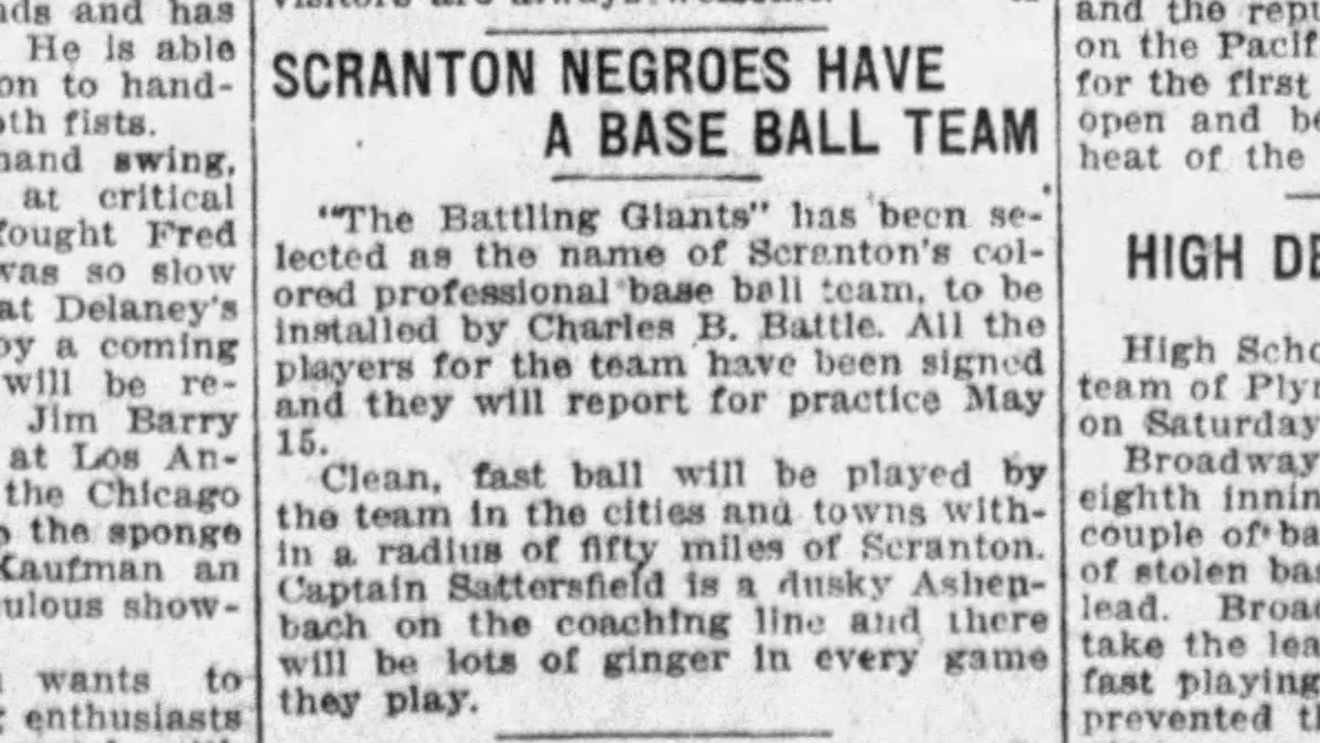
To learn more, research turned to newspaper archives. At the Luzerne County Historical Society’s library, a review of the Wilkes-Barre Times Leader uncovered 12 references to the team across a three-month span, beginning on April 5, 1909. Among advertisements and local notices appeared the headline: “Scranton Negroes Have A Baseball Team,” offering one of the first glimpses into the Battling Giants.
Named in part for owner Charles “Susky” Battle, the team began practicing in May 1909. Drawing players from surrounding states and some from the South, they competed in towns within roughly 50 miles of Scranton. Their first recorded game, an exhibition match against Nanticoke, ended in a 6–8 loss. Despite that start, reports soon noted the team was doing “fine work this season on the diamond.”
Additional records from the Lackawanna County Historical Society helped expand the team’s scope. Between May and June 1909, the Battling Giants played in Olyphant and Lestershire, New York (neither score was found), defeating Archbald twice, as well as Endicott, White Mills, and Hawley. The Hawley game remains significant as a picture was taken, and it stands as the only known photograph of the team.
Johns continued, “We don’t have that many living images, or when there were photos being taken, they were only taking them of the white players on the field, you know? So, it’s like we were there, but we weren’t always seen and like we weren’t given the spotlight a lot of times.”
While many game records have been lost, contemporary coverage makes clear the team’s impact. White sportswriters at the time acknowledged their prowess. While recounting two Battling Giants wins, an article in the June 30, 1909, edition of The Citizen said, “It was no disgrace for the locals to lower their colors before the Giants; we were simply outclassed in every part of the game,” and described the Battling Giants players as “greased lightning on the bases.” After a different win, an article from the May 29, 1909, edition of The Archbald Citizen admitted, “They are fast players and it is no disgrace to be walloped by them.”
“It’s not an easy thing to discover,” said Adam Marco, director of communications for the Scranton/Wilkes Barre Railriders. “You’re talking about historical records, players from over 100 years ago. It’s just been such an interesting deep dive to figure out as much as you possibly can with just a miniscule amount of information.”
A key figure behind the Battling Giant’s success was Clarence “Waxy” Williams, the team’s manager and catcher. Williams was one of the most prominent Black players of the era and had also played for the Cuban Giants, the first paid professional Black baseball team.
Research also shed light on team owner Charles “Susky” Battle. Best known for operating the Newport Hotel on the 300 block of Center Street in Scranton, Battle was described as “the dominating spirit of the colored people of this city” and was widely recognized for his generosity.
“He was a wealthy man, and he’d always give back to people in the community,” explained Johns. “So, he was seen as someone who, if you needed a place to stay or you needed a meal, he was someone that was going to do that.”
Battle’s influence extended beyond Scranton. He was a key figure and close friend to boxer Jack Johnson, helping arrange fights and financially backing him early in his career. In 1910, Johnson knocked out Jim Jeffries in a 15-round bout in what became known as “the fight of the century,” becoming the first Black world heavyweight boxing champion. Battle, through betting on his friend, would make a fortune.
Battle died at the age of 42 in January 1912 from acute Bright’s disease. Hundreds attended his funeral. After his death, ownership of the Battling Giants changed, and while some references suggest the team may have existed into the 1940s, limited records make their later history difficult to confirm.
Now, more than a century after their founding, the team is being recognized once again.
The conclusion of years of work, the Scranton/Wilkes-Barre Railriders plan to host an event in collaboration with the Black Scranton Project in late July. The event aims to honor the players and preserve the history of a team long overlooked.
“We tell the stories of yesterday and yesteryear because it is who we are,” explained Marco after being asked why it’s important for them to honor the forgotten team. “It is what made us this area, this team, this sport, this industry all at the same time. So, you tell it in part because we’re historians, we’re custodians of the game, but also because it’s fascinating and because Clarence “Waxy” Williams and Charles Battle and the Battling Giants need their story told. And if it’s not done by the Black Scranton Project and the Scranton/Wilkes-Barre RailRiders, I’m not going to say the authorities on the subject, but if it’s not done by us, then who? So, it is up to us to be able to pass this information along.”
It’s the long overdue recognition of a team, and owner, that shaped sports history in NEPA.
In a time when Black achievements were often minimized or ignored, the story of the Scranton Battling Giants stands as a reminder that Black Scrantonians and the communities they built have always been important, influential, and integral to making America amazing.