
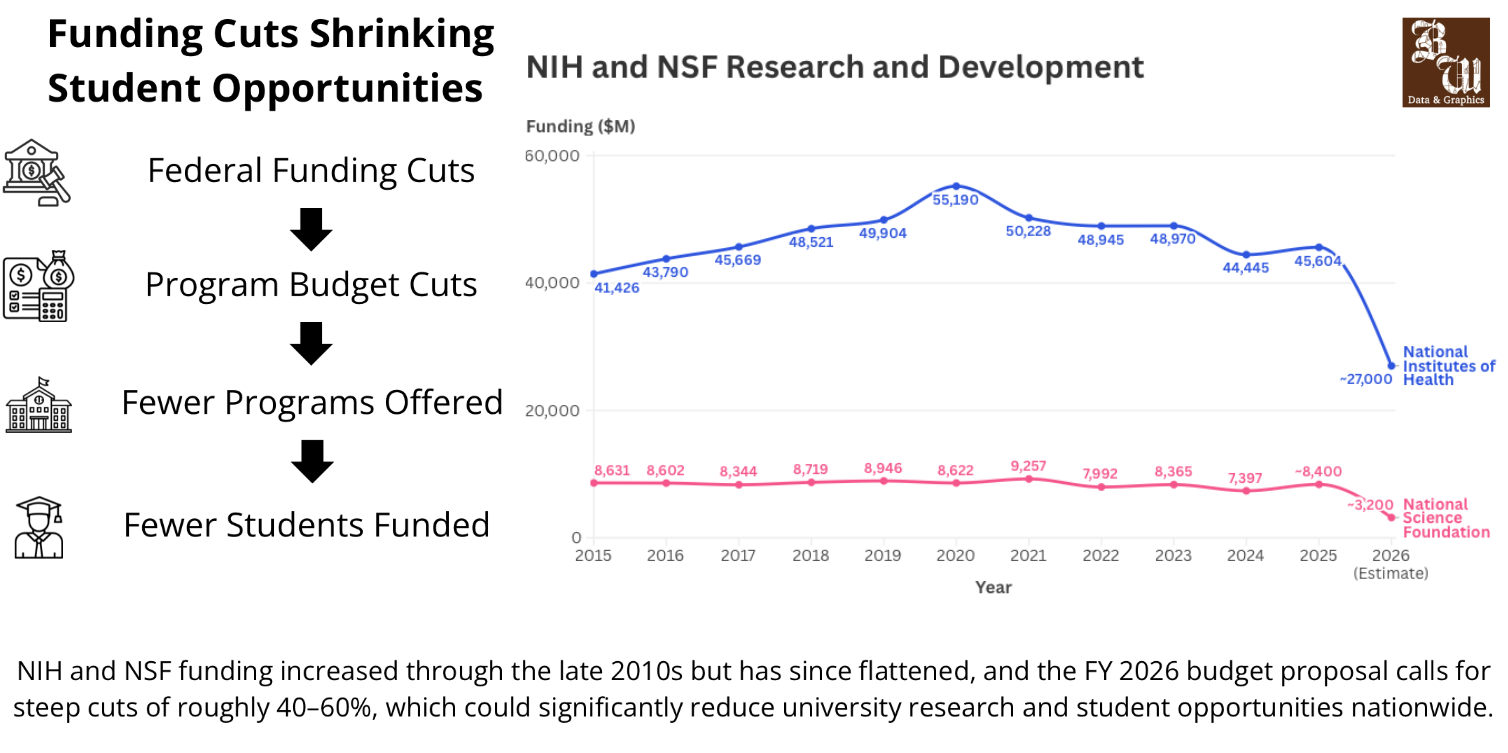
Federal funding cuts are affecting universities across the country and influencing the availability of student opportunities. When funding is delayed or reduced, universities nationwide may face budget constraints that impact programming.
Many of these programs rely on a combination of federal grants and university matching funds to support students and travel costs. Funding allocations are often determined on a multi-year basis, making programs sensitive to shifts in federal grant renewals.
At Lehigh, these changes are reflected in research, travel and experiential learning programs. Summer programs have already been affected, as funding levels help determine how many students can participate and whether programs continue.
Khanjan Mehta, vice provost for the Creative Inquiry program, said Lehigh’s Global Social Impact Fellowship, Summer Resource Opportunity Program and National Science Foundation programs could possibly be forced to reduce the number of students they accept and support.
The Global Social Impact Fellowship still supported about 115 students in fieldworld this year, but sustaining that level may be difficult. Mehta said that the uncertainty could discourage students from applying.
“While this year (Lehigh) was able to make things work, the more (funding cuts) prolong, it gets untenable,” he said. “We’ll see fewer students apply, and we will have fewer funds available to support them.”
Despite the uncertainty of the long-term picture, Mehta said these programs remain important for student development and encouraged students to continue applying, adding that students should still pursue these opportunities and work with program leaders to find ways to participate, with faculty committed to supporting them.
This impact extends beyond Lehigh. According to a report from the Center for American Progress, federal funding cuts have targeted more than 4,000 research grants worth up to $8.2 billion across over 600 colleges and universities.
Jessecae Marsh, associate dean for interdisciplinary programs, said a long-standing National Science Foundation-funded psychology summer research program at the University of Wisconsin-Madison was suspended this year due to financial uncertainty from nationwide funding cuts.
R. Michael Burger, associate dean for research and graduate programs, said the impact of federal funding cuts extends beyond individual programs and reflects broader changes in student research opportunities.
“Student research can be affected if laboratories and projects on campus have reduced or eliminated budgets,” Burger said. “It might limit opportunities for undergrads in the long run if research labs have less funding overall.”
Marsh said research positions, summer programs and fellowships provide applied learning, mentorship and professional connections that help students succeed after graduation.
She also said these lost opportunities can have lasting effects, particularly for students who rely on research experience to build their resumes and pursue future academic or career goals.
“There was a student who didn’t get to work in the lab,” Marsh said. “A possible future that could have existed was just pulled away.”
When funding is reduced, universities often scale back or eliminate entire research projects, which in turn reduces the number of available student positions. This reduction also increases competition for a smaller amount of research positions, making it more difficult for students to secure placements, said Marsh.
Burger said last year in the College of Arts and Sciences, four projects totaling more than $14 million per year in research expenditures were eliminated from a research portfolio.
While the budget cuts remain in place, Mehta said Lehigh faculty and administrators are working to ensure these opportunities remain accessible.
“These (programs) are often the most transformative experiences for our students,” Mehta said. “It helps them find their place in the world.”