
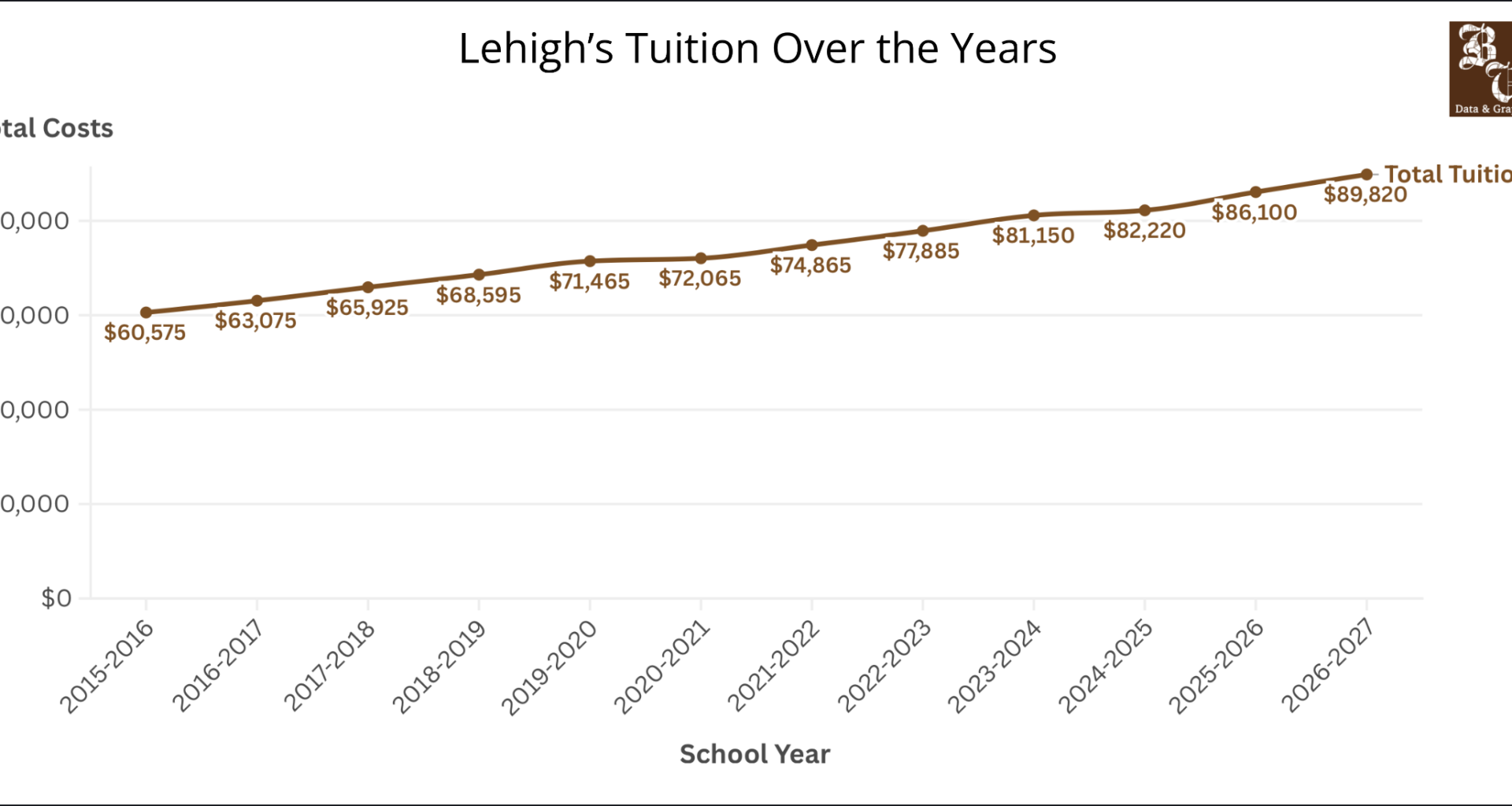
Lehigh approved a 4.5% tuition increase, aligning with broader national trends in higher education costs.
According to the Undergraduate Student Financial Aid website, financial need at Lehigh is calculated by subtracting a family’s expected contribution from the total cost of attendance, which includes tuition, housing, fees and estimated indirect expenses such as maintenance, facility costs, and extra living expenses.
Jennifer Mertz, assistant vice provost of financial services and director of financial aid, said the university’s need-based aid model adjusts with increases in cost. Families submit updated financial information each year, and aid packages are recalculated annually, which can change a student’s expected contribution depending on shifts in income or assets.
Mertz said if the cost of attendance rises while a family’s expected contribution remains unchanged, a student’s need-based aid would increase.
She said while tuition increases are announced in advance, their impact is often most noticeable later in the year. For families of admitted students, she said financial planning plays a central role in determining whether the university is a good fit.
While student loans are often viewed cautiously, Mertz said they’re commonly used as part of a long-term investment in education.
“(Lehigh) likes to say, ‘Is this a good financial fit?’” she said. “There’s a lot of focus on whether this is an academic fit or a social fit, but sometimes, it’s not a good financial fit.”
Josh Swavely, ‘26, said cost is a major factor for many students choosing whether to attend Lehigh and acknowledged inflation contributes to tuition increase. He said he would’ve considered a different school if finances were a concern for his family.
“Part of coming to Lehigh is realizing that you’re paying an exorbitant amount of money,” he said. “(Lehigh’s tuition increase) is justified in the sense that the value of a dollar decreases due to inflation, but it’s also unjustified because it’s greater than inflation. I expect maybe a 2% increase in tuition every year, and this one is larger.”
Mertz said rising tuition isn’t uncommon among private institutions, but it continues to shape how students and families evaluate affordability and long-term value. She said university officials said Lehigh’s tuition is comparable to similar private institutions, though students may experience the cost differently depending on their financial circumstances and expectations.
Alex Strauss, ‘26, said the recent increase has made tuition more prominent in his day-to-day thinking.
“The change in price has put (tuition) front and center into what I have to deal with,” Strauss said. “It means I have to confront how high tuition is now. At $60,000, the price for tuition was already a lot and prohibitive in a lot of ways. Now, the change has put it front and center.”
He said the increase has also raised questions about transparency and how funding is allocated and communicated.
Swavely said clearer communication would help students and families better understand the reasons behind rising costs.
“I don’t want to have to poke through back roads and documents and do research for a month or two to understand where (Lehigh’s tuition) goes,” Strauss said. “If (Lehigh) put out a report that said, ‘This is where it all goes, and why,’ that level of transparency would have a big effect on how students saw the increase. I wish the school was better about being honest with pricing, funding and where money was being sent.”
Strauss said he hopes revenue from the increase is used to improve existing resources, emphasizing that the university’s core identity comes from its professors, faculty and students rather than new buildings or infrastructure.