

Influential labor leader Ryan Boyer says he’s trying to bridge a bitter divide with the city’s teachers union over his support for charter schools and private school vouchers, although the union contests his description of the supposed outreach effort.
Boyer heads the Building & Construction Trades Council and was a crucial supporter of Mayor Cherelle Parker’s successful 2023 campaign. He discussed a wide range of topics during a Center City Business Association lunch last Thursday, including his career, his vision for the education system, and his hopes of seeing a new power plant built in South Philadelphia.
During a question-and-answer session, Boyer said he was planning to meet with the president of the Philadelphia Federation of Teachers to discuss his concerns about underperforming public schools.
“I’m gonna be very honest, they’re not a big fan of mine,” he said. “You know, I’m gonna meet with [president] Arthur Steinberg next week of the school teachers union. I’m a union guy, but if your product isn’t good, then I’m not going to support you. And right now, your neighborhood product, you wouldn’t send your child there. So why do you want me to send mine?”
Boyer subsequently explained that he was planning to meet with the union to discuss his advocacy for school choice, a term that typically encompasses charter schools and public funding for private education.
Most charter schools have non-unionized teachers. In addition, Republican demands that the state fund vouchers for families to pay private school tuition are staunchly opposed by teachers unions and most Democratic lawmakers, and have played a role in the current state budget impasse.
“I’ve been public [about supporting] school choice, and they don’t like school choice, and I could be persuaded not to support school choice, if the district-run schools will have some innovation and some change on their own,” Boyer told Billy Penn. “I actually prefer that more, because philosophically, I’m not for school choice, but I understand how desperate some people are to get their child educated.”
However, PFT spokesperson Jane Roh said no such meeting with the union’s leader has been scheduled.
“President Steinberg has repeatedly extended invitations to Mr. Boyer to discuss their differences one-on-one,” she wrote in an email. “While disappointed that Mr. Boyer has so far declined the hand the PFT has extended, President Steinberg remains open to opportunities to initiate a dialogue with Mr. Boyer directly (as opposed to through the press following business association functions).”
She also forwarded a link to a social media post she made in May. It shows a photo of public schools advocate Lisa Haver standing next to Boyer at a meeting and holding up a sign that reads, “Charter schools are non-union shops.” “Bless you,” Roh wrote in the post, and tagged Haver.
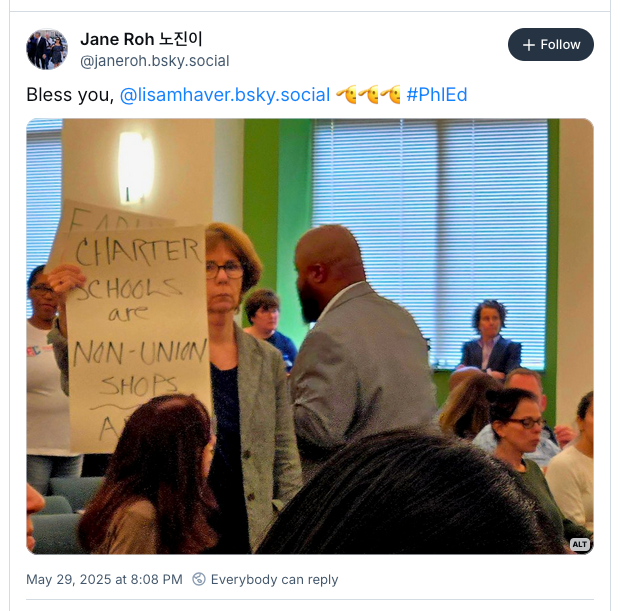 A post by Philadelphia Federation of Teachers spokesperson Jane Roh from May 2025. (Jane Roh/Bluesky)
Union vs. union
Boyer was interviewed by PR consultant Quincy Harris about his life and career, including his rise to leadership positions at Laborers Union Local 332 and the Laborers District Council. He discussed his advocacy for pro-business policies and economic growth in the city, and his efforts to create career paths for young people and improve educational opportunities.
He repeatedly criticized the public schools, saying they should be modernized and reoriented to provide training for jobs in construction and the trades, where he said there aren’t enough skilled workers to satisfy demand.
“My phone in 2025 looks a lot different than my phone looked in 1989 when I graduated high school, yet the classroom looks the same. It should not be that way,” he said in response to a question from Harris. “America is moving forward. The world is moving forward. We must educate differently.”
“We can’t sit [our children] in the room and say, OK, let’s just give the school districts more funding. Yes, they need funding. No question, they need funding, but they also need a different curriculum for this day and time,” he added.
Boyer praised his mother for fighting to get him into a special-admission public school in Philadelphia rather than his neighborhood school, and noted that he sent his own kids to schools outside the city. He recently lobbied for establishment of Early College Charter School, which will be the city’s first new charter in nearly a decade when it opens next year.
His positions have led him to ally with conservative critics of traditional public education, and illustrated long-standing splits in the broader labor movement between private-sector and public-sector unions.
In 2023, for example, a political action committee funded by the Laborers District Council contributed $25,000 to another PAC called the Coalition for Safety and Equitable Growth, the Inquirer reported.
The PAC was primarily funded by conservative megadonor and charter school advocate Jeffrey Yass, a leading bogeyman for the PFT and other teachers unions. It paid for ads opposing the campaigns of two progressive City Council candidates, Councilmember Kendra Brooks and pastor Nicolas O’Rourke of the Working Families Party, and mayoral candidate Helen Gym, who was heavily supported by teachers unions. (Brooks was subsequently reelected and O’Rourke also won his race.)
Members of Boyer’s union have also reportedly crossed picket lines, a major taboo among unions. During the strike in July by sanitation workers and other city employees with AFSCME District Council 33, some Laborers Union members did preparatory work for the city’s annual Wawa Welcome America concert, per the Inquirer.
Steinberg said at the time that scabbing — crossing a picket line — “is deplorable, traitorous conduct, and cannot be tolerated by organized labor for one second.”
Touting gas as a “bridge fuel”
Boyer spoke on a number of other topics, including rising regional demand for electricity and his hopes of seeing a new, gas-powered power plant built at the Bellwether District, an industrial campus being built on the site of the former South Philly oil refinery.
“The Bellwether District provides a great place where we could put some cogeneration plants,” he said, referring to facilities that produce both electricity and heat. “We have an amazing opportunity with PECO and PGW to make sure that we build energy resilience in the Bellwether District, maybe some down in the Navy Yard.”
“Those are things that I’m talking about to the CEO of [Bellwether developer HRP Group], the CEO of PGW and the CEO of PECO. Those are conversations that we’re having … We all want to go to renewables, but you need a bridge fuel to get to that. We think that natural gas may be the cleanest and safest alternative, or bridge fuel, while we get to wind and solar and renewables,” he said.
HRP Group and PGW declined to comment on the prospect of a power plant at the site or confirm that Boyer had spoken with their CEOs. PGW referred questions to HRP Group.
“While we are aware of public discussions regarding a potential cogeneration facility at the Bellwether District, we cannot comment on the plans of other parties involved,” PGW spokesperson Candice Womer said.
“We are committed to supporting solutions that help meet the evolving energy needs of our region, especially those that would enhance energy supply as demand continues to increase exponentially,” she said. “We are working with stakeholders on approaches that will help enable more generation to be added to the grid to further ensure reliability and to help address rising energy supply costs for customers.”
Any plan to build a power plant would likely face stiff opposition from environmentalists and others who point out that use of natural gas is a major contributor to climate change. It might also be fought by nearby residents who say they were harmed by decades of air pollution from the old refinery and have raised concerns about the site’s ongoing environmental impact.
The Bellwether District currently consists of two unoccupied warehouse-type buildings that could be used by logistics or e-commerce companies like Amazon, and HRP Group has said the site would also be appropriate for cold storage, large-scale manufacturing, and other non-residential uses.
California canned beverage manufacturer DrinkPak is considering building a 1.3 million-square-foot facility at Bellwether, the Philadelphia Business Journal reported last week. The firm, which works with companies that produce energy drinks, sodas, waters, hard seltzers and canned cocktails, has said it plans to open a new facility in the region in early 2027.