
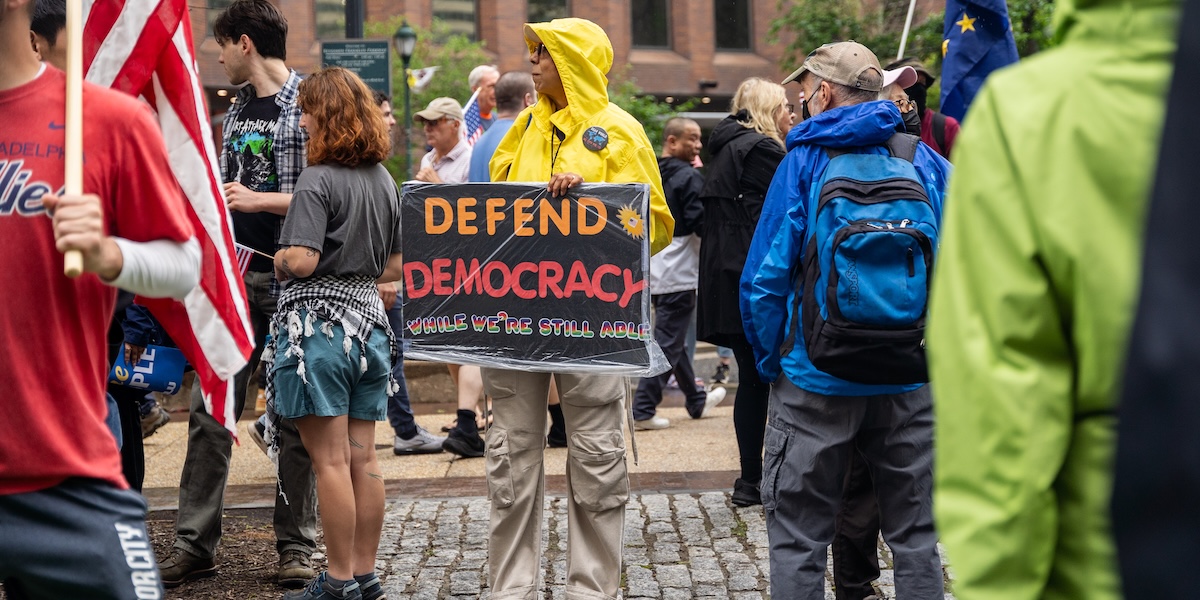
For more than a decade, free speech has dominated civic debate in the United States. We argue over who is being silenced and who is being amplified. We debate expression on college campuses, on social media, and in nearly every corner of public life.
Listen to the audio edition here:
But in the summer of 2026, as Philadelphia becomes a gathering place for the nation during the 250th anniversary of the Declaration of Independence, another freedom will be on full display: the freedom of assembly.
This anniversary will not be quiet. Millions of people will come to Philadelphia to commemorate, protest, perform, worship, celebrate, dissent, and persuade. Our streets, parks, museums, plazas, and public buildings will become more than backdrops. They will become stages for democracy itself.
That matters, because while speech has never been easier, assembly has never been more difficult.
Social media allows anyone to broadcast an opinion instantly and often to enormous audiences. Expression today is constant, immediate, and often solitary. Assembly asks something more of us. It requires people to leave their corners, enter shared space, and stand alongside others, including those with whom they disagree. It is slower, messier, and more demanding.
And yet people continue to show up.
Across the country and here in Philadelphia, citizens gather outside courthouses, at city halls, in school board meetings, and in the streets. What unites them is not ideology but presence, the insistence that institutions respond to those who appear in person. That would not surprise the Founders.
Democracy lives in shared spaces and in the sometimes difficult, always necessary work of being with one another.
The Declaration of Independence did not emerge from a solitary act of expression. It grew out of a culture of assembly. In colonial Philadelphia, town meetings, taverns, and halls were crowded with debate. Delegates gathered, argued, compromised, and chose to stand together. Independence was practiced before it was declared.
The First Amendment reflects that truth. It protects speech, yes, but it also protects “the right of the people peaceably to assemble.” We often speak about free speech as though it stands alone. It does not. Speech is personal. Assembly is collective. Speech gives voice to belief. Assembly tests whether we are willing to live with one another in the presence of disagreement.
That test feels especially urgent now.
Public gatherings are often treated first as problems to manage rather than civic acts to protect. Permits, barriers, and policing shape where and how people can appear together. At the same time, everyday civic spaces feel brittle. For some, showing up seems futile. For others, unsafe.
That is the paradox of this moment: There has never been more speech, and less practice at being together.
History is complicated and unfinished, but it is rooted in a simple democratic truth: Democracy requires presence.
The digital age has expanded expression, but it has narrowed our tolerance. Online, we curate our surroundings, mute opposing voices, and retreat into comfort. Speech becomes performance, while accountability fades.
Assembly offers no such distance. It requires proximity and patience. It reminds us that democracy is not an abstract idea or a spectator sport. It is a shared responsibility, lived in public.
Our history makes that plain. Labor rights, civil rights, religious liberty, and women’s rights were not secured through speech alone. They advanced because people gathered, organized, persisted, and accepted risk. They showed up not only to be heard, but to stand with one another in pursuit of change.
Philadelphia knows this well. From the Constitutional Convention to abolitionist meetings, labor marches, civil rights protests, and recent demonstrations, the city’s civic life has been defined by those who show up. Its history is complicated and unfinished, but it is rooted in a simple democratic truth: Democracy requires presence.
While speech has never been easier, assembly has never been more difficult.
That truth will be visible in the summer of 2026.
As the nation marks its 250th birthday, Philadelphia will not simply host ceremonies. It will host assemblies; some celebratory, others critical, many noisy, joyful, solemn, and uncomfortable. That is not a failure of the moment. It is evidence that democracy is still alive.
The American experiment was never meant to function through expression alone. It assumed that citizens would gather, argue face-to-face, and remain committed to one another despite disagreement.
We defend free speech passionately, and we should. Too often, we neglect free assembly as a practice. We celebrate expression while avoiding engagement. But too often we neglect free assembly as a democratic practice. We celebrate expression while avoiding engagement. We prize opinion while losing connection.
Speech gives voice to belief. Assembly tests whether we are willing to live with one another in the presence of disagreement.
Assembly does not require agreement. It requires coexistence.
So, as we approach America’s 250th birthday, this cannot just be a moment for speeches, reenactments, or social media posts. If we are going to truly honor this milestone, we should do what the founders understood so well: Show up.
Put the phone down. Step away from the comment section. Go to the protest. Go to the comedy show. Attend the lecture, the community meeting, the vigil, the performance. Stand in a crowd. Sit across from someone you disagree with. Speak. Listen. Respond. Be present.
Our founders did not imagine a democracy sustained at a distance. They understood that democracy lives in shared spaces and in the sometimes difficult, always necessary work of being with one another. They knew that presence creates accountability, that community requires patience, and that liberty depends not only on our right to speak, but on our willingness to gather.
As we mark 250 years of this ongoing American experiment, let us celebrate not just with words, but with assembly. Because democracy does not live in isolation. It lives wherever people choose to come together.
Dr. Alaine K. Arnott is the president and CEO of the National Liberty Museum in Philadelphia. She has more than two decades of for-profit and nonprofit leadership experience.
The Citizen welcomes guest commentary from community members who represent that it is their own work and their own opinion based on true facts that they know firsthand.
 MORE ON OUR FIRST AMENDMENT RIGHTS
People march in the street to protest President Trump during the ”No Kings Protest” in Philadelphia, Pennsylvania, United States, on June 14, 2025. (Photo by Nathan Morris/NurPhoto)