
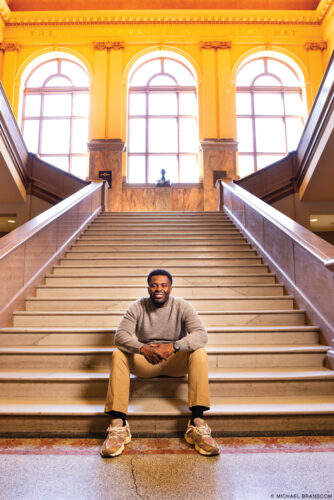
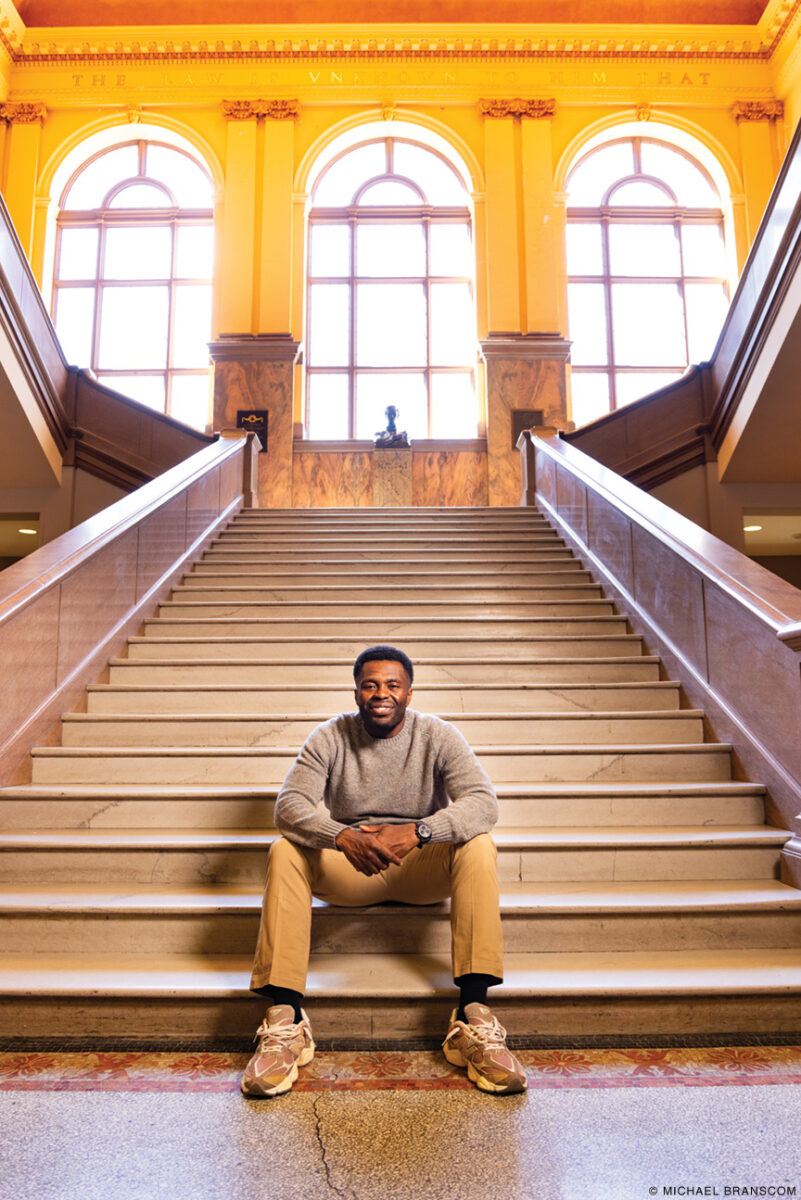
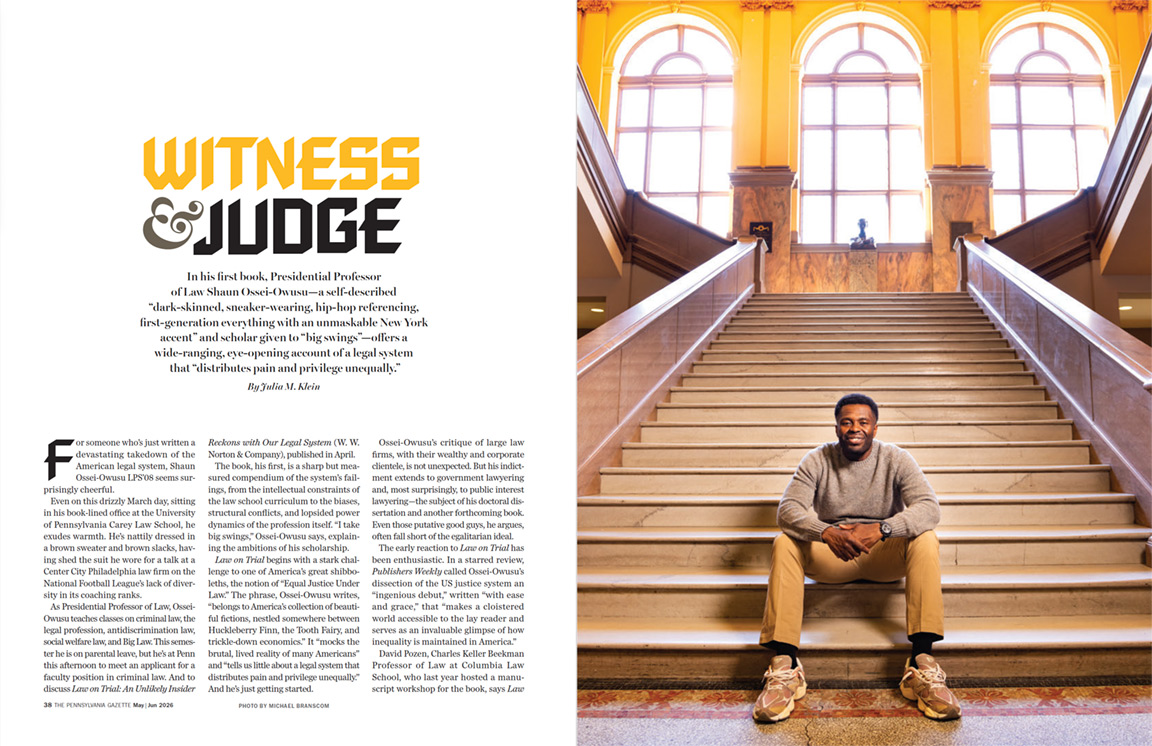
In his first book, Presidential Professor of Law Shaun Ossei-Owusu—a self-described “dark-skinned, sneaker-wearing, hip-hop referencing, first-generation everything with an unmaskable New York accent” and scholar given to “big swings”—offers a wide-ranging, eye-opening account of a legal system that “distributes pain and privilege unequally.”
By Julia M. Klein
Photography by Michael Branscom
 Download a PDF of this article
For someone who’s just written a devastating takedown of the American legal system, Shaun Ossei-Owusu LPS’08 seems surprisingly cheerful.
Even on this drizzly March day, sitting in his book-lined office at the University of Pennsylvania Carey Law School, he exudes warmth. He’s nattily dressed in a brown sweater and brown slacks, having shed the suit he wore for a talk at a Center City Philadelphia law firm on the National Football League’s lack of diversity in its coaching ranks.
As Presidential Professor of Law, Ossei-Owusu teaches classes on criminal law, the legal profession, antidiscrimination law, social welfare law, and Big Law. This semester he is on parental leave, but he’s at Penn this afternoon to meet an applicant for a faculty position in criminal law. And to discuss Law on Trial: An Unlikely Insider Reckons with Our Legal System (W. W. Norton & Company), published in April.
The book, his first, is a sharp but measured compendium of the system’s failings, from the intellectual constraints of the law school curriculum to the biases, structural conflicts, and lopsided power dynamics of the profession itself. “I take big swings,” Ossei-Owusu says, explaining the ambitions of his scholarship.
Law on Trial begins with a stark challenge to one of America’s great shibboleths, the notion of “Equal Justice Under Law.” The phrase, Ossei-Owusu writes, “belongs to America’s collection of beautiful fictions, nestled somewhere between Huckleberry Finn, the Tooth Fairy, and trickle-down economics.” It “mocks the brutal, lived reality of many Americans” and “tells us little about a legal system that distributes pain and privilege unequally.” And he’s just getting started.
Ossei-Owusu’s critique of large law firms, with their wealthy and corporate clientele, is not unexpected. But his indictment extends to government lawyering and, most surprisingly, to public interest lawyering—the subject of his doctoral dissertation and another forthcoming book. Even those putative good guys, he argues, often fall short of the egalitarian ideal.
The early reaction to Law on Trial has been enthusiastic. In a starred review, Publishers Weekly called Ossei-Owusu’s dissection of the US justice system an “ingenious debut,” written “with ease and grace,” that “makes a cloistered world accessible to the lay reader and serves as an invaluable glimpse of how inequality is maintained in America.”
David Pozen, Charles Keller Beekman Professor of Law at Columbia Law School, who last year hosted a manuscript workshop for the book, says Law on Trial is distinguished by its scope. While others have examined the intersections of inequality with specific fields of law, Pozen says, Ossei-Owusu offers a view, at once granular and expansive, of the whole system.
“Shaun has produced a genuinely eye-opening study of how inequality threads its way through legal pedagogy and the legal system,” Pozen says. “And one thing I found remarkable about the book is its panoramic quality. It moves from classrooms to courtrooms to board rooms, from environmental law to labor law, health law, civil rights law, criminal law, free speech law, and manages to maintain a coherent narrative and critical throughline even as it covers this remarkable breadth of topics.”
Laura Beth Nielsen, a professor of sociology at Northwestern University and research professor at the American Bar Foundation who studies law and social change, is another longtime admirer. “He learned to think like a lawyer, and then he applied that kind of analysis to the law itself,” making an argument of “big breadth and depth” that “most scholars would be hesitant to do,” she says. From Ossei-Owusu, she adds, “I expect nothing less.”
Law on Trial isn’t a memoir, but, on the advice of his early readers, Ossei-Owusu does tell some of his personal story in the introduction, “Notes from the Margins.” He describes himself this way: “I’m a dark-skinned, sneaker-wearing, hip-hop referencing, first-generation everything with an unmaskable New York accent. I look like a rapper. I have a pandemic afro that occasionally transforms into cornrows.” He is one of two Black men on the law school’s full-time faculty. Some of his students “stare in awe” when he explains constitutional provisions, he writes, and even some colleagues regard him “as though I’m a trapeze artist performing a daring stunt.”
Now 41, Ossei-Owusu grew up working-class in the South Bronx, the American son of Ghanaian immigrants—an outsider by any measure. He went on to earn a PhD and a JD from the University of California, Berkeley. Over the years, he has held fellowships or visiting professorships at the University of Chicago, Columbia, Princeton, and Harvard. But he has landed, happily, at Penn, a hub for legal history. This is the place he says he wants to be, where he completed a master’s degree in Urban Studies and Africana Studies almost two decades ago, and where Sophia Z. Lee, the law school’s dean, lauds him as “a prolific and wide-ranging scholar” characterized by his “infectious curiosity,” “interdisciplinary approach,” and “emphasis on impact.”
It has been a long journey from his roots to Penn and the Northwest Philadelphia home he shares with his partner, Jasmine,also an academic, and their two children, three-year-old Lucille and infant Clyde. But his withering critique of a hostile system notwithstanding, Ossei-Owusu seems to have enjoyed himself along the way.
Take law school, for instance. In the book, he argues that the required classes on contracts, torts, property, Constitutional law, and other subjects neglect the moral dimensions of law, the dark colonial underside of American history, and the Constitution’s own blind spots. Did sitting through those flawed classes at Berkeley make him angry?
Not at all! “Excellent place,” he says. “I love Berkeley. That law school is one of the best educational experiences I’ve ever had in my life.”
It is normal for aspiring legal scholars to pick up law firm experience; it’s a box to be checked. But surely his stint as an associate at the Washington, DC, office of Sidley Austin LLP, the epitome of Big Law, must have been something of an ordeal.
“I liked it!” he says, grinning. “I liked the people that I worked with. People were really nice. There’s a lot of horror stories of partners yelling at associates at certain firms, but I didn’t experience any of that. I had literally no microaggression during my time there. Some of the work was interesting. And let me be clear—it was a lot of money.” He laughs a little at the thought, knowing that he has left both Big Law and Big Money behind.
“I also knew that I was a person of ideas,” he says. That was his bent, his chosen trajectory, even if he wasn’t always certain where his intellectual passions would lead.
Hileen Tejeda, an educational consultant who has known Ossei-Owusu since they were teenagers, says her friend always brought an “intentionality” to both his work and his relationships. “He always had a clear vision of the kind of life that he wanted to have,” she says. “He’s probably one of the most laser-focused people I’ve ever met. Nothing that he did ever felt accidental.” That focus was not just on professional success, she suggests, but on securing “the freedom and credibility to be able to speak about issues that he cares about, and be able to advocate for communities like the ones that he grew up in.”
Ossei-Owusu’s father, who died in 2008, was a taxi driver. His mother, now retired, worked in the housekeeping department of the Waldorf Astoria Hotel. His parents had arrived in New York from Ghana in the 1970s, joining family and friends. “And they emphasized education like many immigrant parents,” he says. As he relates in the book, they never bought a home, devoting their savings instead to tuition at the Catholic schools he attended.
Their neighborhood of African and Caribbean immigrants, as well as African Americans, provided a sense of community. Ossei-Owusu grew up in a rent-controlled apartment abutting the Cross Bronx Expressway, on a block that was better than some. But he also notes that it was populated by “a gauntlet of halfway houses and drug rehabilitation programs.”
Tejeda, raised in the South Bronx by a single mother from the Dominican Republic, met Ossei-Owusu in a Fordham College–sponsored summer enrichment program before their sophomore year of high school. “Shaun would come and visit me at my house, sit in the living room, and practice his Spanish with my mom,” she recalls. Her mother still asks after him.
“He’s got a very magnetic personality,” Tejeda says. “He’s got this really big smile, really big laugh, and that really drew me to him. Whenever we get together, we talk about the serious things in the world, but there’s a lightness and a joy that comes with having conversations with him. One moment, he is talking about policy or law, and then the next minute he could be quoting a hip-hop cultural icon from the ’90s.
“That mix of intellectual curiosity and the cultural grounding is very much who he is,” she says. “He reminds me so deeply of home and what’s possible—that you can be a tenured professor at an elite university, and still very much be connected to the stories and the cultural aspects of our childhood and of our home, and be able to navigate both of those things so beautifully.”
Ossei-Owusu’s older brother, Larry Ossei-Mensah, has also done well—he’s an independent art curator and cultural critic who earned an MBA and cocurated the 2021 Athens Biennial. In the book’s acknowledgments, Ossei-Owusu credits him with the gifts of “tough love, street smarts, and the confidence to trust my instincts.”
His own childhood was a bookish one. He frequented libraries, and, when he was about 13, took the subway to the Barnes & Noble on East 86th Street, ensconcing himself in a chair and ploughing through R.L. Stine’s Goosebumps series—horror stories featuring young protagonists fending off supernatural creatures. He also remembers reading The Autobiography of Malcolm X.
A few years later, when he decided fiction wouldn’t directly benefit his career, he switched to ethnographies instead. “That’s how obsessed I was with learning,” he says. (He has since returned to reading novels and short stories; recent favorites arePercival Everett’s Jamesand Nana Kwame Adjei-Brenyah’s Friday Black.)
An academic star in high school, he turned to the U.S. News & World Report rankings of colleges and universities and decided to aim for one of the magazine’s “top 10.” When an admissions officer from one of those schools, Northwestern University, made an unexpected stop in the Bronx, he writes, “the school … and I discovered each other.” One attraction was Northwestern’s prestigious Medill School of Journalism, a career he was considering at the time.
Ossei-Owusu ended up majoring in the related field of Communication Studies, taking classes in persuasion, argumentation, public speaking, and rhetoric. He minored in African American Studies. That was how he met the sociologist Celeste Watkins-Hayes, now dean of the Gerald R. Ford School of Public Policy at the University of Michigan. She became one of his mentors.
“He understood that he would be responsible for crafting his own career,” Watkins-Hayes recalls. “He was very good at coming to talk about professional opportunities. He was often applying to summer programs and internships and all manner of things to figure out, given his intellectual curiosity, what would be the right fit.
“So I wrote a ton of letters of recommendation for Shaun. Because he was always applying to something. But it really showed how industrious and proactive he was in shaping his own path and his own future. He always did this with an awareness that there were other people who didn’t have the kinds of opportunities that he had,” she says. “When somebody has that kind of drive and initiative, you just get pulled into their orbit.”
Ossei-Owusu mentions two other mentors at Northwestern, also prominent Black academics: Dylan C. Penningroth, now a legal historian at Berkeley, and Dorothy E. Roberts, now a Penn Integrates Knowledge Professor and founding director of the Penn Program on Race, Science & Society. Both have won prestigious MacArthur Foundation Fellowships, the so-called genius awards. They “explained to me what an academic did,” Ossei-Owusu says. He remembered thinking: “This is consonant with the things that excite me.”
But he still wasn’t sure of his next step. Enrolling in the Master of Liberal Arts program at Penn was a test “to see if I felt intellectually engaged and capable of pursuing a PhD.” It worked. At the same time, he filled in as a substitute teacher for grades pre-K to 9th in Philadelphia’s Northern Liberties neighborhood. “It was one of the hardest things I’ve ever done. There were social work aspects to it,” he says. It was also “an opportunity to teach students who came from a background like me.”
In college, Ossei-Owusu had done an internship at Warner Bros. in Los Angeles. California, with its ethnic diversity, intrigued him, so he chose Berkeley for his doctoral work in African American Studies. After finishing his coursework, he applied for a fellowship to research his dissertation at the American Bar Foundation in Chicago.
There he would encounter Nielsen, who also has a PhD and JD from Berkeley. Nielsen remembers a call from one of her Berkeley mentors, Lauren Edelman, a professor of law and sociology who was one of Ossei-Owusu’s professors. “She said, ‘You’re going to really want to give this guy the fellowship,’” Nielsen recalls. “I think she introduced him to me at a conference, and then we read the materials, and, of course, she was correct. She knew genius when she saw it.” (Edelman, known for trailblazing scholarship on antidiscrimination law, died in 2023.)
Ossei-Owusu had been investigating 19th-century Black public interest lawyers, an original topic in its own right. But Nielsen and others at the American Bar Foundation encouraged him to broaden his focus to a more sweeping history of legal aid. (That was slated to become his first book, but internal problems and editorial turnover at Harvard University Press caused delays and scuttled that plan. Princeton University Press will publish the book next year under the working title Steps Toward Equality: A Multiracial History of Legal Organizing.)
As a PhD student at Berkeley, Ossei-Owusu already had taken four or five law classes, which made him realize he had more to learn. So, with his dissertation on its way to completion,he enrolled in law school.
None of this was easy. “I didn’t finish school until I was 31!” says Ossei-Owusu. “I had friends that went straight through college, went to law school, who were making money, and friends who went into investment banking—they were really making money. And [on his graduate fellowship], I’m making $27,000 a year.”
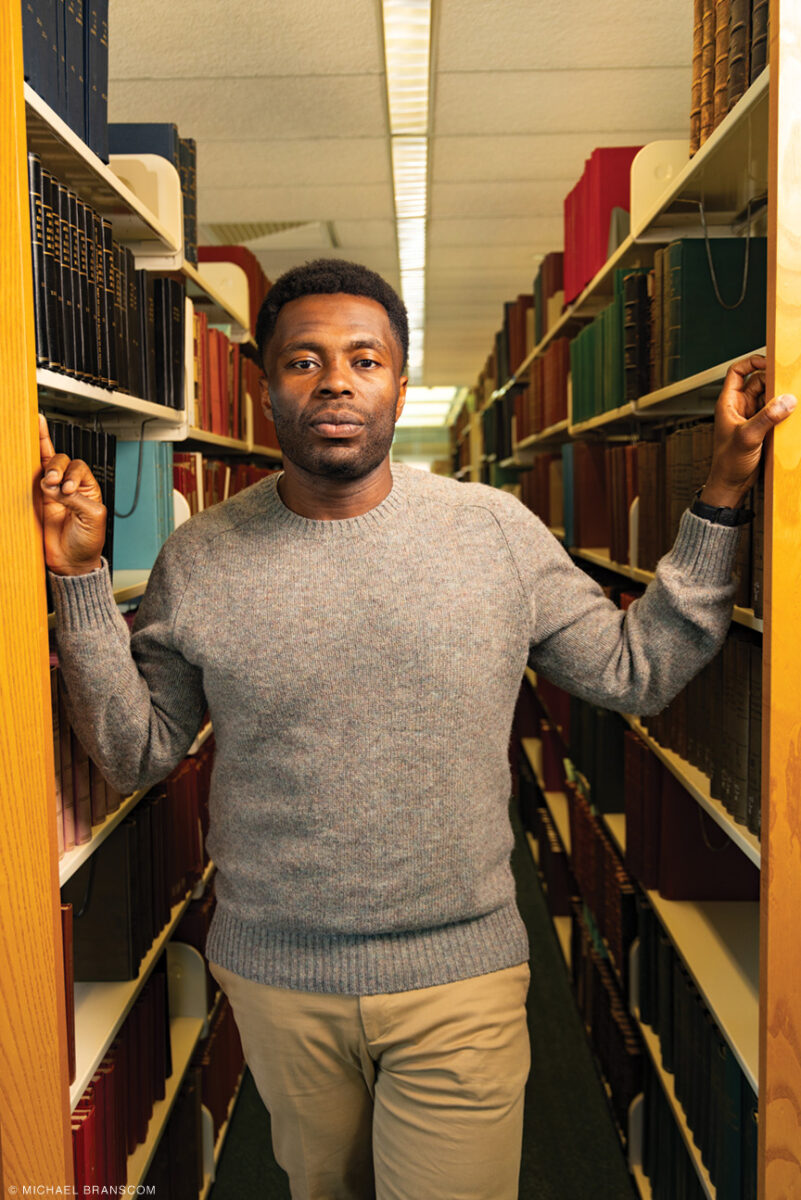 “Legal education and legal practice help develop an important skill. But it’s a skill
that sometimes requires divorcing law from human consequences.” Photo by Michael Branscom
In the book’s introduction, Ossei-Owusu credits his “magical code-switching capabilities” for allowing him to thrive in diverse environments. The remark is only mildly sardonic. “He is able to get along with pretty much everyone and navigate all kinds of different spaces,” Pozen says.
Ossei-Owusu calls himself “ideologically homeless,” someone who draws from a wide array of sources in both his research and his teaching. But it’s fair to say that his background informs everything that he does.
“Part of me was interested in better understanding the world around me,” he says. “That’s where the interest in sociology comes in, but also the interest in civil rights, social welfare, the welfare state, policing. These are things that I saw in the neighborhood that I grew up in, and things that I see as someone who walks through the city. Now, being a law professor, I’m just fascinated by the legal profession itself.”
He had hands-on experience. Along withhis corporate law stint, Ossei-Owusu put in time with various public interest groups: Bronx Defenders, a nonprofit offering legal services to low-income residents; Whitman-Walker Health in Washington, DC, a nonprofit community health center that also offered legal services; and the Legal Aid Society of the District of Columbia.
In 2016, he accepted a postgraduate fellowship at Columbia Law School. Olotunde C. Johnson, Jerome B. Sherman Professor of Law at Columbia, recalls that, as a fellow, “he would actively seek feedback on his work from a wide range of people. He brought the same dedication to teaching.
“He’s persistent and resilient in environments that may be very much unlike those environments that he grew up in,” she says. “He seems to have a fearlessness, a courage, which I appreciate.”
Over the years, Ossei-Owusu has published scholarly articles on the intersections of race and class with criminal law and constitutional protections, as well as on public interest law, health law reform, and discrimination in sports and public accommodations. One 2021 Virginia Law Review article, “Velvet Rope Discrimination,” discusses racial and gender preferences in admittance to nightclubs and restaurants.
Law on Trial seems to vacuum up all his experiences. It’s the book he says he would have wanted to read before he went to law school. And it’s also something of a nuts-and-bolts primer for nonlawyers that takes readers through each of law school’s required classes and then into various nooks and crannies of the legal system. It is, at its core, an analysis of “how legal professionals—the people entrusted with justice—become central actors in its betrayal.”
When he was in law school, he writes, he realized that “mastering legal doctrine sometimes required a numbness to human consequences.” The curriculum skips over issues such as language barriers, government misconduct, and housing insecurity, preventing law students from “deliberating about legally relevant injustices.” His own specialty of criminal law typically focuses on murder and sexual assault, and students “don’t see the assembly-line processing of poor people through plea bargains, the criminalization of mental illness, or the routine dehumanization of daily practice.”
In the book, Ossei-Owusu touches briefly on what he sees as the abuses of the current administration. “The president’s got lawyers running around like repo men, slapping executive orders on anything that moves too freely,” he writes. But, in his view, plenty of abuses already are built into the system at the county and municipal levels, where prosecutors exercise (biased) discretion and “a Black male body like mine is more likely to be processed by this system than to interrogate it.”
When it comes to Big Law, Ossei-Owusu challenges both the “cynical” and “romantic” views. Most of what these firms do, he says, “are not moral crimes.” As for the long hours, his parents (and many others) “performed harder, physically debilitating work for an iota of the pay.” But the romantic view, which regards elite lawyers as “stewards of democracy,” is too simplistic, he says. Facilitating potentially devastating hospital mergers and fighting environmental regulation, they “exist in professional ecosystems that reward technical competence while actively discouraging moral reflection.”
Public interest law is “closest to my moral commitments,” he writes, adding that “even the best-intentioned actors can reproduce the very hierarchies they are fighting against.” Inadequate funding for public defenders and restrictions on civil legal aid hamper just outcomes, he writes, and so does implicit bias. Some contemporary issues—involving, for instance, the clash of free speech with other rights—require making “a tragic choice” or “unsatisfying compromise.”
At first glance, Ossei-Owusu’s arguments are reminiscent of a left-wing movement called Critical Legal Studies, which emerged in the 1970s. That school of thought—and its offshoot, Critical Race Studies—rejects the notion that the law operates in a neutral fashion. It argues that the legal system enshrines the status quo at the expense of marginalized groups.
But he see his approach as “more pluralistic,” andmore influencedbyLaw and Society scholarship, which emphasizes the social context of law and “how law actually operates on the ground.” He tries to avoid political absolutism. “Law on the ground is messy and complicated,” he says. “The scholar in me tries to be pretty careful about the kinds of claims that I’m making.”
For all their shortcomings, he says, “legal education and legal practice really help develop a skill, a skill that is important. I don’t think it’s inherently bad. It’s a necessary skill. But it’s a skill that sometimes requires divorcing law from human consequences.”
And that lawyerly approach is the nub of the problem?
“Yes. Although it’s necessary. And that’s the challenge. That’s the subtlety of the book. It’s not just like, ‘Oh, these people are ignoring human consequences, and they don’t care.’ Some of the work of law requires disregarding some of that. That’s in part the structural challenge.”
He offers the example of municipal law departments, which serve as legal counsel for cities and towns. “They have to do what’s best for their client,” he says. “But what’s doing best for their client means that they have to defend the city in police brutality claims being brought by people who were actually abused by police officers, or ADA [Americans with Disabilities Act] claims brought by people with disabilities who are not provided access to public services.”
So, from the perspective of both lawyers and society, what is the solution?
“I don’t know that that there’s a solution per se,” he admits. But “being more intellectually honest about what’s happening” may be a good first step.
In its dissection of law school, Law on Trial seems to be crying out for curricular reform. But academic freedom is one obvious impediment. “My view is that each professor’s classroom is their own fiefdom,” Ossei-Owusu says. In his own criminal law classes, for instance, he references sociology and history and exposes students to diverse ideological sources, from conservative viewpoints to readings from abolitionists “who want to dismantle the carceral state.”
“I tell my students, ‘Your ideological priors might not shake out the way that you expect them to. There might be some instances where you believe in robust enforcement of criminal law. And there might be some instances where you don’t.’”
Public interest law has its own distinct challenges: overcoming insufficient funding, implicit biases, exhaustion, what Ossei-Owusu calls “repeated exposure to people at their worst in the criminal context or people in need in the civil context.”
Pozen sees Ossei-Owusu as an “enormously appealing narrator and figure,” but the book’s message as sobering. “He explains how law is a great demoralization engine, in two senses. He talks about how demoralizing it is for law students and young lawyers to be thrust into this hyper-demanding field, and the psychic cost it can impose,” Pozen says. “Really, his deeper theme is how law can obscure the moral stakes of questions. You come as a lawyer to lose sight of the first-order moral values of an issue as you navigate the system and try to help your client. That double sense in which law demoralizes was to me one of the great lessons of the book.”
Nielsen argues that Law on Trial has political implications. It speaks to the current moment by providing insight into the widespread discontent Americans feel about democratic institutions and processes. People are “being disaffected and disappointed by the state systems around justice, around equality,” she says, and Ossei-Owusu’s book is “an incredibly important diagnostic.”
After resisting writing a conclusion, Ossei-Owusu tries his best to end Law on Trial on a hopeful note, with a blueprint for action. For the general public, consumer boycotts, political pressure on prosecutors, increased funding for public interest law, and other efforts can lessen inequality. Lawyers can be more cognizant of the moral tradeoffs of their work and establish ethical deal breakers.
Change is, after all, possible. The system that once sanctioned slavery helped dismantle it, he notes. And it eventually secured women’s access to credit and employment, as well as disability rights. “The profession,” he observes, “produced me as well—not as a triumph of bootstrap meritocracy, but as a witness positioned to see the full spectrum of the legal system’s contradictions.”
Julia M. Klein, a frequent Gazette contributor, writes for the Atlantic, the Wall Street Journal, the Los Angeles Times, and other publications.
