
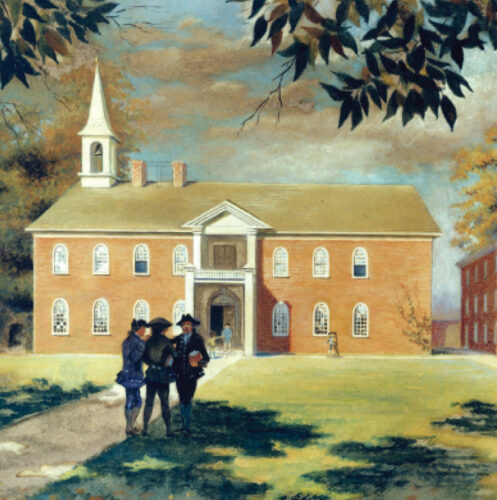
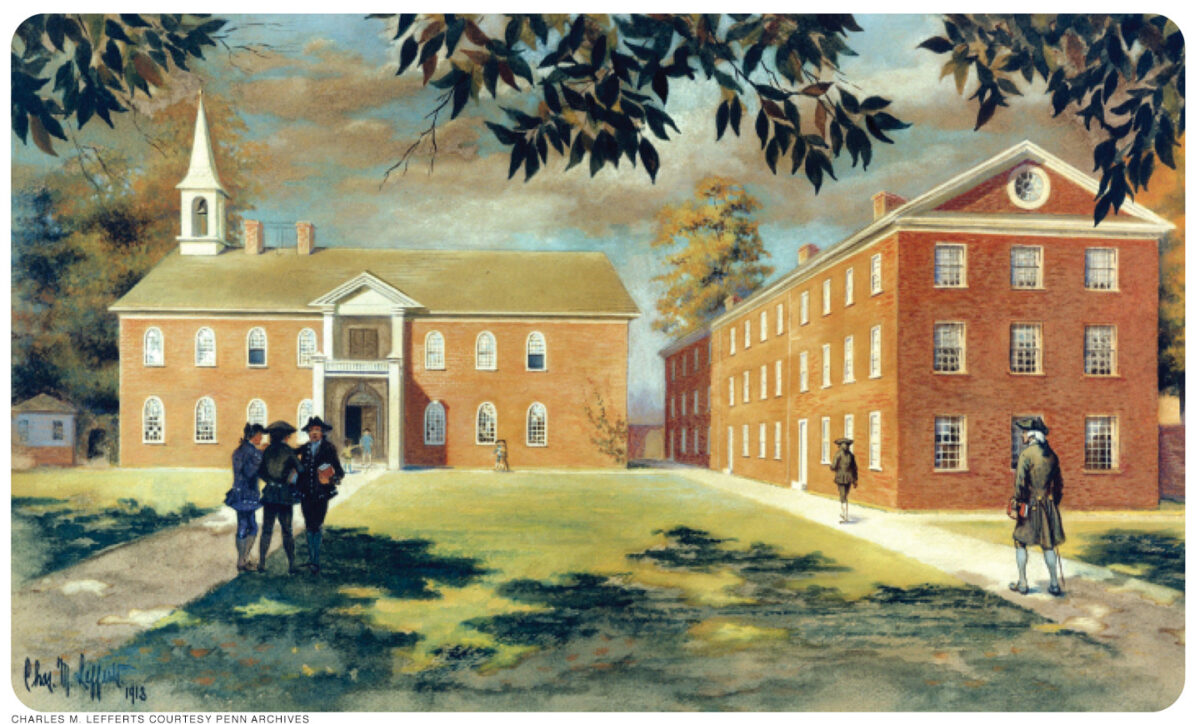
On July 4—250 years ago—the United States was officially founded through the adoption of the Declaration of Independence here in Philadelphia, in the shadow of Penn’s first campus. Over the following pages, the Gazette is spotlighting what happened at Penn (then the College of Philadelphia) during the American Revolution and to its Class of 1776 graduates; what the University is doing today to remember the Revolutionary era and the printing of the Declaration (as well as the country’s 200th birthday 50 years ago); and how one alumnus is leading this summer’s semiquincentennial celebrations in Philadelphia.
When Penn Was a State School | The Class of 1776 | Revolutionary Typography | Dissenting Voices | Party Planner
 Download a PDF of this article
As the capital-R Revolution raged across the colonies, a smaller one was happening inside Pennsylvania’s first college. It’s a little-known story—a chaotic time often glossed over in Penn’s lengthy history—but one worth knowing about ahead of the nation’s 250th birthday.
By Molly Petrilla
It’s 1775 in Philadelphia, a bustling and well-established city—the Northeast’s biggest, in fact.
Some 30,000 people live and work in what will later be called Old City. Walking its streets are rich men and poor ones, families and orphans, doctors and ministers and merchants, people of varied faiths and ethnicities. And at the center of it all, on the corner of 4th and Arch Streets, sits the College of Philadelphia: the colonial-era precursor to Penn, and the only college in the Province of Pennsylvania.
It’s also May, meaning it’s time for that college’s annual commencement. With change looming and battles already erupting, members of the Second Continental Congress—led by their president John Hancock, and with George Washington in their midst—join the commencement procession from Independence Hall to the College’s main building. They’ve come to the ceremony as guests, watching the Class of 1775 graduates alongside the usual audience of parents, professors, and provosts. In his speech, the college’s valedictorian mentions “our great American cause” and calls liberty “the choicest gift of heaven.”
Looking back on it today, “that moment was an ending and a beginning,” remarks John Pollack, curator of research services in the Kislak Center for Special Collections, Rare Books and Manuscripts. “It was a moment of civic unity that wouldn’t exist afterwards.”
That’s because, only a month later, the American Revolution escalated, and a year after that, on July 4, 1776, the Second Continental Congress approved the Declaration of Independence.
While Penn, Philadelphia, and the rest of the country plan to stage many events this year to celebrate the country’s milestone 250th birthday, the Revolutionary War era is largely forgotten in Penn’s history, according to Pollack. “People don’t know what happened during all these crazy years,” he says. “They just don’t.”
“It’s this weird, awkward period in Penn’s history,” notes J. M. Duffin, assistant university archivist, who together with Pollack curated the exhibition Revolution at Penn?, which was on display last year at Van Pelt Library’s Goldstein Family Gallery [“Old Penn,” May|Jun 2025]. “People want to gloss over it because it’s hard to explain.”
But in the mid-1770s, proto-Penn “was at the center of the city geographically and it was at the center politically,” Pollack says. And that starring role explains a quirky chapter in the University’s history, when it was taken over by the new revolutionary-led Pennsylvania government and entered a period of identity crisis and upheaval.
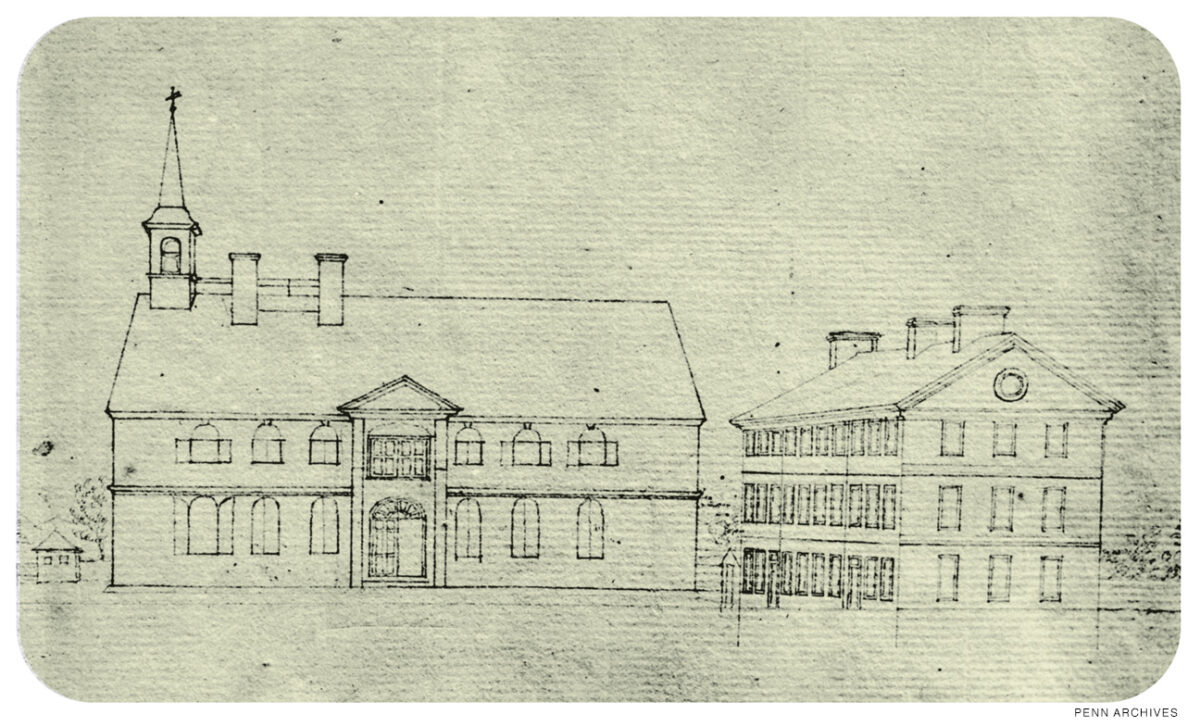 The College of Philadelphia’s Fourth Street campus in 1770.
After the Declaration was signed in 1776—including by nine men with Penn ties—there ensued a string of closings and reopenings at the College of Philadelphia. Classes were paused, resumed, and then paused again; Continental Army soldiers quartered at the school; and then British troops turned the campus into a military hospital upon occupying the city.
Meanwhile, Pennsylvania’s revolutionaries were hammering out a fresh state constitution, which obliterated the role of state governor and established a single-house legislature to be elected annually. James Cannon, a math professor at the College, was among the document’s main writers. “They went from the idea of having a King-in-Parliament and all these intermediary layers, to basically direct rule by the populace,” notes Duffin, calling it “one of the most radical constitutions of all the new states.”
In 1777, Pennsylvania began requiring all men over age 18 to take a loyalty oath before a Justice of the Peace, renouncing any allegiances to England’s King George III and promising their commitment to the Commonwealth of Pennsylvania. And there was more: “I will discover and make known,” the oath continued, “… all treasons and traitorous conspiracies which I now know or hereafter shall know to be formed against this or any of the United States of America.”
“The outcome of the war was uncertain, so the revolutionaries of Pennsylvania really hunkered down and started looking for spies and traitors,” Duffin says. A law required any suspected traitors to appear in court and defend themselves. If they didn’t, they’d officially be declared traitors and the state would seize their property. “That happened to a lot of people,” Duffin says, “and several trustees of the College of Philadelphia were among them.”
The College’s provost, an Anglican reverend originally from Scotland named William Smith, raised eyebrows too [“Dueling Quills: The Provost Smith Papers,” April 1997]. “The revolutionaries didn’t feel he was revolutionary enough, and so they were suspicious of him,” Duffin says.
It didn’t help that Smith hadn’t condemned the College’s Tory trustees, who’d already fled to Britain and British-occupied New York for safety and never returned. Nor that he’d put out a pamphlet back in 1755, slamming local Germans and calling for an oath of allegiance to the British crown.
“From the point of view of the revolutionaries, the entire board of trustees was guilty of being friendly to the British cause,” says Mark Frazier Lloyd, Penn’s University archivist emeritus. The revolutionaries also recognized the importance of their state’s only college—and because they considered it a hotbed of loyalism, “they felt they had to do something about the college,” Duffin says. “So they decided they wanted to take it over.”
So began this strange era in Penn’s history. In November 1779, Pennsylvania’s new state legislature passed “an act of dissolution” to alter the College’s charter and seize its property. “They kicked out all the old trustees, put in a whole new set, and got a new provost,” Duffin says. They replaced the Anglican Williams with a Presbyterian named John Ewing. They even changed the school’s name to the University of the State of Pennsylvania—the first state-controlled college in America.
To ensure diversity among its new trustees, the University’s revamped charter granted the “senior minister” of each church in Philadelphia a seat on the board: Lutheran, Presbyterian, Baptist, Anglican, Reformed, and Catholic—but not the Quakers, who had frustrated the revolutionaries by refusing to fight in the war.
“This was another example of how the revolutionaries were turning the college into something they felt would be more democratic,” Duffin says. “Religious identity in Pennsylvania at that time was very much intermingled with ethnic identity … so this was a way to ensure that these different ethnic groups were given representation on the board.”
“I think the revolutionary school tried to open itself up to more people, more students, more voices,” Pollack says, noting that it also began teaching in German—a sizable ethnic group in Philadelphia that Smith had once dismissed as “an uncultivated race.”
The school’s seal transformed, too: from a pile of books with Latin titles to an image of an orrery—a mechanical model of the solar system used to visualize planets and moons. It was a decidedly New World icon, Duffin says, and seemed to promote the revamped school as a mecca for modern science.
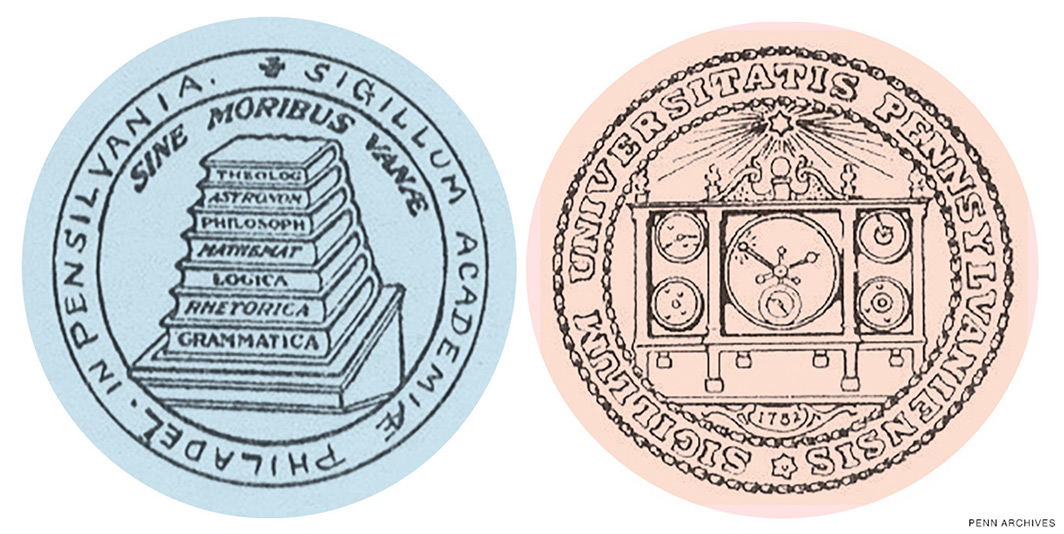
Provost Smith and the original College’s trustees, however, weren’t willing to step aside without a fight. They launched a 10-year legal battle, arguing that the state’s takeover had been unjust and illegal. And eventually, they won.
By 1789, “the same state legislature that had voted in 1779 to displace the old trustees voted to return all the property to them,” Lloyd says. “So the old trustees, led by William Smith, reconstituted themselves.”
The ruling didn’t dissolve the new University of the State of Pennsylvania. It simply returned all funds, land, and buildings back to the original College. The College of Philadelphia restarted with Smith back as provost; students were enrolled and the school began awarding degrees again. The state-controlled University moved down the street and continued operating, too.
“Both schools limped along,” says Lloyd, “but it was very apparent within two years that there weren’t enough students, tuition money, or qualified faculty to support two separate institutions.”
By then, the revolutionary fervor had faded and “the moderates finally got control of the situation,” Lloyd says. A new state law in 1791 plucked all 12 trustees from each school to form a single, unified, private institution: the University of Pennsylvania.
This state-run chapter in Penn’s history lasted only 12 years, Duffin notes, but it was “a very interesting example of what happens when key figures at the school become completely enmeshed in local politics.”
“Officials at universities today do not comment on political events,” he adds. “It was completely different in the 18th century. Provost Smith jumped right into Pennsylvania politics only a year or so after the College was created.”
But other issues from that time continue to reverberate today. Whether the government should control higher education “strikes me as a fundamental question that is being debated again now,” Pollack says.
Questions around who should run a school, who should be admitted to it, what those students should learn, and who decides whether practices are equitable and participants are sufficiently diverse linger, too. “These are old questions in American life,” Pollack notes. “The Revolutionary story at Penn suggests those were big questions then, too—and they’re never fully answered in education.”
Molly Petrilla C’06 writes frequently for the Gazette.
Seven young men graduated from Penn one month before the American colonies declared their independence.
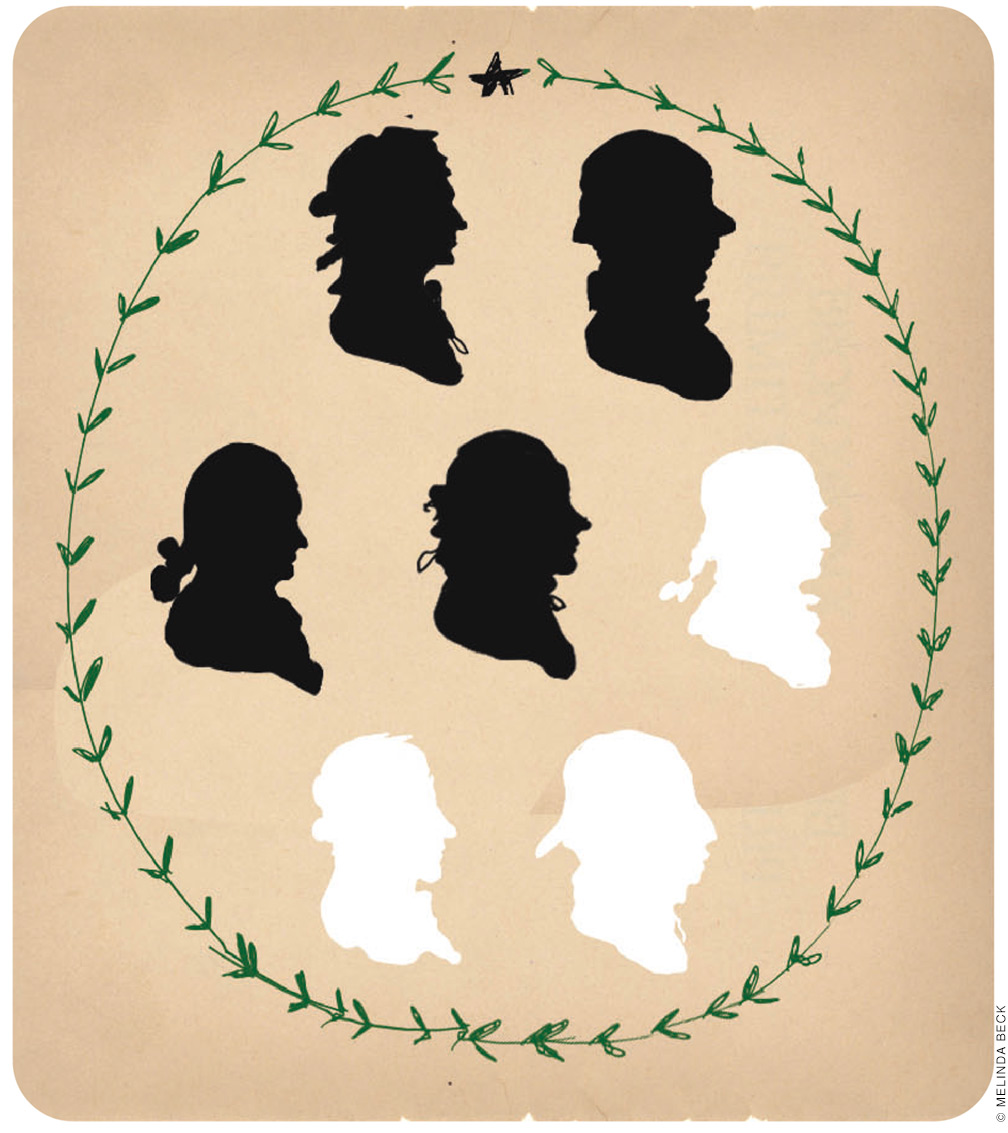 Illustration by Melinda Beck
In 1776, seven young men graduated from the College of Philadelphia, later the University of Pennsylvania, during an unprecedented time for the school founded by Benjamin Franklin. Several class members made their marks on American history, in sometimes unexpected ways. A few all but disappeared from history.
Members of the Class of 1776 earned Bachelor of Arts degrees at the College of Philadelphia amid escalating tensions between the American colonies and Great Britain. The future graduates began their studies close to when colonial rebels in Boston dumped shipments of tea into the harbor to protest mounting British taxes. By autumn 1774, the First Continental Congress convened to draft a list of colonial grievances for King George III and a plan to boycott British trade. This pivotal meeting took place at Carpenters’ Hall near Third and Chestnut Streets, just a few blocks away from the college campus. The following year saw several clashes between the Revolutionary and British armies both north and south of Philadelphia, including the Battle of Lexington and Concord in Massachusetts and the Battle of Great Bridge in Virginia.
The College of Philadelphia Board of Trustees responded by closing the June 10, 1776, commencement ceremony to the public, allowing only the graduating students, trustees, and faculty to attend. “The Commencement is ordered to be a private one, on account of the present unsettled State of public affairs, and the Candidates to be excused from the delivering [of] the public Exercises usual on such occasions,” the board’s May 23 meeting minutes reported with customary brevity. Unlike nearly every previous year—including in 1775 when the commencement was attended by members of the Continental Congress and featured a religious service, several lectures, and musical performances—the 1776 ceremony was a quiet affair.
Despite the war, 1776’s class of seven graduates was in line with the College of Philadelphia’s historically small number of graduates in the 18th century. The Class of 1760 had eight graduates, while the classes of 1770 and 1771 each had 14 and the Class of 1772 only two. “Bear in mind, at this time period, the idea of having a college degree wasn’t something that people sought,” says J. M. Duffin, Penn’s assistant university archivist. “It was an honor and a status symbol, but it wasn’t like today, where it’s something that you need for professional development.”
Unsurprisingly, the Class of 1776 came from privileged families and used their education to launch careers in the church, medicine, law, and politics.
Two 1776 graduates hailed from the Philadelphia area. Rev. James Abercrombie (1758–1841) was born in Philadelphia, the son of a Scottish sea captain, also named James Abercrombie, who went down with his ship on a voyage in the North Sea when his son was two years old. Abercrombie grew up on Second Street between Spruce and Locust Streets in a house still still known today as the Captain James Abercrombie House.
After graduation, Abercrombie abandoned his desire to study for the ministry due to an eye ailment. He became a merchant and city councilman but, after a doctor cured his eye injury, resumed his theological studies and was ordained. He served as assistant minister at St. Peter’s Church in Philadelphia from 1794 to 1832 and often officiated at other churches in the area. Abercrombie also cofounded Philadelphia Academy in 1800, later becoming the private school’s sole director.
The outspoken Abercrombie frequently used sermons to voice his opinions and didn’t shy away from targeting high-profile public figures. While preaching at Christ Church in Philadelphia, Abercrombie notably made a thinly veiled dig at President George Washington, who was in the congregation that day. In an oft-reported story, the minister chastised well-known people who skipped communion and left church after the sermon, citing the “unhappy tendency of those in elevated stations who invariably turned their backs upon the celebration of the Lord’s Supper.” Abercrombie didn’t call out anyone directly, but the president knew the minister was talking about him. Washington subsequently simply stopped attending church on Sundays when communion was offered, according to the book, The Faiths of the Founding Fathers by David L. Holmes.
Also born in Philadelphia was Thomas Duncan Smith (1760–1789), the second-eldest son of William Smith, the College of Philadelphia’s first provost. Smith followed in the academic footsteps of his older brother, 1775 graduate William Moore Smith. After his graduation in 1776, Thomas Duncan Smith studied medicine and set up his practice in Huntingdon, a town in central Pennsylvania founded by his father in 1767, according to a biography of the provost, Life and Correspondence of the Rev. William Smith, D.D. The younger Smith also served as a justice of the peace once the town became the capital of Huntingdon County. But he died young, at the age of 29, after suffering a severe fever. He is buried in Huntingdon.
John Clopton (1756–1816) left Virginia for Philadelphia to further his studies, but his heart remained in the Richmond area where he was born and died. Clopton first attended William and Mary College and then earned a degree at the College of Philadelphia before studying law. He served in the Revolutionary Army as a lieutenant and captain and was wounded at the Battle of Brandywine in 1777 under General Washington. Clopton refused all other promotions “because of his attachment to his company, which was composed of his relatives, friends, and humble dependents of his family, all belonging to the Parish of St. Peter’s, who were furnished with supplies and clothed by his father during the whole war,” according to the Penn Archives.
After the war ended, Clopton entered politics. He served as a member of the Virginia state house of delegates from 1789 to 1791. Clopton was elected as a Democratic Republican to the House of Representatives, serving multiple two-year terms from 1795 until his death in 1816.
Another graduate, John Leeds Bozman (1757–1823), was the son of a colonel, born in Oxford, Maryland. After earning a degree at the College of Philadelphia, Bozman traveled to London in 1784 to study law at the Middle Temple. Several years later, he returned to Maryland, was admitted to the bar, and began practicing law, according to the 1887 publication A Memoir of John Leeds Bozman, The First Historian of Maryland. He served as deputy attorney general of Maryland from 1787 to 1808. Bozman was also the first person from Maryland to chronicle the state’s history. His books include A Sketch of the History of Maryland During the Three First Years After Its Settlement (1811) and The History of Maryland: From Its First Settlement in 1633 to Its Restoration in 1660 (1837).
Penn’s remaining three 1776 graduates are a bit of a mystery due to the lack of documentation about their origins.
Ralph Wiltshire might have come from Barbados, based on clues pieced together by Duffin. A Ralph Wilshire was born in Barbados in 1757, the son of a doctor with the same name who died in 1770. A Ralph Wiltshire, presumably the son, married in Barbados in 1778. “I can’t be absolutely certain this is the same person, but it is not impossible since there were students from the Caribbean who attended the college and academy,” Duffin says.
Research-based presumptions are all that can be applied to graduate William Cocke, as well. Cocke is believed to be from Maryland and may have been the same man who became a Circuit Court judge in Tennessee and served as a US senator from Tennessee between 1796 and 1805, according to the Penn Archives.
Even less is known about the seventh graduate, William Thomas. “It’s primarily because we don’t know where he’s from. The only record we have of him is his name at graduation and his name in the tuition account books,” Duffin says. “Unfortunately, it’s a fairly common Welsh name. So it could be anyone.”
Nothing is known about how the members of the Class of 1776 interacted, their activities outside of classes, or if any kept in touch with each other. What is known is that the College of Philadelphia shut down at the end of the year when the Pennsylvania militia moved into the city. As the board of trustees’ December 1776 meeting minutes reported: “No Meeting, the Schools broke up, on Account of the public Alarms.” By the beginning of 1777, troops were camped out on school property.
No further graduation ceremonies were held until 1780.
—Samantha Drake CGS’06
Penn’s Common Press studio is shining a (candle)light on how the first edition of the Declaration of Independence was printed 250 years ago.
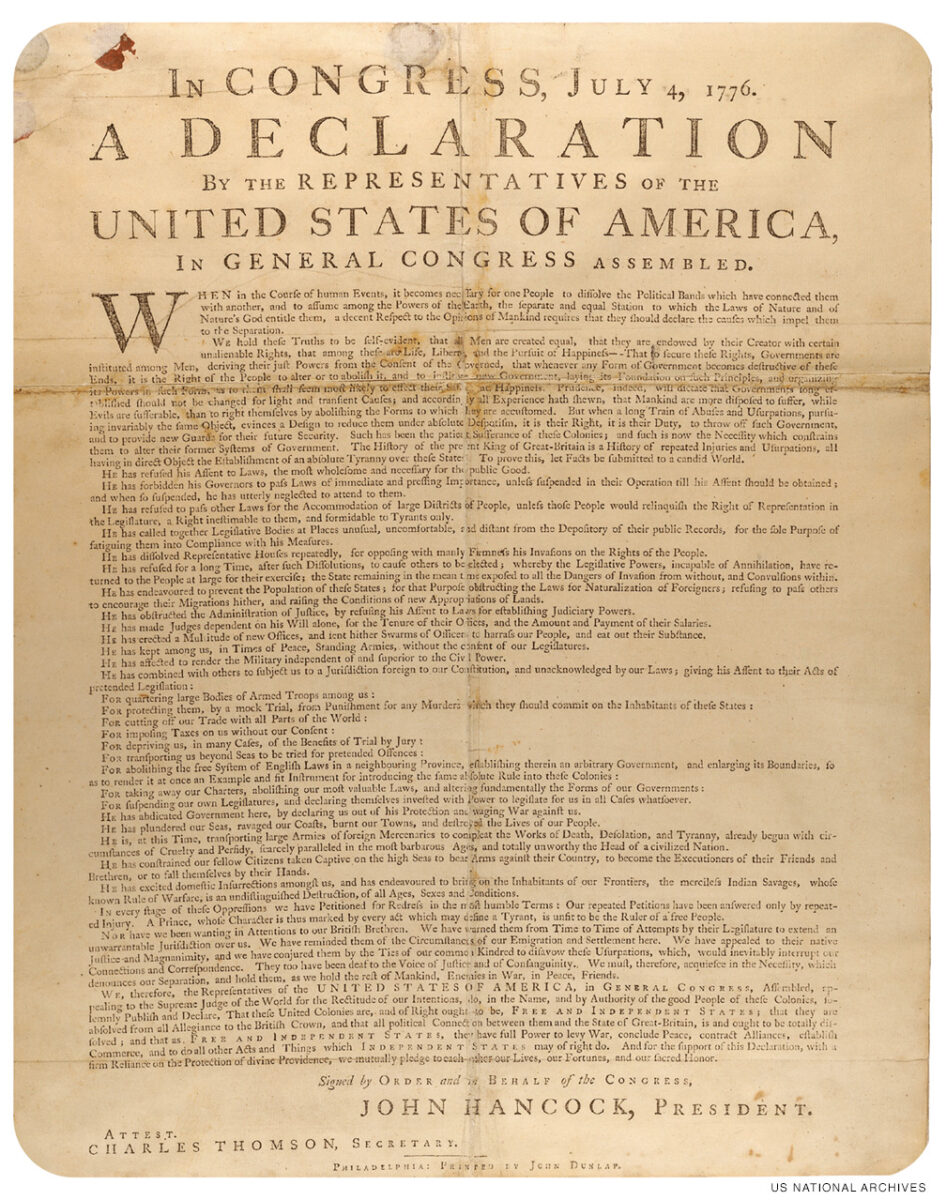
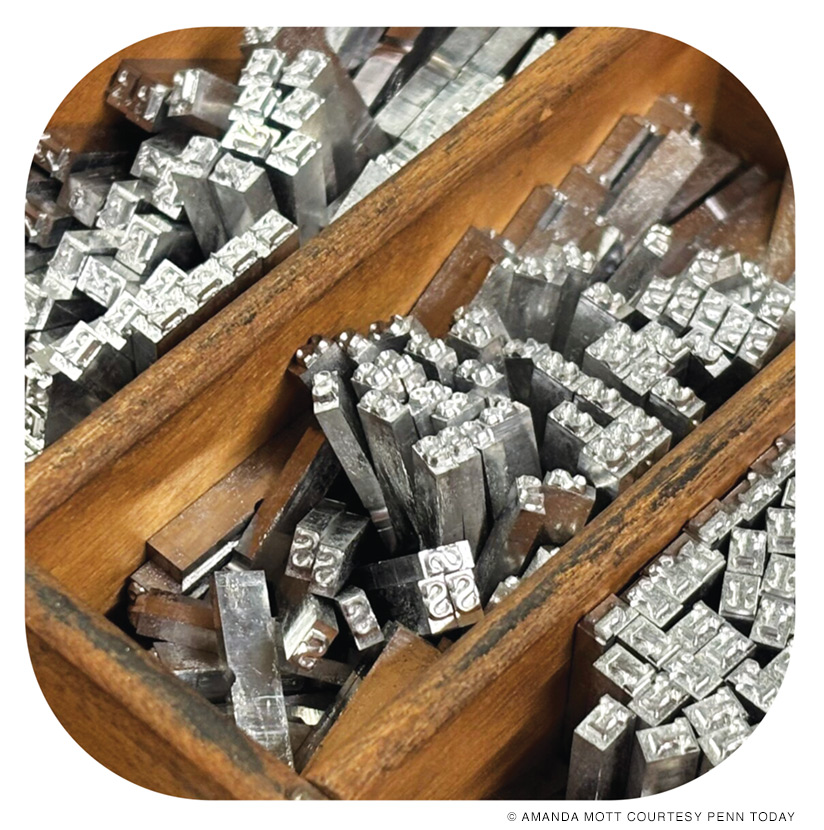 John Dunlap’s original 1776 printing of the Declaration of Independence will be replicated
by handsetting metal type (above) at Penn’s Common Press Studio. Broadside courtesy US National Archives; type photo by Amanda Mott courtesy Penn Today
Early in December, Jessica Peterson placed electric candles all around the Common Press studio and invited members of the Penn community to try their hand at 18th-century typesetting, as printer John Dunlap would have done the night of July 4, 1776, in creating the first edition of the Declaration of Independence.
“It ended up looking kind of like a romantic comedy set, instead of a revolutionary print shop,” recalls Peterson, Common Press’s manager. “People came in like, It’s so beautiful in here. And I was like, That’s not what we’re trying to go for.”
A more historically accurate representation of Dunlap’s working conditions in his Philadelphia print shop at Second and High (now Market) Streets would have included real candles—but open flames are not allowed inside the Fisher Fine Arts Library, where the Common Press sits tucked away in the historic building’s basement. Dedicated to “the scholarly exploration and creative practice in the history, craft, and material culture of printing and bookmaking,” the studio is in the midst of a yearlong program called “The Typography of Independence” during which it has been hosting events to mark the country’s 250th anniversary.
About two months after “Lighting in the Revolutionary Era,” Common Press held an interpretative typesetting workshop in which participants set lines of type from the original Declaration of Independence with the option to alter or omit words. And on May 14–15, it will host a 12-hour, two-day Alumni Weekend community typesetting event to handset metal type to create a historically accurate replica of the Declaration—which through the summer will remain available on the studio’s 1889 cast-iron handpress for anyone to visit and print a copy for themselves. (Peterson calls Common Press’s handpress a “very high-end model” of the wood one that Dunlap and his contemporaries used.)
Peterson—who came to Penn two years ago from New Orleans, where she had her own commercial printing shop—doesn’t have a background in history and was initially not all that interested in the Revolutionary era. But after being asked what the Common Press had planned for the US Semiquincentennial, “I started doing a little bit of research, and it was really fascinating that letterpress printing is a huge part of this history,” she says. “And no one really thinks about it or talks about it.”
She’s since come away with newfound empathy for Dunlap, who received the handwritten manuscript of the Declaration of Independence late in the afternoon on July 4, 1776, and had to work all night with his staff to complete what many refer to as the most important printing job in American history. Even for someone experienced in setting the tiny pieces of metal type upside down and backwards on a composing stick, doing it overnight was “I’m sure exhausting for your eyes,” Peterson says. In an era long predating the Edison bulb, it required trust that each letter was in the correct spot of the wooden case he was pulling it from. (During Common Press’s candlelight event, “it was virtually impossible to see what letters you were using,” Peterson notes, “and you really had to trust the map” showing the locations of different letters in the case. In the next event, participants had the benefit of electricity but still failed to set all the type in the 15 or so hours it took Dunlap to complete the job.)
Had Dunlap not been working under intense time constraints so that his shop could print hundreds of copies on the morning of July 5 to be immediately distributed throughout the colonies, Peterson postulates that he would have created something “with a lot more design consideration” than what became known as the Dunlap Broadside. “When you’re given a handwritten document, it’s really hard to figure out how long it’s going to be,” which could explain the very long line length across one single-wide column to fit in all 1,320 words on one poster-sized sheet.
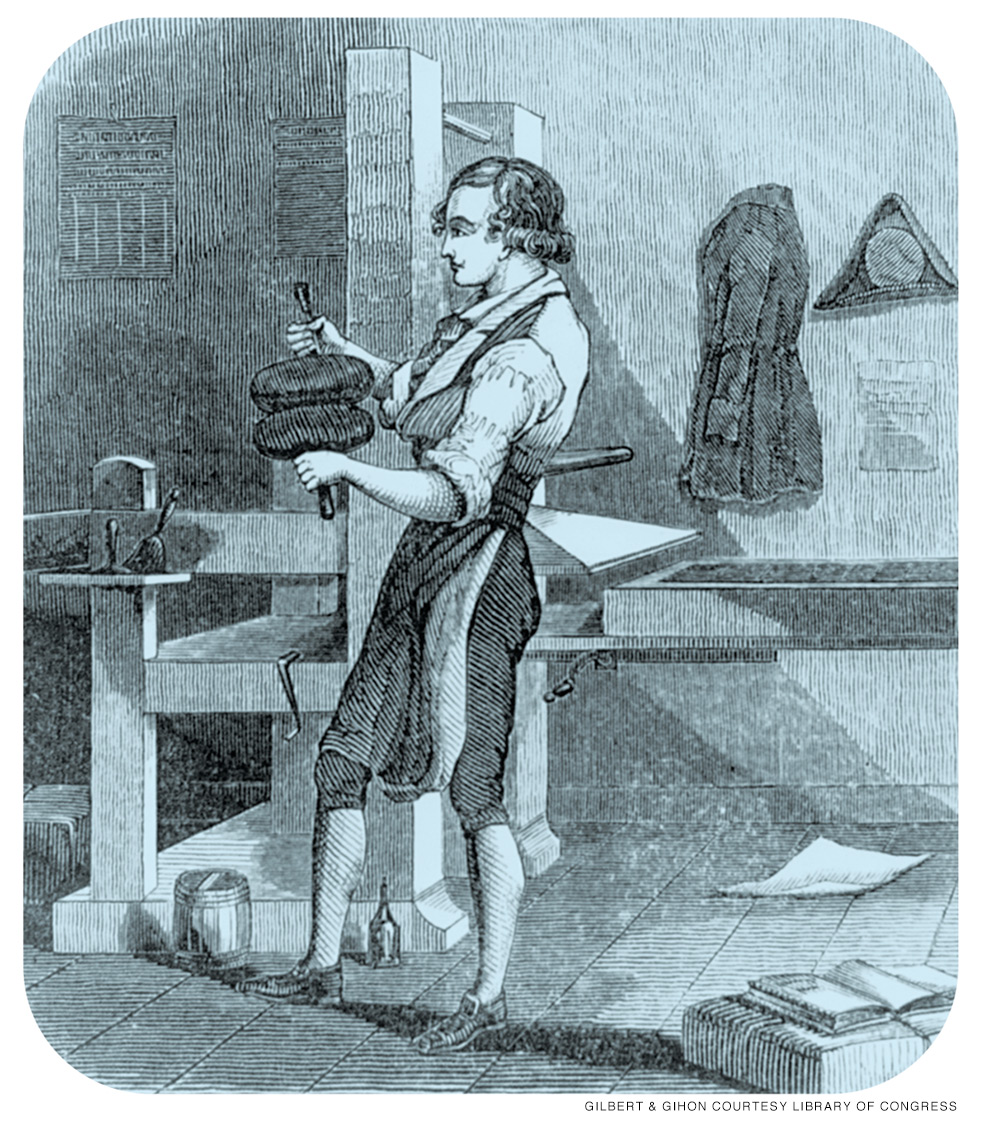 Benjamin Franklin, seen here as a young man working on the printing press, imported the Caslon typeface used in the Declaration of Independence.
Although there is no definitive record about who was inside Dunlap’s print shop the night of July 4, 1776, Peterson likes to imagine Thomas Jefferson and Benjamin Franklin making the short walk from the Pennsylvania State House (now Independence Hall) and hand-delivering the manuscript before Franklin decided to “hang out for a while, being like, I’ll help set the type.” (The acclaimed printer and original Pennsylvania Gazette publisher did import the Caslon typeface used in the Declaration from England.)
Dunlap’s original printing was the subject of a late January lecture, cohosted by the Common Press, featuring historian Emily Sneff, an expert on the history of the Declaration of Independence and a former fellow at Penn’s McNeil Center for Early American Studies. Sneff also examined “the messy work” that came afterwards: publishing more copies of the Declaration by other printers and newspapers and spreading the news of the colonies declaring their independence.
While broadsides like the one Dunlap printed were used for public readings at town squares or posted inside taverns, “every active newspaper in the United States included the Declaration of Independence,” beginning with Benjamin Towne’s Pennsylvania Evening Post on July 6. And Towne “starts this trend of taking away most of the capital letters in the Declaration of Independence” noted Sneff, adding that other newspaper editors subsequently made their own capitalization and punctuation choices. “So the text never looks the same from one copy to the next, even within the same city,” she said. “It makes for a really interesting project of tracing all of those changes.”
Although many printers and publishers made their own mark on the Declaration, not all were positive. Given the difficulty of typesetting, Dunlap made several minor errors in his original printing. So did Mary Katharine Goddard, a Baltimore printer whose January 1777 broadside, commissioned by the Continental Congress, was the first to include the names of all of the signatories and, according to Sneff, “transitions the Declaration of Independence from a piece of news that’s being published and communicated to people to the archival treasure that we think about today.” The discrepancies and missing words in those broadsides, however, pale in comparison to those in the Massachusetts Spy newspaper, which accidentally changed “be self-evident” to “us self-evident” and misspelled “states” as “sates,” among other glaring typos.
“They didn’t have the benefit of spell check in 1776,” said Sneff, adding that the poor quality of wartime paper, combined with iron gall ink eating away at the paper, led to “ink blotches and splotches and fingerprints” on many copies.
The lack of modern technology also slowed how quickly people around the world caught wind of the news. Although newspapers in the Northeast began printing the Declaration within a week of July 4, “it took about three weeks for it to reach the Carolinas, a full month for the Declaration to reach Georgia—in part because the news had to go over land rather than by sea, because of British naval activity along the East Coast at that time—and five weeks to reach London,” said Sneff, whose new book, When the Declaration of Independence Was News, covers the topics she spoke about in the lecture, including the timing, transmission, transcription, typesetting, and translation of the world-famous document.
Peterson has become a big fan of Sneff’s research and believes the discoveries of typos and changes in the text “is really fascinating because we view the Declaration now as this static document that’s always been the way it is.” She hopes alumni and other Penn community members will visit Common Press to experience the challenge of 18th-century typesetting firsthand and enjoy printing a replica Declaration of Independence to take home. —DZ
A Penn Libraries exhibit shows how Philadelphia—central to the nation’s Bicentennial celebration in 1976—was a magnet for protests as well.
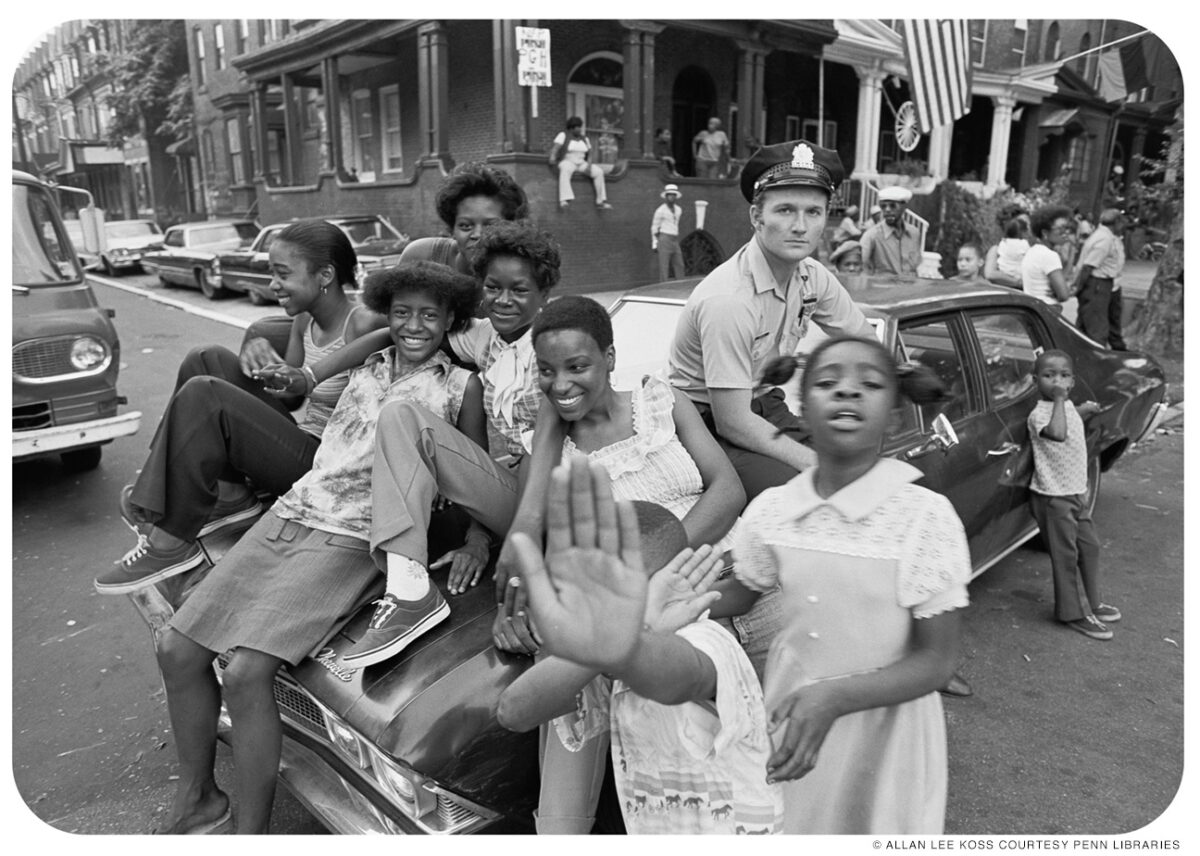
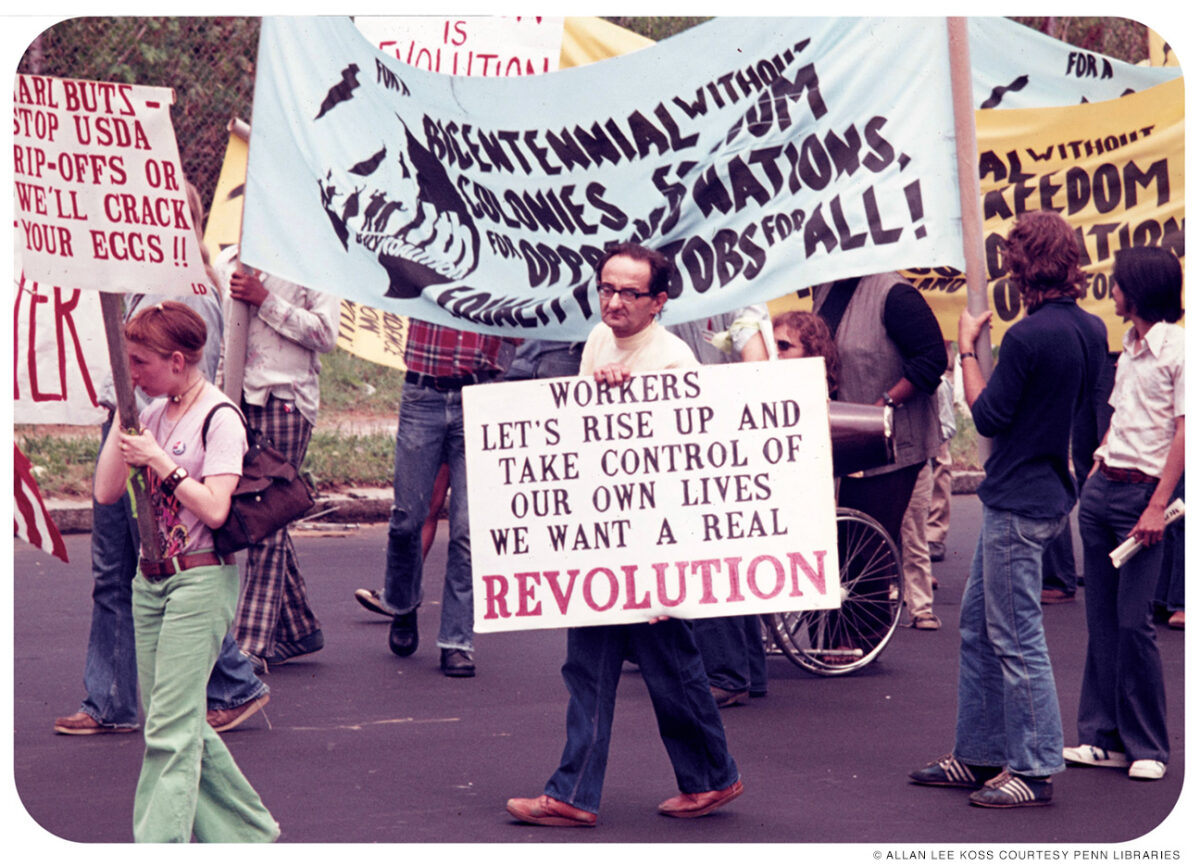 Allan Koss photographs of the Bicentennial Protest, Philadelphia, Pennsylvania, July 3–4, 1976.
“There’s so much collective memory about the Bicentennial, and Philadelphia was really at the center of the celebrations,” says Mitch Fraas, senior curator for special collections at the Kislak Center for Special Collections, Rare Books and Manuscripts. “And it seems like the most prevalent collective memory is of the sort of red, white, and blue—parades and the fireworks and the tall ships.”
But there’s another thread to the story, he adds, which is the subject of “Celebrate or Demonstrate? Philadelphia and Bicentennial Discontent,” a modest but provocative exhibition he curated that is on view in Van Pelt Library through Alumni Weekend. Fraas started gathering materials as far back as 2019, aided by bookseller David Anthem in particular, with an eye to this year’s 250th anniversary observance, thinking it was important to help “people understand that in that moment there were also voices of dissent,” he says. “And a lot of the sources are not canonical. They come from flyers or buttons or stickers and stuff like that.”
The materials displayed in a pair of glass cases on the library’s first floor represents about a tenth of the Kislak Center’s collection, Fraas says. Featured are posters made by the two main organized protest groups, the more broad-based July 4th Coalition and further left-leaning “Rich Off Our Backs,” which staged marches of more than 20,000 people in the city to counter the mainstream celebration at Independence Hall headlined by President Gerald Ford. Nearby are some blown-up photographs of marchers in Fairmount Park and along the route, taken by Chicago-based photographer and activist Allan Lee Koss, who traveled to Philadelphia for the protests, part of a collection recently acquired by the Penn Libraries.
Other highlights include materials from the People’s Bicentennial Commission—brainchild of Jeremy Rifkin W’67—which sought to counter the commercialization of the Bicentennial celebration, including a mock advertisement for “Tom Paine Cola” and “Revolutionary Toothpaste”; copies of the The Weekly Gayzette (“Gays Protest on July 4th,” “Dykes for an American Revolution”) and Majrity Report (“Women & the Bicentennial”); a sticker calling for “a Bicentennial Without Colonies” by the Puerto Rican Socialist Party; and a mimeographed typewritten flyer for “A Community Celebration of Struggle and Hope” at the Church of the Advocate at 18th and Diamond Streets in North Philadelphia.
The flyer “is just fascinating, because it’s the community worship service in parallel—opposition, you could say—to the official events,” says Fraas, both of which kicked off at 10:30 a.m. on July 4. “And it’s very much a patriotic celebration, but a different kind of patriotic activity … that’s still just as American as the Independence Hall celebration.”
As for protests around this year’s US Semiquincentennial, Fraas says he isn’t aware of the kind of long-range planning—the People’s Bicentennial Commission started up in the early 1970s—or the level of coordination represented by the July 4th Coalition, for example, which involved more than 100 groups around the country. The official celebration plans seem more diffuse as well.
“I wonder if there won’t be more spontaneous things in July that pop up as the event gets closer. That’s totally possible.” Collecting materials today would involve a lot of electronic media, he adds, “although you know, there are also people in the city with a big interest in street art, and stickering things and flyering things. That’s still very much alive.” —JP
Meet the Penn alum coordinating Philadelphia’s semiquincentennial investments and
celebrations.
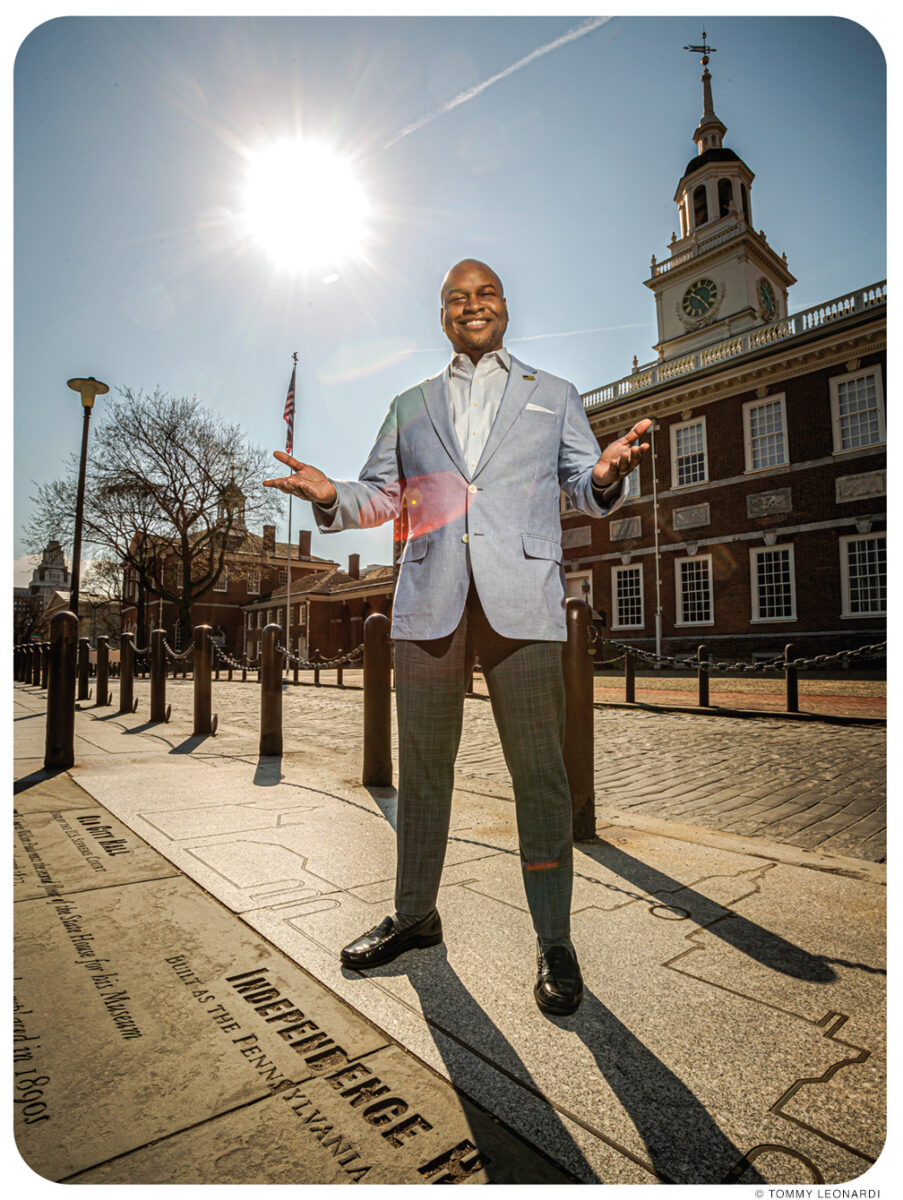 Photo by Tommy Leonardi
For Michael Newmuis LPS’21, being tasked to lead Philadelphia’s strategy for its semiquincentennial celebrations has been both rewarding and deeply personal.
“My fourth-great grandmother, Josephine, walked 20 miles toward freedom in 1863 with barely 40 cents and a dream,” Newmuis says. “Today, her descendant is leading America’s 250th birthday celebration in the city where that freedom was first promised. That is the American story—improbable, unfinished, and worth passing down.”
And the perks of the job have come unexpectedly since Philadelphia Mayor Cherelle Parker G’16 LPS’16 appointed him the city’s 2026 Director two years ago. “I had a terrific meeting with the Masonic Lodge and held in my hand letters handwritten by George Washington and Lafayette,” Newmuis recalls. “It was a day I will remember for the rest of my life.”
The city’s expansive efforts to commemorate the nation’s 250th birthday have taken Newmuis from the Masonic Lodge to Zoom meetings with White House officials to visits across the region with leaders in politics, business, and philanthropy. Among the events and projects he’s helping coordinate are:
• The city’s hosting of World Cup soccer games and the Major League Baseball All-Star Game this summer.
• Ring It On!—the city’s neighborhood investment program for the semiquincentennial, which will bestow $120 million on more than 60 community and cultural organizations, with a focus on neighborhood festivals and beautification projects. Ring It On! programming includes a citywide high school vocal competition, free weekly events celebrating Philadelphia-born innovations, 250 block parties with “Life, Liberty, and Happiness” themed kits, and 20 artist-designed Liberty Bell replicas displayed in various neighborhoods with a citywide treasure map.
• Infrastructure projects that include $500 million in airport modernization, set to be completed in time for the FIFA World Cup, as well as highway beautification along I-76 and improvements to the Market East corridor.
• The commissioning of three permanent public sculptures honoring historic Black women leaders, including Sadie Tanner Mossell Alexander Ed1918 G1919 Gr1921 L’27 Hon’74 [“Old Penn,” May|Jun 2021], whose statue by sculptor Vinnie Bagwell is expected to be unveiled across the street from City Hall in 2027.
• The opening of the First Bank of the United States, which had been closed to the public for roughly 50 years, as a museum on July 1—one day before a joint session of Congress convenes at Independence Hall, two days before a semiquincentennial parade is held, and three days before a time capsule will be buried at Independence National Historical Park on July 4 (engineered to survive 250 years underground and to be opened in 2276).
While working tirelessly to prepare Philadelphia for the spotlight this summer, Newmuis has emphasized the importance of working collaboratively and giving others credit. “It’s really about setting a grand vision, but then empowering folks to execute it,” he says. “And in this role when you’re setting a vision that’s citywide, across so many partners, both at the federal, state, local, and hyper-local community level, you need to be able to see where people are and really align their interests in a way that’s meaningful.”
Newmuis previously worked as head of impact at the global asset manager FS Investments and executive director of the FS Foundation. Before that, he was the chief external affairs officer and chief of staff at Visit Philadelphia, the region’s official tourism marketing agency, where he contributed to the successful execution of events including the 2017 NFL Draft, the 2016 Democratic National Convention, and Pope Francis’s first visit to the US in 2015.
During a recent speech, Parker praised Newmuis’s contributions to the city. “I watch people, I watch talent. I met him when he was at Visit Philadelphia, and I remember saying to myself, ‘I’m going to have to steal him and he’s going to work with me.’”
Newmuis says he took a significant pay cut to leave an $86 billion asset management firm to work for the City of Philadelphia, but he felt compelled to “be part of something so much bigger than myself” in large part because of the mayor. “She’s historic as the first Black woman to lead this city,” he says. “But for Philadelphia, the semiquincentennial is more than any one person. It’s the combination of imaginations from so many leaders that just needed to be coordinated in a more strategic way.”
Jonathan Burton, director of development for the Independence Historical Trust, the philanthropic partner to Independence National Historical Park, believes Newmuis “has a rare ability to bring the right people to the table and make everyone feel invested in the outcome. He understands that 2026 is not just about celebration, but about collaboration. Michael consistently uplifts organizations across Philadelphia and is deeply committed to ensuring the semiquincentennial reflects the full story of our city and is truly inclusive and welcoming for all.”
At Penn, Newmuis studied cognitive psychology. What drew him to the University and that program was “it’s really interdisciplinary,” he says, noting that he took courses across Penn’s schools. “And why I loved it so much is because when you think about cognitive science, it’s really about the ways in which we see the world and see each other and our place within it. It’s about judgments and decision making.
“I think that plays nicely through the current role that I’m in and, frankly, through some of my past roles in shaping the narrative of Philadelphia and getting people to see it.”
In his current role, Newmuis has been gratified to help deliver on key funding and partnerships—and hopes that the country’s 250th birthday party will “set a bold new narrative for not just our city but our nation.”
“Celebrations create moments; investments create change,” he says. “Philadelphia is pairing this milestone with real investment in neighborhoods, small businesses, and communities still striving for the American Dream, while bringing folks closer together. If 2026 inspires a new generation to live up to our founding ideals, Philadelphia will have done more than host a party—we will have reawakened the promise.”
—Jon Caroulis
Across several departments and spearheaded by Penn Libraries, the University will be commemorating
the nation’s 250th birthday through the rest of the year. Follow this link to see some of the events, exhibitions, performances, and other programming on tap: www.library.upenn.edu/america-250-penn/events-and-exhibits
