
In the early 1930s, as the country was sinking deeper into the Great Depression, Allentown’s General Harry C. Trexler, arguably the area’s wealthiest citizen, went seeking an elderly female friend who he was concerned about. On finding her he asked, “So tell me, how are bearing up under these hard times?” Her reply came swiftly. “Well, General,” she replied, “I always lived like it was hard times.”
Trexler was said to have later told this story to his friends. Pennsylvania Dutch frugality and hard work, it seemed to say, were virtues shared by the community. They would be the solution to whatever economic distress the town and the larger country was suffering from, if only they were followed.

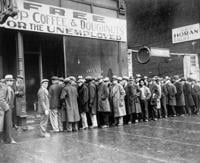
A soup kitchen in Chicago, 1931
National Archives at College Park
Trexler died tragically from injuries he received in an automobile accident shortly thereafter. So, he did not live to see how Allentown handled this national and worldwide economic catastrophe. But in the 1970s a young graduate student, Ernest B. Fricke, began research on how Allentown did during the Depression. What he found by digging into the files and microfilm rolls of the Morning Call piqued his interest.
Although a great deal of economic distress could be found in Allentown, as was the case in the rest of the country, the community, particularly the business leadership, was able to organize and limit the extent of its impact. It cooperated with federal government New Deal programs and local efforts.
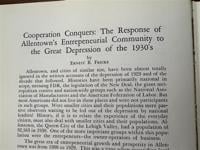
This information was gathered by Fricke in an academic dissertation, and a condensed version was included in the 1978 issue of the Lehigh County Historical Society’s Proceedings. This information comes from his research.
Lehigh County Historical Society
“The reduction of economic activity in the Lehigh Valley was massive,” says Fricke. From October 1929 to April 1933 factory workers were the hardest hit. By his personal testimony, this included William “Bud” Tamblyn, later Morning Call/ Evening Chronicle cartoonist, who was among those laid off from his $30 a week job at the Yeager Furniture Company on which he supported his widowed mother and sister. Construction workers’ wages were down 7.3% and retail sales registered a decline of 64.3%.
“Competition intensified,” Fricke writes. “It was every man for himself as extraordinary efforts were made to reduce costs by lowering inventories, wages, rents, taxes and the profits of suppliers. Frenzied efforts were made to expand sales and preserve markets and customer conveniences. Individual establishments faced economic catastrophe and fought to survive.”
At the same time, trade associations were formed for everything from bankers to plumbers in an attempt to lessen competition by lessening the number of entrants in the trade. “With methods such as these Allentown trade associations cooperated to limit or share costs and make more secure their economic position,” Fricke argues.
Banks were also organized into what became the Allentown Clearing House Association. Three banks, the Jordan State Bank, the Allentown Trust Company and Ridge Avenue Deposit and Trust Company, closed their doors.
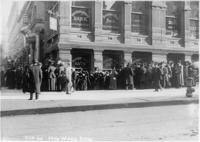
Run on 19th Ward Bank, New York
Library of Congress
The actions of the association led to mergers as a preventive measure worked out by the Allentown Clearing House Association. “By this prompt and decisive response,” writes Fricke, the association “stemmed the tide of bank closings in the city eight months prior to federal government action in March of 1933,” closing banks across the country.
“The most important of Allentown’s merchant alliances, the only one which intentionally served the general interests of the Allentown community, was the Chamber of Commerce,” Fricke writes. He found that through numerous groups the Chamber, by the leadership of downtown merchants, encouraged the city government to keep taxes low.
Fricke notes that this was of course in the merchants’ self-interest, but it led to general community involvement. He notes that rather than having the city pay for decorating the flowered lamp posts, the chamber established a committee that canvased the local merchants to directly pay for those in front of their places of business.
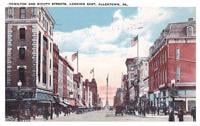
700 block of Hamilton Street looking east, Allentown, circa 1930
In May 1935 a trade association of the merchants featured an event that brought national attention to the city. Hamilton Street was closed and an auto show was put on with new and antique cars. When a sufficient crowd had gathered the stores would turn on their windows and show off their wares to attract buyers. National publications like American City and Readers Digest carried articles about it.
Christmas displays were also encouraged. The Chamber encouraged what it called “business recovery clinics” where merchants shared ideas. But perhaps the most significant action was a business recruitment campaign, selling the city to companies with growth potential who might be looking to move.
The number of plants in Allentown rose from 283 in 1930 to 308 in 1933, diminished to 257 in 1937 (which may have been due to the recession that year), and stood at 268 in 1940.
This occurred although 10 silk mills in the city moved to the South during the 1930s. By the decade’s end, Allentown had nearly as many plants as it had at its beginning and 3,410 more jobs.
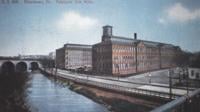
The Adelaide Silk Mill, Allentown, circa 1915
Pennsylvania State Archives
With the arrival of the New Deal the Chamber of Commerce and other organizations were willing to work with the National Recovery Act and its famous Blue Eagle insignia code.
Fricke goes on to detail the creation of Hanover Acres and other projects that mark the era both locally and nationally up to World War II when the war related industries brought the Great Depression to an end. He concludes that Allentown’s business community, in that time of economic crises, did its part.
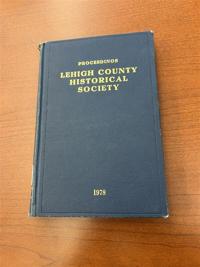
Lehigh County Historical Society
Fricke sums it up this way: “In the 1930s Allentown’s entrepreneurs, for whom the city was ‘home’ stayed and were active in raising the community out of the depths of the Depression. Collectively they worked hard to make good on the city’s booster slogan ‘Dwell Here and Prosper.’”