

The Pittsburgh Bureau of Police is investigating a local tech professional who allegedly used a LinkedIn alias for more than three months without disclosing it on his official sex offender registry page, a possible violation of Megan’s Law.
A Technical.ly investigation that began last December found that a LinkedIn profile under the name Mike Reilly appeared to be linked to registered sex offender Michael Riley, a local technologist and cofounder of the startup IS4.ai.
Key details on the social media account matched Riley’s sex offender registry and court records related to his 2020 criminal conviction, including education, employment history and profile photo, but the alias was not listed on Riley’s sex offender page.
Under Pennsylvania’s Megan’s Law, convicted sex offenders must keep their registry information current, including any names or aliases they use.
The law requires a new alias to be reported within three business days. Technical.ly’s reporting indicates Riley may have used the alias for more than three months before it appeared on his registry page.
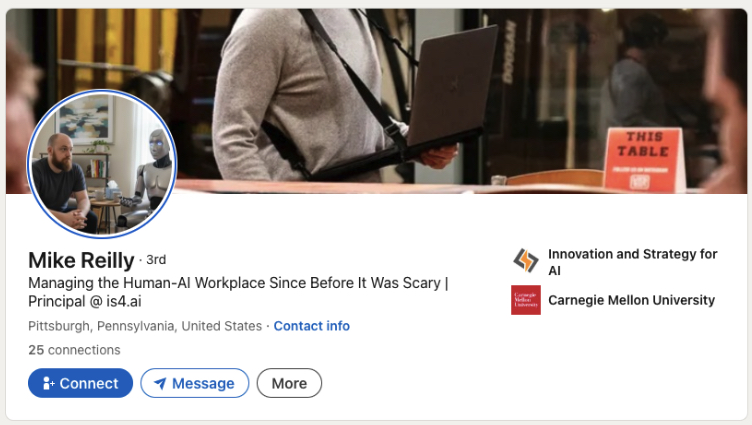
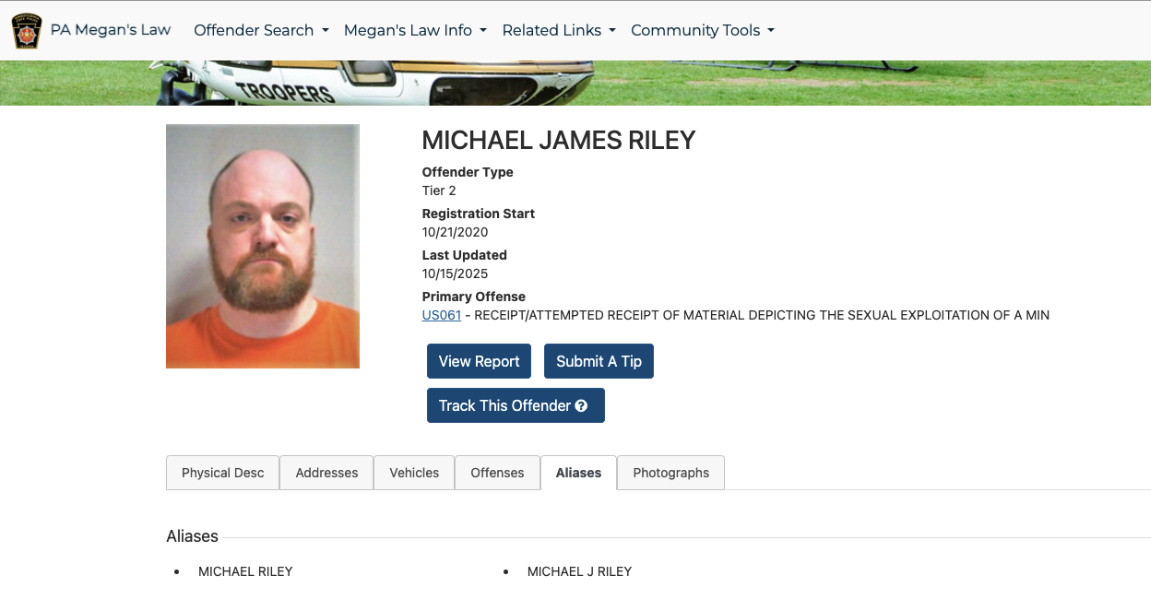
Left: The “Mike Reilly” LinkedIn account in January; Right: Riley’s sex offender page in January (Reilly is not a listed alias)
Technical.ly received an anonymous tip in late 2025, prompting the investigation.
After finding several key details matched between Riley and the LinkedIn account, Technical.ly submitted a tip to the PA Megan’s Law hotline and contacted the PA State Police, who confirmed a request for investigation had been forwarded to “the appropriate law enforcement agency.”
Before Riley’s registry page was updated, Technical.ly independently found that the work and education history in documents from his 2020 criminal court case aligned with the information on the “Reilly” LinkedIn profile. For example, both listed Carnegie Mellon University in 2004, NoWait in 2013 and Uber in 2015. Technical.ly also found that Riley was listed as CTO and cofounder on the IS4.ai website, while the LinkedIn profile identified “Reilly” as the company’s CTO.
Three of Riley’s former coworkers also confirmed to Technical.ly that the LinkedIn profile picture looked like the man they worked with at Uber before his 2020 criminal conviction.
The same day Technical.ly contacted Riley to ask whether he owned the LinkedIn account, the alias “Mike Reilly” was added to his sex offender registry page.
“In this case, it appears the alias was a self-report,” Chris Caracino, deputy communications director for the Pennsylvania State Police, told Technical.ly a few days after we’d reached out to Riley for comment. “The Pittsburgh City Police Department is handling the investigation into compliance with reporting requirements.”
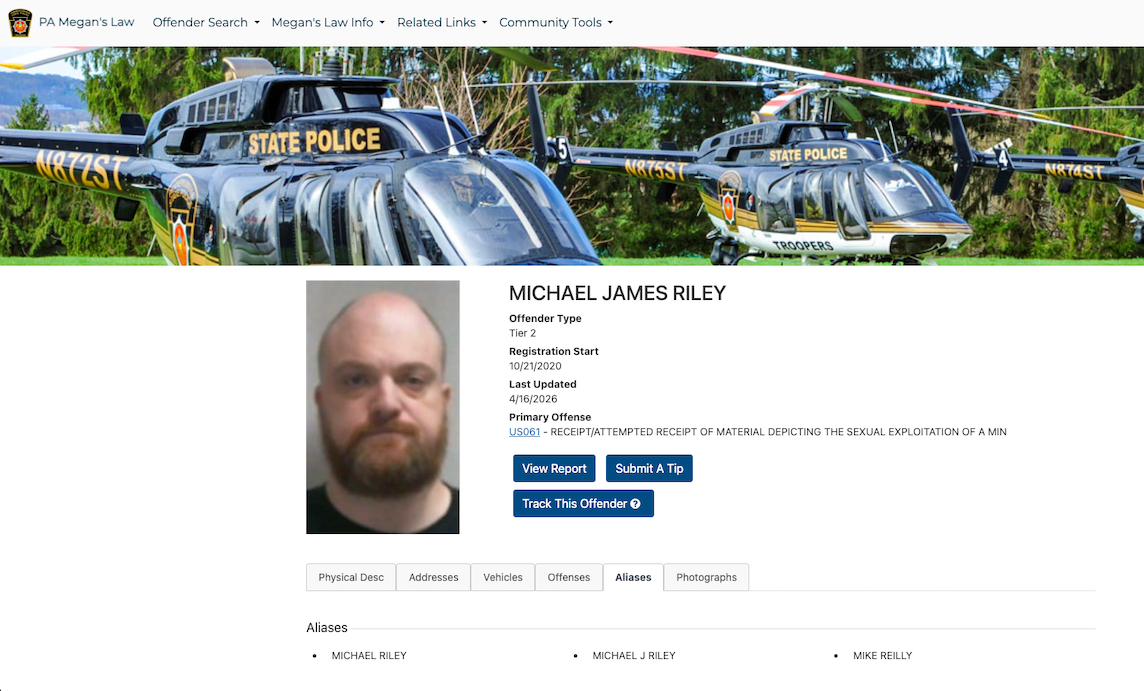 Riley’s current sex offender page list “Mike Reilly” as an alias, an update made on April 16, the same day Technical.ly reached out for comment (Screenshot/PA Megan’s Law)
Riley initially responded to Technical.ly’s request for comment, but did not reply to detailed questions. Neither Riley nor his cofounders at IS4.ai ultimately responded to questions about the LinkedIn alias, the investigation into possible violations of Megan’s Law, his jail time or other related circumstances.
Pennsylvania’s Unified Judicial System web portal, which lists criminal cases filed across the state’s courts, shows no new charges or criminal cases against Riley since his release from federal prison in January 2025.
Pittsburgh Police did not respond to Technical.ly request for comment on the status of its investigation.
Sentencing and time served
When a registered sex offender goes by more than one name, they are required to submit a list of official aliases for their Meghan’s Law profile within three business days per the Pennsylvania Crimes Code, PA State Police confirmed.
Prior to Technical.ly reaching out for comment, Riley’s sex offender page had not been updated since October 2025, according to the public listing.
In March 2020, Riley was charged with the receipt and attempted receipt of material depicting the sexual exploitation of a minor, or otherwise known as child sexual abuse material (CSAM).
In August of that year, Riley pled guilty to the charge.
Riley was required to report to prison in December 2020, according to court documents, and was no longer in Bureau of Prisons custody as of January 2025, according to the federal inmate locator.
Engineer, startup therapist and founder
According to court documents, Riley received and attempted to receive CSAM videos from roughly January to March 2020. At the time, Riley was working as a software engineer for Uber, and one of the devices seized during an FBI investigation was an employer-issued laptop.
A forensic review of that laptop found 20 videos of CSAM on the device stored under the computer user name M Riley, court documents show.
Former Uber coworkers who confirmed the LinkedIn profile matched the engineer they worked with said nothing about his behavior suggested the criminal case that followed — though they described working with him as difficult and at times extraordinarily frustrating.
“He didn’t really take a whole lot of interest in what was going on on our team,” former Uber coworker Gopi Flaherty told Technical.ly, recalling a time when Riley was his manager in 2019.
 Listed cofounders on Is4.ai’s website include Riley (Screenshot/Is4.ai)
“We had a culture around freedom of movement, but above that, there were times where he seemed especially aloof,” said Jeff Warner, an Uber employee from 2017 to October 2019, who worked on Riley’s team for over a year.
Riley was generally a hands-off manager, another former Uber coworker, Ilya Belopolsky, said, but recalled his behavior shifting in the years leading up to the FBI investigation, describing him as becoming “pretty aggressive.”
“He was always on his computer,” Belopolsky added. “It was unclear, in fact, what he was doing all the time at work.”
Following the 2020 FBI investigation into the CSAM on Riley’s work computer, Uber terminated his employment, per court documents.
Uber did not respond to Technical.ly’s request for comment on Riley’s employment and termination. Riley also did not respond to questions about his conduct at Uber or termination.
Starting with his release from prison in 2025, Riley is required to serve seven years of supervised release. A standard condition of that release is complying with Megan’s Law and working at least 30-hours per week.
“Mr. Riley is hopeful that his computer skills will be useful upon his release from incarceration,” Riley’s lawyers wrote in a memorandum shortly before his sentencing, “and that he will be permitted to use them for future employment.”