
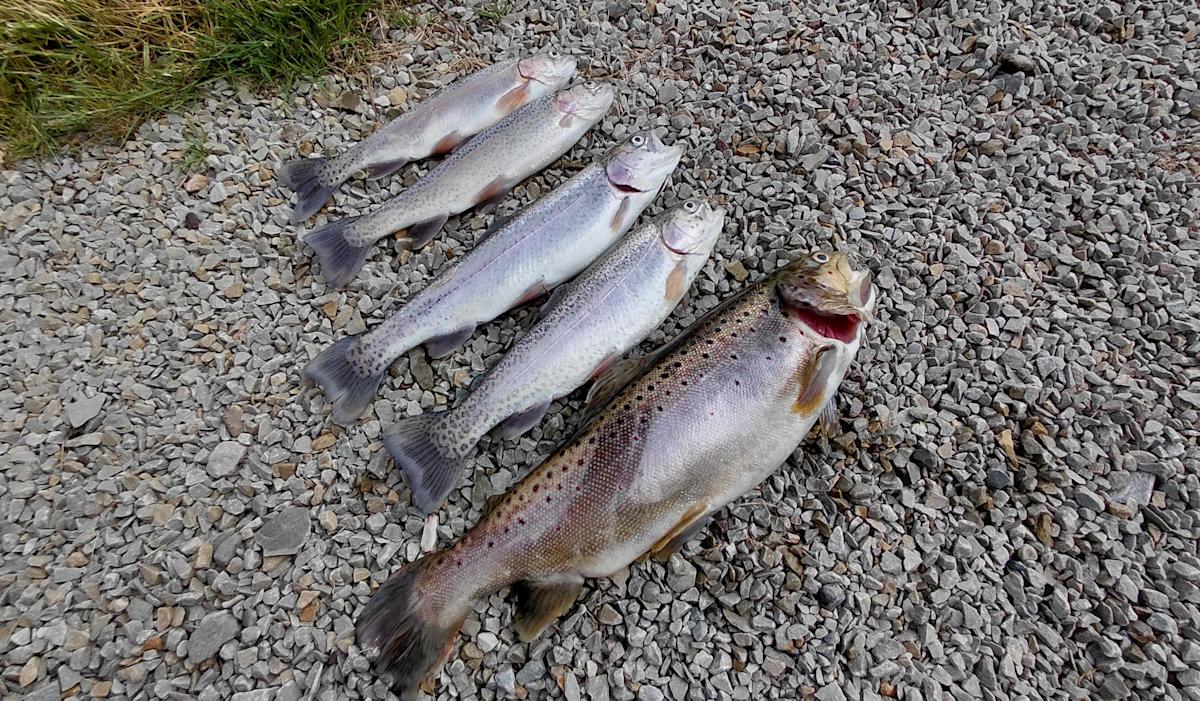
The Pennsylvania Fish and Boat Commission (PFBC) tentatively approved a new size limit for trout as well as a formal defined way to measure the length of a fish.
During the PFBC’s quarterly board meeting April 27, the commissioners preliminarily approved raising the minimum length to keep a trout to nine inches. Presently, the minimum size has been seven inches since 1983. Before that, the size was six inches long.
“Really, the point of this regulation is now being driven at the protection of wild brook trout,” Dave Nihart, chief of fisheries management, said.
Between 2015 and 2024, the agency sampled fish in 2,891 streams and captured 195,518 wild brook trout. Of that total, 12,598 were greater than seven inches long. “A seven-inch brook trout is fairly rare. There are very few streams that support seven-inch brook trout. There’s even fewer that support a nine-inch brook trout, but they do occur,” Nihart said.
Let’s go fishing: Get expert tips for a successful catch in Pennsylvania’s trout season
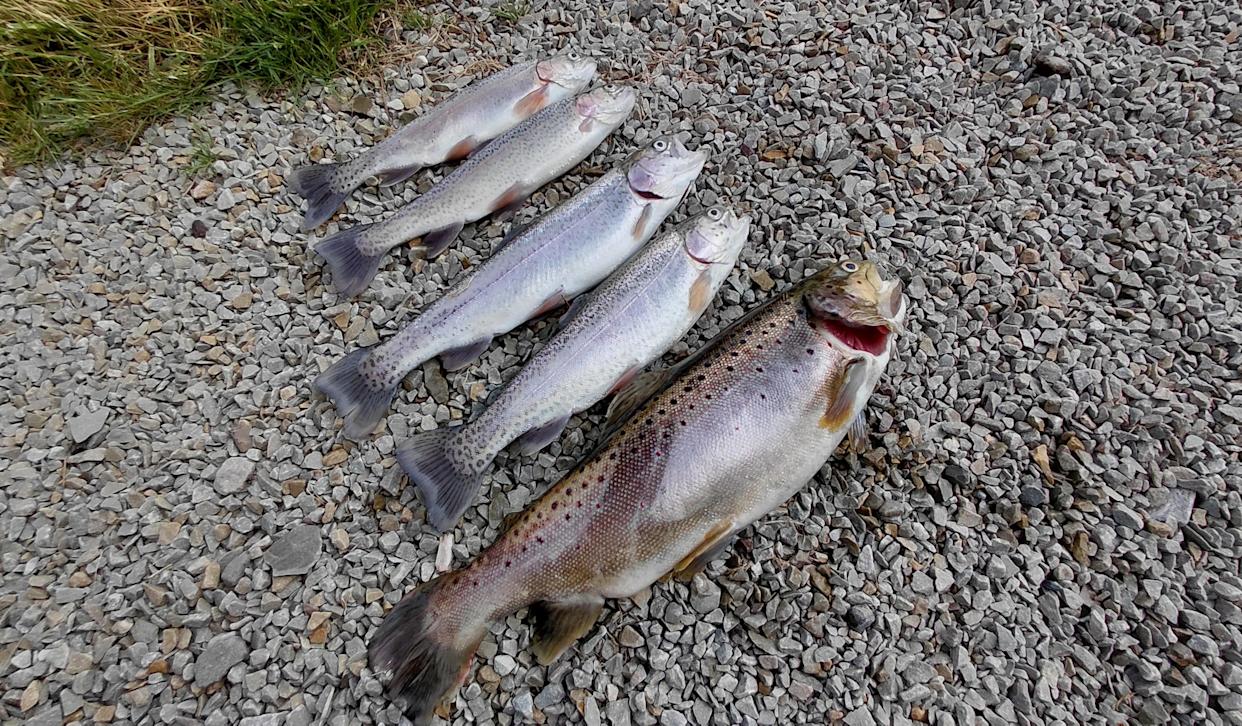
The Pennsylvania Fish and Boat Commission has proposed increasing the size of trout anglers can keep from 7 to 9 inches. The agency stocks trout that are usually at least 11 inches long.
More: Walleye season soon opens in Pennsylvania. Here’s how to catch them
With change to nine inches, he said, “Only about 1% of all the wild brook trout in the Commonwealth would now be available for harvest,” he said.
The change will not impact anglers who fish for stocked trout across the state. The agency stocks trout with the goal of them being at least 11 inches long and that goal has been met over the past three years.
“The vast majority of the fish that are being stocked by the agency right now are averaging almost 11.5 inches in length, well above the proposed 9-inch minimum size,” Nihart said. The data shows 5% of the stocked trout are in the nine-to-11-inch range.
During a September 2023 angler survey, the agency asked people about increasing the minimum size limit. “Eighty-five percent of the people indicated they would support it, 7% opposed it and 8% had no opinion. So, the vast majority of all trout anglers in Pennsylvania support the idea of increasing the minimum size limit as a mechanism to protect wild brook trout,” he said.
In addition to the 3.2 million trout raised in state fish hatcheries, there are about 160 volunteer cooperative nurseries that raise about 1 million trout each year for public fishing waterways. “Most cooperative nurseries will not have an impact,” he said about the 9-inch creel limit.
The agency is working with hatcheries that have trout that are under nine inches to find ways to increase the fish size to at least nine inches before being stocked.
Commissioner Richard Lewis of Gettysburg supports the change but pointed out one thing that will be lost. In speaking about his childhood, he said, “One of my fondest memories was going on a brook trout stream, taking a frying pan and some bacon and catching a bunch of small brook trout, watching them curl up in a pan and eating them for lunch. And we’re effectively eliminating that with this process. But I understand why, and I’m supportive,” Lewis said.
Commissioner Dan Pastore of Erie also supports the change. “The change here is to protect all wild trout, right? It’s not simply brook trout,” he said. “If all the fish we’re stocking are longer than nine inches, then what we’re protecting is any trout. The trout we’re protecting have to be wild trout essentially.”
There are places in Pennsylvania that also have wild brown and rainbow trout populations.
Nihart agreed. “It will have a benefit to wild trout in general, but it’s really going to benefit wild brook trout,” Nihart said.
Pastore likes the process with a preliminary approval. “Once we adopt proposed rule making, we’ll get public comments and we can see what the public’s reaction to this is to get a better sense,” he said.
If approved on final rulemaking at a future meeting, the change will go into effect Jan. 1.
Dave Rothrock, representing Trout Unlimited Pennsylvania Council, spoke in favor of raising the minimum size for trout during the public comment portion of the meeting. “We look at this as a conservation win,” he said. He likes that the change will lead to fewer wild brook trout being kept by anglers. “It’s as close as we can get to catch and release, which we fully understand would not be feasible considering the current conditions,” he told the board.
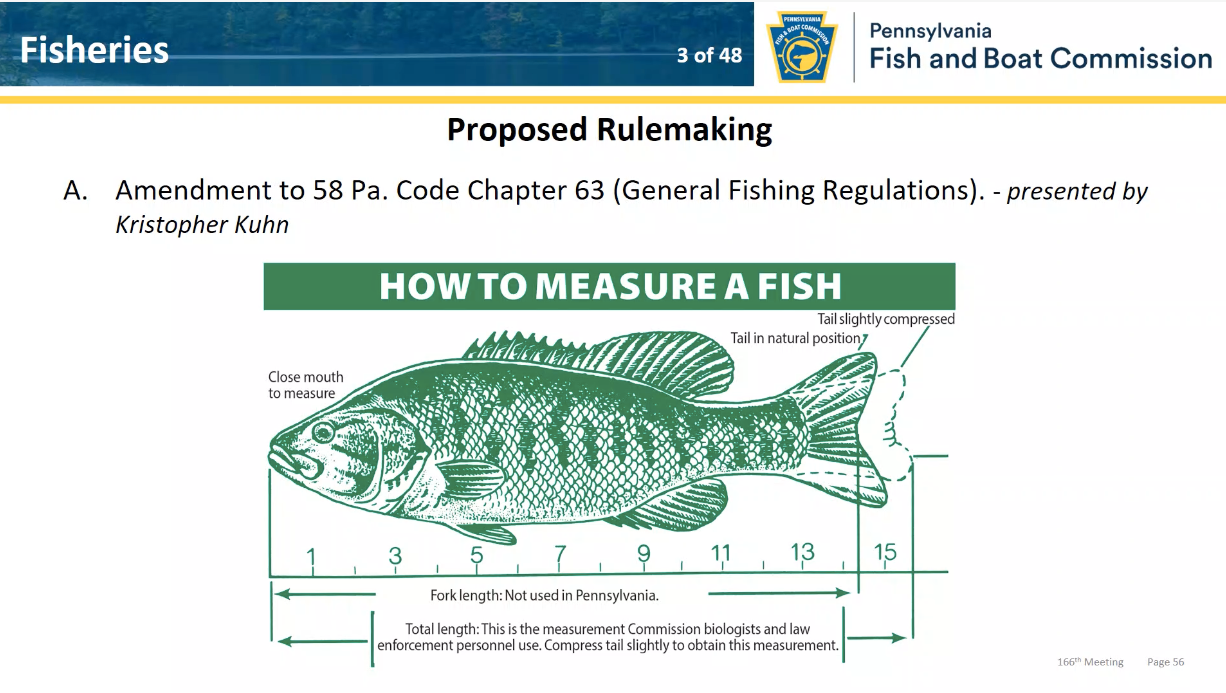
The Pennsylvania Fish and Boat Commission is formulating a regulation on how anglers should measure their fish with the tail slightly compressed.
Measuring fish
The board approved the publication of proposed rulemaking in regards to how people measure their fish.
Kris Kuhn, director of the Bureau of Fisheries, spoke of the need to formalize a regulation about how a fish is measured to address requirements with the Atlantic States Marine Fisheries Commission’s (ASMFC) requirements for Atlantic Striped Bass.
“It’s been determined that standardization is needed as different measurement methods can yield different results, potentially leading to enforcement complications,” he said.
The PFBC advises anglers how to measure fish in the Pennsylvania Fishing Summary book; however, no formal definition is present in Title 58.
Creating a formal definition would meet the ASFMC requirement while applying to all other species of fish across the Commonwealth.
The board tentatively approved the following method: “Total length is defined as the greatest straight-line length as measured on a fish while laid flat on its side with its mouth closed from the most forward tip of the jaw or snout to the farthest extent of the tail with the upper and lower tail lobes compressed or squeezed together.”
Kuhn said this method of total length is used by other states. “But there is variation in states and as a member of the Atlantic States Marine Fisheries Commission, we were mandated, required under Addendum 3 to Addendum 7 to standardize this for striped bass and in conferring with our law enforcement folks and biologists, it seems like it makes good sense to do it for all fish rather than just striped bass in the Delaware,” Kuhn said.
For example, some states measure just to the to the fork in the tail, and not the total length of the compressed tail fin.
If adopted on final rulemaking at a future meeting, this amendment will go into effect upon publication of a second notice in the Pennsylvania Bulletin.
Catfish in the Ohio River Basin
Commissioners voted to authorize the publication of proposed rulemaking pertaining to Miscellaneous Special Regulations for blue and flathead catfish within the Ohio River Basin in western Pennsylvania, including in the Pittsburgh area.
Under this proposal, which would apply to multiple counties, the regulation would make blue catfish a catch and release species in the basin.
More: Pennsylvania considers new catfish fishing rules in Ohio River Basin
Additionally, a four fish per day creel limit for flathead catfish would be implemented with only one of the four flatheads being greater than or equal to 35 inches in length.
For all other species of catfish, and in lakes within the Ohio River Basin, Commonwealth Inland Waters regulations would apply.
These proposed regulations would replace the current 50-fish-per-day limit on catfish with no minimum size, in which catfish are included among panfish.
The goal of this proposed change is to enhance protections for blue cats, which are the focus of a 15-year reintroduction plan by the PFBC within the Three Rivers, and prevent the potential overexploitation of flathead catfish and conserve trophy-sized fish.
Flatheads naturally reproduce in the rivers, but they are slow growing. Nihart explained it takes 15 years for a flathead to become 24 inches and 30 years to be 35 inches in Ohio River Basin.
“There are high levels of angling efforts that are occurring for flathead catfish in the Three Rivers, and primarily, folks are targeting the bigger, older fish, the trophy-sized fish,” Nihart said.
If approved on final rulemaking at a future meeting, this amendment will go into effect Jan. 1.
The agency notes blue catfish are a native species within the Ohio River Basin. However, they are invasive to the Atlantic Slope basins in Pennsylvania including the Delaware River, Potomac River, Susquehanna River and Lake Erie.
Commissioner Don Anderson from Somerset County asked the agency to investigate more protection for channel catfish in Pennsylvania that are also part of the existing 50 fish per day creel limit.
He pointed out that school children are helping the state raise channel cats for waterways across the state. “I think they’re a very nice fish and they warrant a little bit more conservative harvest,” Anderson said.
Nihart responded that the agency is looking to separate panfish species from the catfish in the regulations. “We fully recognize it’s time to not manage catfish as the same as we would bluegill,” he said.
As part of the panfish management plan, he said they will be proposing at some point regulations that would be specific to certain panfish species and catfish. “That’s something we’re actively working on now,” Nihart said.
Brian Whipkey is the outdoors columnist for USA TODAY Network sites in Pennsylvania. Contact him at bwhipkey@gannett.com and sign up for our weekly Go Outdoors PA newsletter email on this website’s homepage under your login name. Follow him on Facebook @whipkeyoutdoors.
This article originally appeared on The Daily American: Pennsylvania fish and boat commission proposes new regulations