

BETHLEHEM, Pa. – The ongoing conversation around universal free lunch continued Monday at the Bethlehem Area School District Board of Directors meeting.
“Hungry kids cannot learn; they cannot concentrate,” said Louise Torres, a former teacher from the district.
Currently, 53% of BASD students receive a free lunch and 5% receive a price reduction.
The district says it participates in state and federal programs that provide free and reduced-price meals to eligible students, ensuring support is directed to those who need it most. In addition, all BASD students receive free breakfast, funded by the state.
Similarly, the district has also committed to ensuring no student goes without a hot meal or has to accept an “alternative cold meal.”
Despite this, providing free lunch without reimbursement to all 12,400 of the district’s students would require the district to absorb the unbudgeted costs, officials said.
They also said these costs could ultimately impact essential educational programs and student support services.
Speakers on Monday stressed that the issue goes beyond finances.
“Don’t just look at a balance sheet because it’s so much more than a balance sheet,” urged Susan Ott, communications director and food services director at Arts Academy Charter Middle School.
For her part, board member Rayah Levy was encouraged by the impassioned speakers she’d seen coming forward to speak on the subject, and she said she was mindful of their “advocacy, tenacity and courage.”
She also urged reaching out to legislators, who she said ultimately control funding.

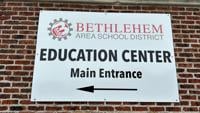
The Bethlehem Area School District Board of Directors discussed challenges, including stricter federal funding, related to free lunches.
Board member Winston Alozie also thanked speakers.
“We thank you for doing what’s right,” Alozie said, and like Levy, encouraged continued advocacy at the state and national level.
Commenter Sebastian Zaveruka discussed the Community Eligibility Provision (CEP), which is a federally funded program that enables school districts to serve free meals to all students.
Another speaker spoke about the program’s potential to reduce school lunch debt for students.
The district has previously said it could pursue various options, including implementing CEP at specific schools and implementing the program on a pilot basis.
District officials have said that under current funding structures, programs like CEP do not cover the full cost for a district like BASD.
District Superintendent Jack Silva has said that implementing such a program would result in a significant financial shortfall of approximately $500,000 per year that would need to be financed locally.
Food-related funding
In related news, the board approved the 2026 Summer Food Services for Children Program, sponsored by the U.S. Department of Agriculture and the Pennsylvania Department of Education. The program will provide meals for children during the summer months when the National School Lunch Program is not available.
The school board also approved submission of 10 grant applications to the Pennsylvania Department of Education’s Fresh Fruit and Vegetable Program to benefit BASD’s eligible elementary schools.
In addition, the board approved applying to receive “Healthy Start Smoothie Carts” for all 22 schools through the End Student Hunger Equipment Grant.
District design process
In other news, board President Michael Faccinetto gave an update on the district’s design committee.
Monday, Faccinetto said the district has created a website for the committee and has finalized the request-for-proposal process for a Comprehensive Enrollment Projection, Building Utilization and Boundary Study.
According to the district site, the District Design Committee is a special advisory committee of the school board “to study enrollment trends, facilities, staffing, attendance boundaries, and financial sustainability in order to recommend a long-term district design plan that keeps BASD strong, equitable, and efficient.”
According to the website, the last time the district experienced redistricting was in the early 1990s, and a neighborhood-specific redistricting took place in 2017.
Significant changes in enrollment, population distribution and neighborhood development in the intervening years have raised the importance of redistricting to “ensure that school boundaries reflect current community patterns and help balance resources, class sizes, and access to programs across our schools,” the site says.