
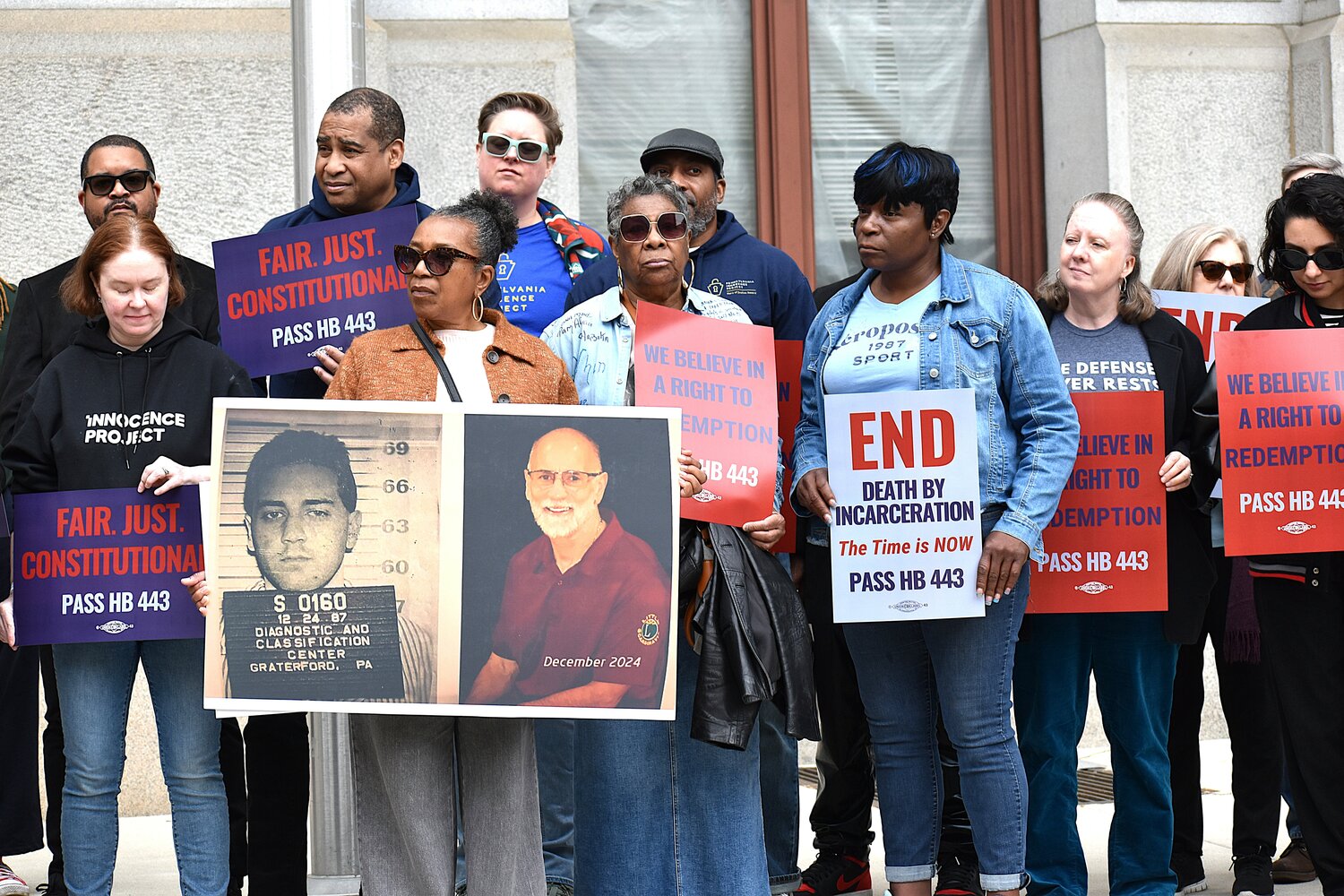
Lorraine “Mrs. Dee Dee” Haw thinks it’s time her son and others like him — those sentenced to a lifetime behind bars for second-degree murder — be allowed to come home.
Phillip Ocampo has spent 32 years in prison; he went in as an 18-year-old and recently turned 50.
“People got a tendency of saying, ‘Well, they did the crime. Let them do the time,’” Haw told a crowd Wednesday afternoon outside City Hall. “I’m with you on that. But how much time is enough time?”
Haw spoke at a rally demanding Harrisburg lawmakers act to reform the second-degree murder statute, after the Pennsylvania Supreme Court ruled March 26 that the state’s longstanding mandatory sentence of life imprisonment without the possibility of parole violates the commonwealth constitution’s prohibition on “cruel punishments.”
Second-degree murder, also known as felony murder, is charged when an individual commits a serious felony and someone is killed, even if the defendant did not pull the trigger. Unlike first-degree murder, prosecutors do not have to establish any intent to kill, but the punishment has been the same for both crimes.
The justices gave the legislature 120 days — until late July — to remedy the law. Bills that would apply retroactively and alter sentencing guidelines have stalled in committee.
Roughly 1,100 people are currently serving sentences of life without parole for second-degree murder in Pennsylvania. Nearly half are from Philadelphia.
Steph Drain, 28, said his aunt, Brenda Watkins, has been incarcerated for more than four decades for second-degree murder. She reminds him of his late mother, and he said she has mentored other women in prison.
“We talk about justice, we talk about accountability, and those things matter,” added Drain, political director for the Pennsylvania Working Families Party. “My aunt herself said she’s haunted every day by what brought her to (State Correctional Institution) Muncy. But what does it mean to say someone can never come home?”
More than 350 people convicted of felony murder in the commonwealth are over 60 years old, according to Sara Jacobson, executive director for the Public Defender Association of Pennsylvania. The oldest is a man in his 90s, she added.
“They can’t wait,” Jacobson told the audience at Wednesday’s rally. “Not one of them can wait for the politics to be sorted out.”
Prison reform advocates have coalesced around House Bill 443, which would grant parole eligibility after 25 years in prison. The proposal would cap sentences at 50 years for those newly convicted.
The legislation was scheduled for a committee hearing earlier this month; however, the sponsor, Rep. Tim Briggs, a Democrat from Montgomery County, pulled it from consideration, the Pennsylvania Capital-Star reported.
A similar bill in the state Senate would permit parole at 25 years and set the minimum sentence at 25 years, with no delineated maximum. It also has not advanced out of committee.
“We are not going to be silent while lawmakers play political games, ping-pong our loved ones back and forth between two parties and two chambers,” said Robert Saleem Holbrook, executive director of the Abolitionist Law Center, which helped to litigate the Supreme Court case.
The ALC and a coalition of other advocacy groups are asking supporters to contact their Harrisburg representatives, particularly Democratic House Majority leaders. A call-in day is planned for May 4.
In the absence of a legislative solution, the process could resemble the aftermath of the 2012 and 2016 U.S. Supreme Court decisions that mandated the resentencing of juveniles serving mandatory life without parole sentences.
Going through the courts, instead of the Pennsylvania Parole Board, would likely be a more time-consuming process, experts have said. In Philadelphia, there are double the number of felony murder cases, compared to the juvenile lifer resentencing effort, according to the District Attorney’s Office.
John Pace, who works with the Youth Sentencing and Reentry Project, was among those ultimately released as a result of those landmark juvenile decisions. He spent 31 years behind bars, after being convicted of second-degree murder at age 17.
“I’m thankful for the opportunity, but I’m not satisfied with it,” Pace said. “Because I recognize that we still have a lot of individuals who are extremely deserving that are still currently incarcerated under an illegal sentence.”
MORE: Police searching for group involved in rape, robbery at Chinatown business
Keywords
Pennsylvania sentencing reform,
second-degree murder law PA,
felony murder Pennsylvania,
Pennsylvania Supreme Court ruling,
life without parole Pennsylvania,
prison reform Philadelphia,
Harrisburg legislation,
Abolitionist Law Center,
Public Defender Association PA,
criminal justice reform PA