
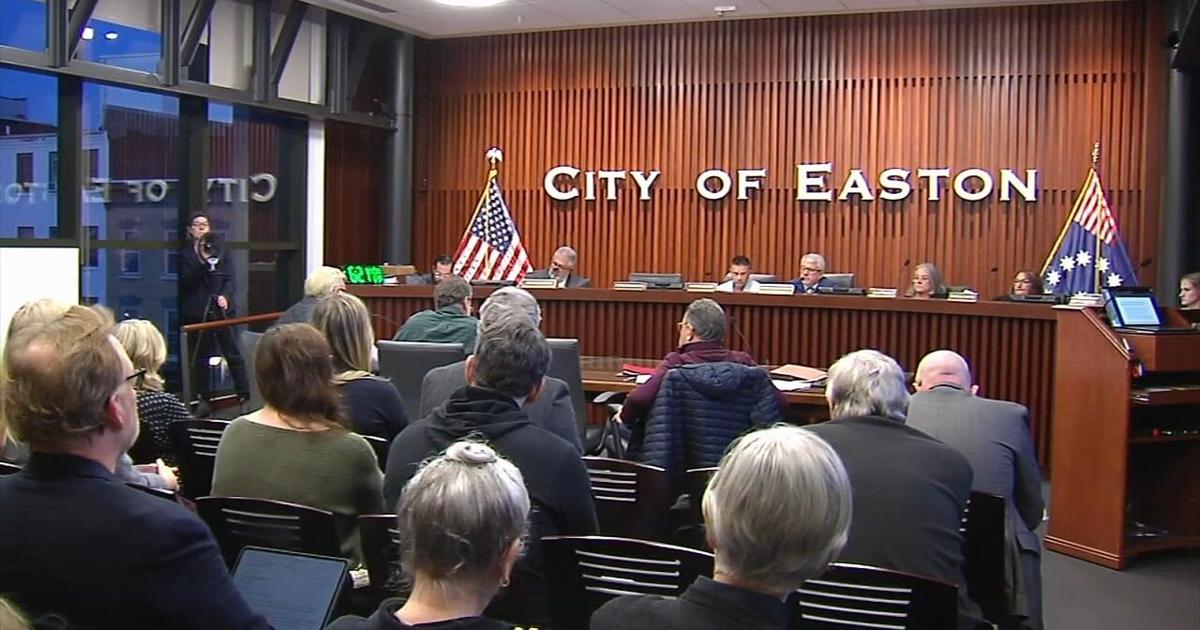
EASTON, Pa. — A highly contentious hearing was held in Easton on Monday night.
The city’s zoning board heard continued testimony regarding a controversial 1-million-square-foot warehouse proposal on Wood Avenue.
The city’s planning commission previously shot down a special exemption involving a flood plain.
Dozens packed Easton City Hall on Monday night, dressed in black, as they listened to testimony regarding the proposed Easton Commerce Center.


A rendering of a proposed warehouse at 1525 Wood Ave. in Easton / Wilson borough
Scannell Properties
The facility would occupy the former 106.2-acre Pfizer Pigments site. The proposal, offered by Easton Wood Ave Propco, calls for a 1-million-square-foot warehouse near the 13th Street and Route 22 intersection at 1525 Wood Ave.
The building would cover about 23 acres near two Route 22 intersections – 13th and 25th streets. Bushkill Creek would flow around a portion of the structure.
Most of the site — 93% — rests in the Borough of Wilson, with some land in the City of Easton and a smaller portion in Palmer Township. Warehousing is permitted by-right in Wilson and Easton.
Monday night’s hearing involved the applicant acquiring a special exception to alter or relocate a watercourse in the floodplain, and for a roadway and retention basin in the floodplain located in a block of the Adaptive Reuse District. The special exceptions are to the city’s floodplain management ordinance.
The hearing, which began Sept. 18, featured two applicant witnesses. Attorney Marc Kaplin, representing Easton Wood, said in his opening statement his client’s requested involved “the relocation of an unknown tributary.” The proposed project will place the unknown tributary above-ground and include various site improvements.
On Monday night, Kaplin began the hearing by indicating his client had acquired National Pollutant Discharge Elimination System and Water Encroachment permits as testified during the previous session’s hearing by witness Donald Haas, an engineer and architect associated with the project.
Following this statement, opposing counsel representing objecting clients presented their cases. The first witness was David Brandes, a civil and environmental engineering professor at Lafayette College, who testified increased runoff volumes would impact Spring Brook and Bushkill Creek. This contradicted testimony from the applicant’s experts.
Brandes testified the Act 167 stormwater ordinance required runoff volume control for the two-year storm, which is 3 inches in 24 hours. He noted Act 167 does not require runoff volume control for the larger 10- to 100-year storms. As such, the professor testified those increased volumes would be passed downstream to the new stream channel.
The professor reached the conclusion “there will be large increases to runoff volumes to Spring Brook and Bushkill Creek for large storms.” This, Brandes added, “will tend to increase downstream channel erosion.”
Under cross-examination, Kaplin reported that Haas’ study compares “very favorably” to FEMA’s study in the area. He added further state agencies have imposed stringent rules for development throughout the commonwealth, and that his testimony was more theory than fact.
“This ought to be about science,” Kaplin said.
Solicitor Robert Nitchkey described the case as “we have a difference of opinion between one expert and another. That’s what it’s going to come down to.”
Monday’s hearing lasted several hours and was continued to the next meeting. No date was provided when the hearing will resume.