
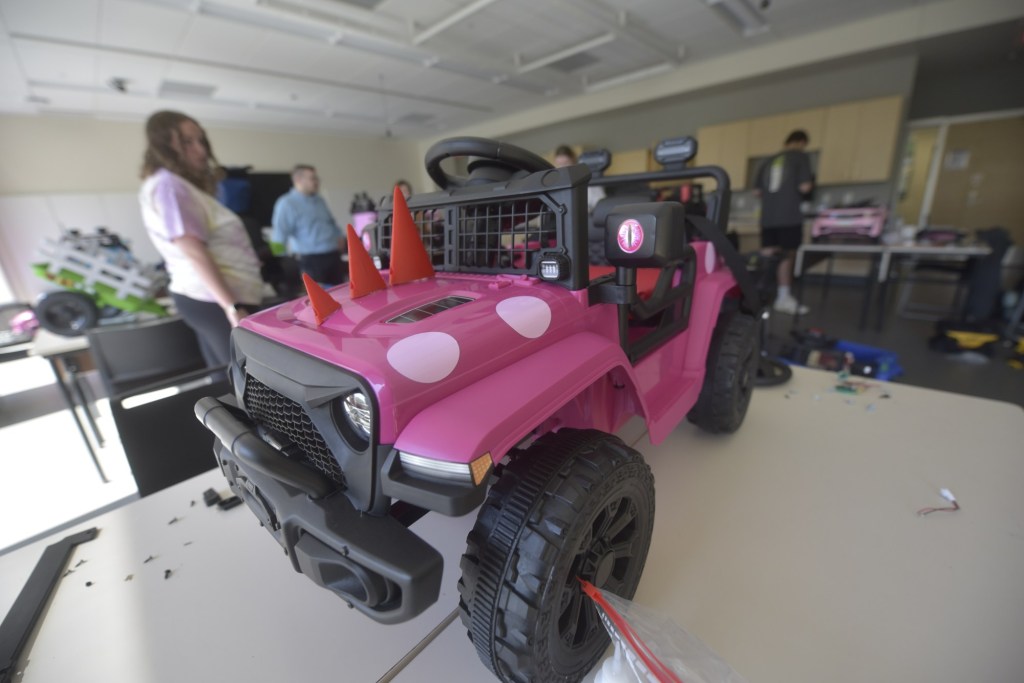
SCRANTON — University of Scranton students Jayden Chang and Samantha Zaic stopped inside a workshop at Leahy Hall on Thursday morning to make some adjustments on miniature toy cars created for local children with disabilities leading up to the big reveal on Sunday.
Funded through a grant from the Edward R. Leahy Jr. Endowment, for a third consecutive year, a group of students led by Stephanie DeNaples, faculty specialist in the Department of Occupational Therapy, constructed and designed vehicles to get kids moving through Go Baby Go — an international program started by Cole Galloway while at the University of Delaware, geared toward improving mobility for the children in a stylish way.

Occupational therapy and mechanical engineering students from the University of Scranton work to create specially designed “mini cars” for local children as part of Go Baby Go, a national community outreach program that benefits children with disabilities at Leahy Hall at the University of Scranton on Monday April 27, 2026. (CHAD SEBRING/STAFF PHOTO)

Senior mechanical engineering student Jack Olonovich works on a project at the University of Scranton’s Leahy Hall on Monday April 27, 2026. Occupational therapy and mechanical engineering students are creating specially designed “mini cars” for local children as part of Go Baby Go, a national community outreach program that benefits children with disabilities. (CHAD SEBRING/STAFF PHOTO)

Graduate occupational therapy student Kaitlyn Gelman works on a project at the University of Scranton’s Leahy Hall on Monday April 27, 2026. Occupational therapy and mechanical engineering students are creating specially designed “mini cars” for local children as part of Go Baby Go, a national community outreach program that benefits children with disabilities. (CHAD SEBRING/STAFF PHOTO)
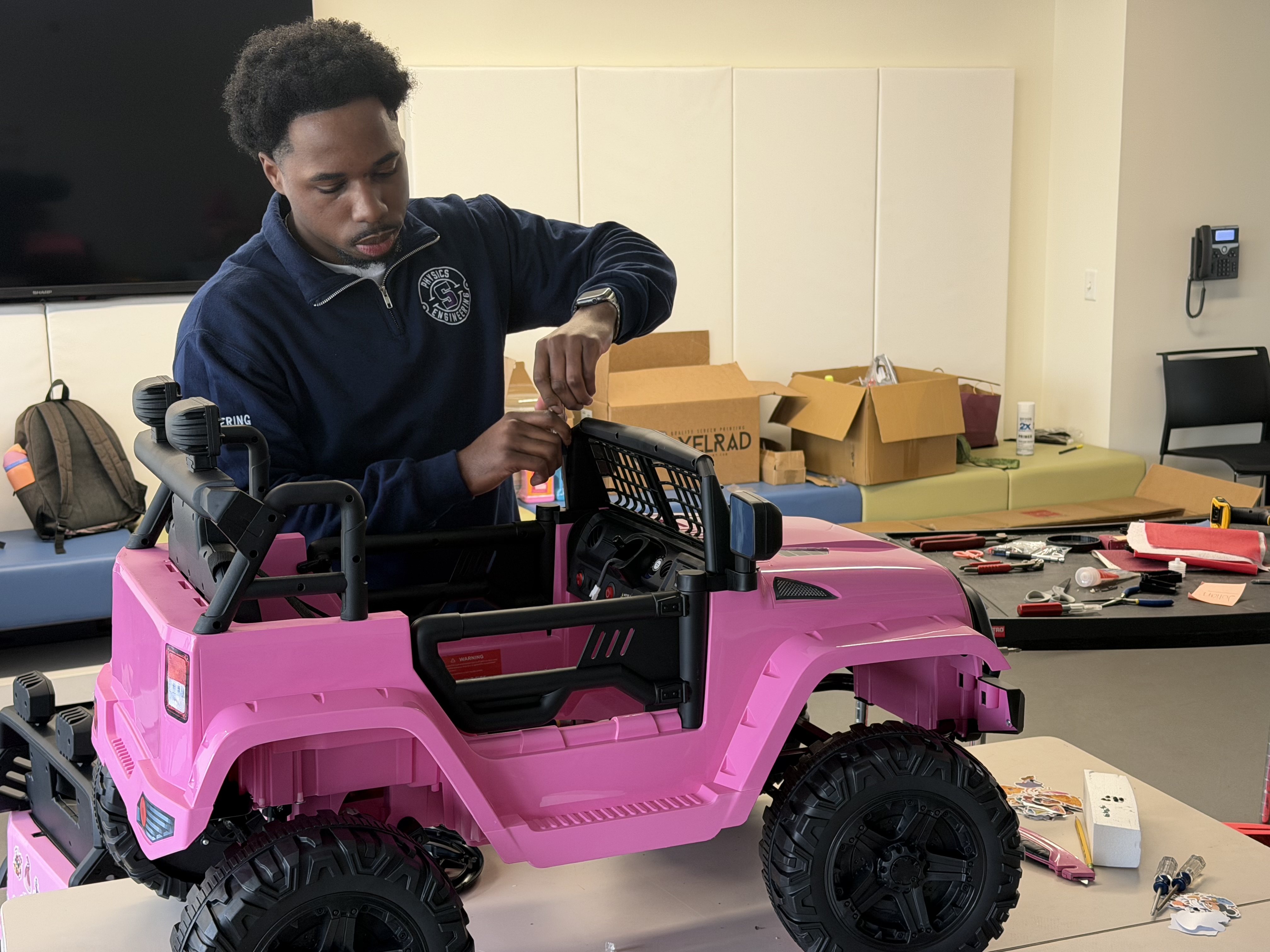
Jayden Chang, a senior electrical engineering student from Elmont, New York, uses a screwdriver to make adjustments to a miniature car inside the University of Scranton’s Leahy Hall on Thursday, April 30, 2026, as part of the Go Baby Go program. (ROBERT TOMKAVAGE/STAFF PHOTO)
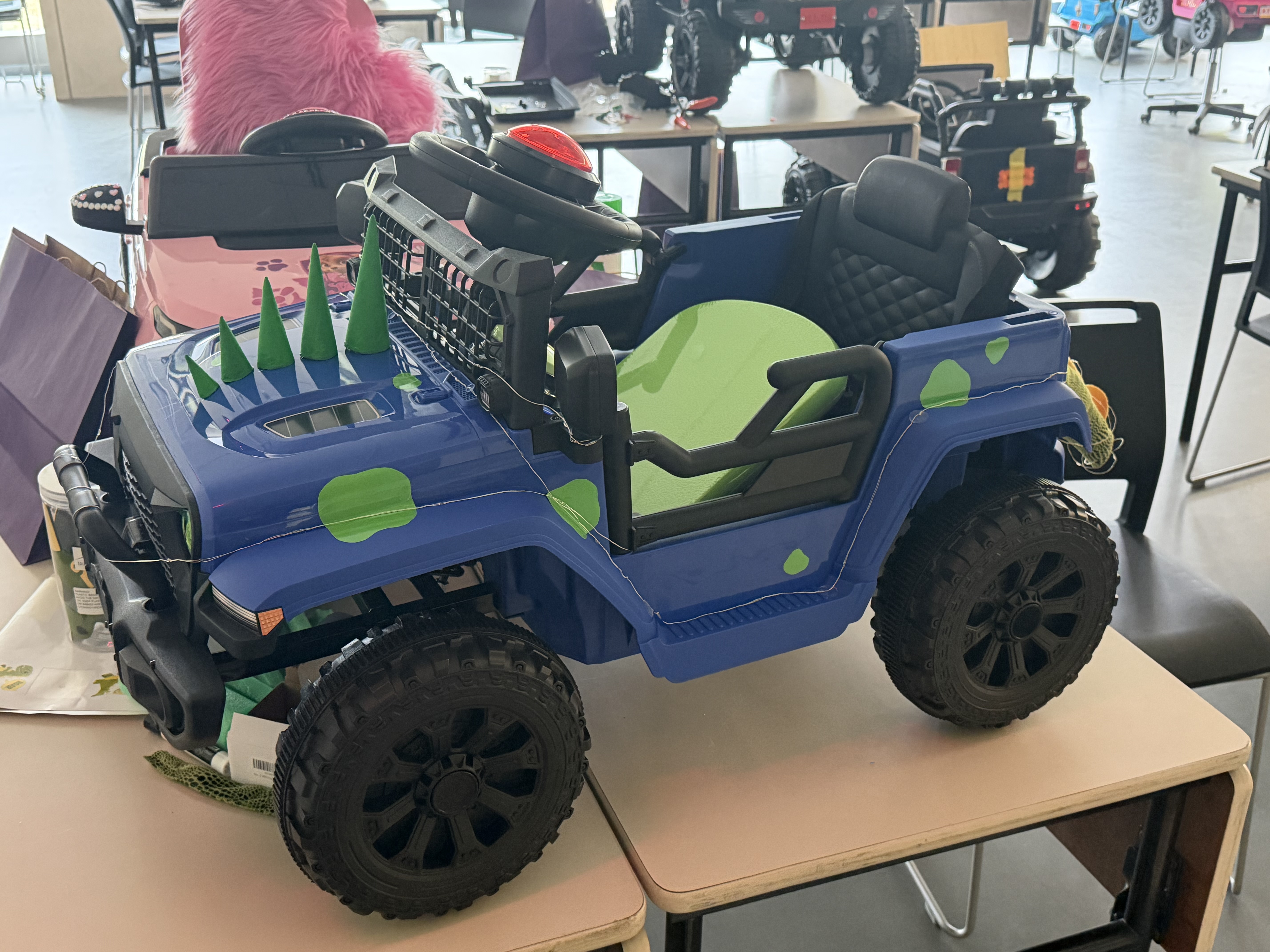
A dinosaur-themed vehicle designed by University of Scranton students sits inside Leahy Hall on Thursday, April 30, 2026. It’s among about 10 miniatures cars that will be provided to local children with disabilities as part of the Go Baby Go program. (ROBERT TOMKAVAGE/STAFF PHOTO)
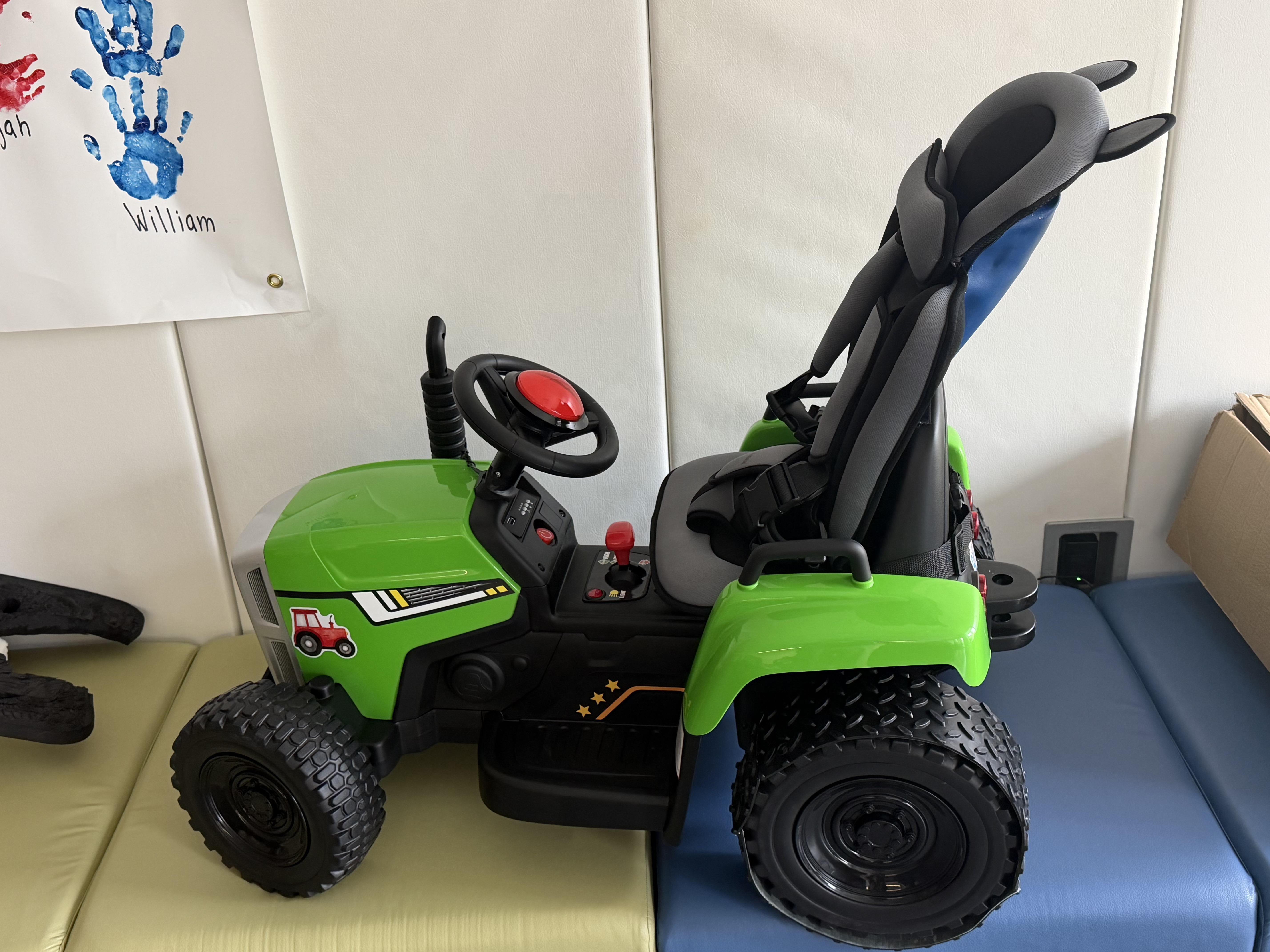
A miniature farm tractor designed by University of Scranton students sits inside Leahy Hall on Thursday, April 30, 2026. It’s among about 10 miniatures vehicles that will be provided to local children with disabilities as part of the Go Baby Go program. (ROBERT TOMKAVAGE/STAFF PHOTO)
Show Caption
1 of 6
Occupational therapy and mechanical engineering students from the University of Scranton work to create specially designed “mini cars” for local children as part of Go Baby Go, a national community outreach program that benefits children with disabilities at Leahy Hall at the University of Scranton on Monday April 27, 2026. (CHAD SEBRING/STAFF PHOTO)
From a farm tractor to a dinosaur-themed Jeep and a pink, furry Paw Patrol ride, the students put their skills and creativity to work for a rewarding cause.
“(Cole) started this initiative in the interest of getting kids who were little to experience mobility independently,” DeNaples said. “He smartly recognized that we want to get these kids moving, but it doesn’t necessarily have to look like a medical device.”
On Sunday afternoon, the children will break through a curtain and cruise around a race track inside the Byron Center in their new wheels as their favorite song plays in the background, DeNaples said.
“The families get to experience their kids who have some limitation, in one way or another, be the star of the show,” she added. “It’s nice to see them get the spotlight.”
Throughout the past three years, the University of Scranton’s Go Baby Go chapter modified and donated approximately 30 custom miniature cars for children mostly ranging in age from 1 to 5. This year, 70 students — across 11 majors — teamed up on the mission, university officials said.
DeNaples noted outreach to area families begins each fall and the group meets with them around February to gauge their needs and preferences for the vehicles.
“The students meet the families, play with the kids, and see what their likes and dislikes are,” she said. “We have a couple models for them to try out, and see what they gravitate toward. We buy the cars and the students get working for the rest of the semester.”
DeNaples appreciates the ongoing and growing support of the program from students in a variety of different academic fields.
“The first year was primarily occupational therapists, and the next year a few physical therapists,” she said. “This year, we have criminal justice, counseling, allied health, mechanical engineering and electrical engineering. We put them in teams and mix them up as much as we can. We really try to get them working across their disciplines and learning from each other. I try not to micromanage; I sit back and let them figure things out.
“It’s nice to see the students outside the classroom, but applying the knowledge they’ve learned to something that is completely volunteer. It’s heartwarming to see them keep showing up. It makes you realize you don’t necessarily need to have money or grades as an incentive to bring out the best in people.”
The vehicles created through the Go Baby Go program feature modifications to improve ease of use, like replacing foot pedals with large, push-button switches on the steering wheel and adding customized seating supports
A miniature car created by University of Scranton students also served as a learning tool for a child in the first cohort of the program, DeNaples noted.
“We made him a joystick that powered it but also drove it,” she said. “His mom said he just started using a power wheelchair and learned how to use it quickly because he had already been practicing.”
Chang, of Elmont, New York, a senior electrical engineering major, participated in the Go Baby Go program after watching the children zoom around in their vehicles during the unveiling last year.
“My roommate is an occupational therapy major and he was DJ’ing the event,” Chang said. “I went with him to see what it was about and I was very intrigued. I see the impact it has on the children and how they get an opportunity to drive a car just like any other kid. This is simple circuitry that we do for these cars. It’s not so complex, but you could see the little things that make people’s lives better.”
Zaic, of Spring Brook Twp., a graduate student studying occupational therapy, enjoys seeing the children let loose in their new cars.
“The whole purpose is for them to have mobility they wouldn’t otherwise have,” she said. “So to watch them be able to drive around with their siblings, it’s their first real experience of being able to be independent and move independently, it’s just such a great feeling.”
Kaitlyn Gelman of Hackensack, New Jersey, who is pursuing a master’s degree in occupational therapy, helped DeNaples launch the program three years ago.
“It’s emotional for the parents, it’s emotional for everybody,” she said. “The first year, I was on stage and I trying not to cry. It’s such a happy day.”
In addition to providing families with a much-appreciated gift, Gelman added the program also helps prepare students for life after graduation.
“It gives us an opportunity to collaborate with all these different majors, learn about what people are doing, what people know, and then be able to apply that,” she said. “I’m going to work with nurses in the future and I’m going to work with physical therapists, so getting to be able to work hands-on with them now is giving me practice for the future.”