

PHILADELPHIA — The 2025-26 Pittsburgh Penguins spent nearly seven months blurring the line between nostalgia tour and legitimate rebuild.
For a city that had endured a few years of inconsequential hockey, the regular season was a revelation — a stunningly successful stretch that saw the Penguins reignite their fanbase and grip Pittsburgh once again.
But as the handshake line formed Wednesday night after their first-round exit against their most-hated rival, the Philadelphia Flyers, the nostalgia evaporated and the Penguins’ challenge returned to the forefront. Their out-of-nowhere winning season ended with a reminder that, although their architect, Kyle Dubas, flexed his muscles and first-year coach Dan Muse burst onto the scene, the Penguins remain several pieces away from truly competing for the Stanley Cup again.
Put it all in a blender, and you’ll see that the Penguins are entrenched in transition with a long road ahead and room for surprises along the way. One thing is certain: They don’t figure to bore their legion of followers anytime soon.
When will the Penguins be true winners again? There is no clear answer. Dubas, their president and general manager, has repeatedly said he doesn’t want simply to reach the postseason; he wants to build a perennial championship contender.
As their six-game series loss to the Flyers made obvious, they aren’t close to that yet.
“Everybody on this team, all the players, staff, they invested a lot. When it’s over, it hurts a lot,” Muse said after Game 6 on Wednesday.
The problem is that the Penguins were carried almost exclusively by players on the back nine of their NHL careers.
At times, the season felt more like a retirement farewell — a successful one, at least — instead of groundwork for the future. By mid-August, Sidney Crosby will be 39, Evgeni Malkin will be 40, Kris Letang will be 39 and Erik Karlsson will be 36. This season was like seeing the Rolling Stones in 2026: The Penguins were still a thrill, and fans got their money’s worth, but it wasn’t the 1971 Rolling Stones.
Those four future Hall of Famers weren’t the only performers on the wrong side of 30. Anthony Mantha, the team’s leading goal scorer this season, will be 32. Like Malkin, he’s a pending unrestricted free agent and no sure thing to return next season. And as with Malkin, there is hardly a groundswell of support in the organization for his return, even though he put up outstanding numbers.
After last season, Dubas was already touting the idea of being younger as the Penguins’ best chance to thrive.
“I feel like we are slightly better positioned moving forward because of some of the younger players we’ve been able to add,” Dubas said before this season.
And now, his veterans are even older.

Kris Letang, right, who turned 39 last week, scored two goals in the series against the Flyers and averaged 23:50 of time on ice. (Photo by Emilee Chinn/Getty Images)
So far, the decision to go young has been a mixed bag. Over the past year, though, some of Dubas’ decisions have led to some legitimate optimism:
• Center Ben Kindel, who just turned 19, wrapped up a wildly successful rookie campaign and seems destined to become a Penguins mainstay.
• Egor Chinakhov has emerged as a gifted, top-six winger, despite a tough playoff series. He’s only 25.
• Elmer Söderblom, a disappointment in Detroit, is only 24 and has looked like an important bottom-six player since coming to Pittsburgh.
• Forward Avery Hayes did some good things in the NHL this season and figures to see more time with the Penguins next season. He’s 23.
• The Penguins’ 2025 draft class routinely receives praise. Bill Zonnon and Will Horcoff project to be good NHL players, and other prospects in the draft have Pittsburgh’s front office brimming with excitement.
• Goaltenders Sergei Murashov, 22, and Joel Blomqvist, 24, were in the organization before Dubas arrived, are just about NHL-ready and, especially in Murashov’s case, have the potential to be special.
Then there are the concerns, of course:
• Forward Rutger McGroarty, considered perhaps the best prospect in the organization since he was acquired from Winnipeg in August 2024, has managed only four goals in 32 NHL games. His skating has been an issue. The 22-year-old hasn’t looked bad or even out of place, but he also hasn’t made the impact the Penguins were expecting.
• Forward Ville Koivunen, one of the crown jewels of the 2024 Jake Guentzel trade, has two goals in 47 NHL games and was extremely disappointing this season. He turns 23 in June.
• Defenseman Harrison Brunicke, who turns 20 in May, looked like a sensation in training camp again, but his play fell off a cliff after his first few NHL games. The Penguins didn’t handle him well this season, but he seems to have taken a step backward.
The Penguins have reached a pivotal time in their rebuild, which began with the Guentzel trade two-plus years ago. The team doesn’t call it a rebuild because it hasn’t been a sudden sell-off. Even if he wanted to, Dubas couldn’t simply eliminate some of the older players from his roster. It takes time to get younger. But make no mistake, a rebuild is happening, it’s just in the background while the older players begin to fade.
Malkin is no sure thing to return to Pittsburgh next season, despite his strong showing over the past few months. Letang, who struggled mightily for most of the season, has two years remaining on his contract. His situation is tricky — because he was 35 when he signed the deal, the Penguins won’t receive any cap relief if they buy out the contract. Three other players who are 30 or older — Kevin Hayes, Noel Acciari and Connor Clifton — almost certainly won’t be back next season.
Dubas has long wanted to take some big swings for talented, young players in the summer of 2026. He took an early cut halfway through this season by trading for Chinakhov, who has star potential, but this summer has the makings of a significant offseason.
The free-agent market doesn’t look all that strong. Dubas will spend some money there — the Penguins figure to have around $45 million in cap space, though they aren’t expected to use all of it — but much of that will likely go toward potential trades.
The Penguins have interest in 26-year-old Stars winger Jason Robertson, who remains unsigned to a long-term deal in Dallas. If other big names, preferably on the younger side, become available this summer, Dubas won’t hesitate to make offers. He is eager to turn the Penguins into a winner — a sustained winner — sooner rather than later. He has a glut of draft picks and older veterans for trade bait, he has money to spend, and, more than anything, he has the Penguins-Flyers series fresh in his mind as proof that his team needs to get younger immediately.
“I think we got everyone playing up to their full potential all year. Then, come this time of the year, you’re going to need a little bit more, and we just couldn’t reach that level, unfortunately,” Karlsson said after Game 6. “We just couldn’t find that extra gear that is needed this time of the year.”
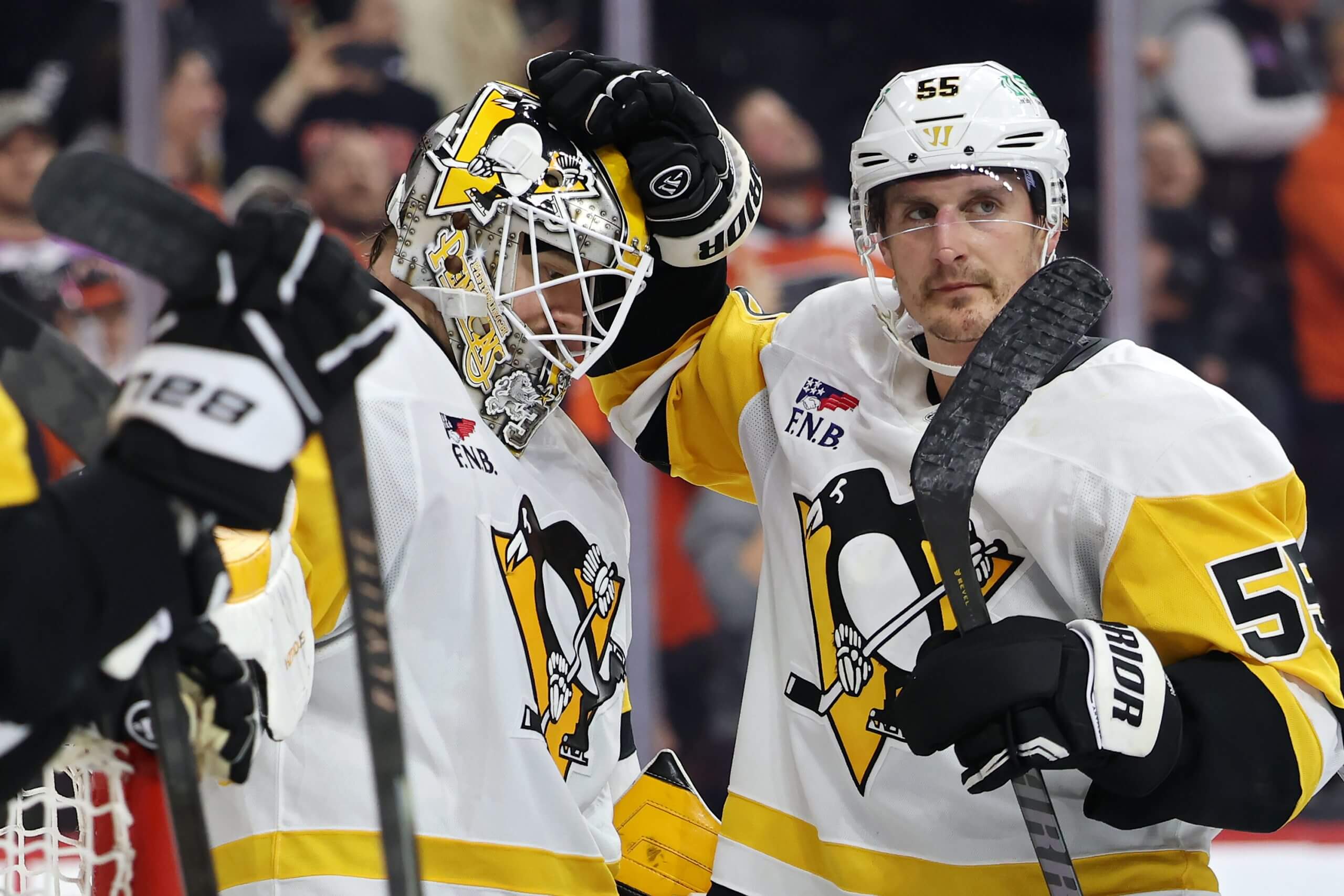
The Penguins’ season, by all measures a success compared to expectations, still ended in heartbreak. (Emilee Chinn / Getty Images)
Despite the way it ended, this season was huge for the Penguins. They matter in Pittsburgh again in a way that they haven’t in many years. Their season-ticket base should get a boost. Muse has brought positive energy that has connected well with the dressing room. He’s clearly a good NHL coach and was a smart, under-the-radar hire last offseason.
In many ways, the Penguins are trending upward. Goal prevention is their biggest issue, but Murashov could make a difference as early as next season. Their blue line is pretty shaky, but their financial flexibility could help Dubas land reinforcements.
The flip side is that the Penguins desperately need young star power, and finding it is an enormous challenge. The one problem with this surprise season is that the Penguins won’t be picking high in the talent-rich 2026 draft. It’s not the end of the world, and Dubas has done a nice job maintaining his army of draft picks and prospects.
Overall, things are looking up. But until a young wave of talent comes along — not just a Kindel here or a Chinakhov there, but a complete wave of hungry, electric young talent — the Penguins will be stuck in the mushy middle.
Dubas has done fine work over the past year, but he’ll need to sustain his hot streak a while longer.
“I wish things could have ended differently,” Kindel said Wednesday night. “It’s been such an amazing thing to be a part of.”