
Of course there will be plenty of fireworks this summer as the Lehigh Valley celebrates the 250th anniversary of the nation’s founding.
However, for the organizing committee of Lehigh Valley 250, the semiquincentennial presents an opportunity to present the region as a cultural tourism destination for years to come.
“I really want the decision-makers to see cultural tourism as a major player of economic development here in the Lehigh Valley,” said Megan van Ravenswaay, executive director of the Northampton County Historical and Genealogical Society in Easton and a member of the Lehigh Valley 250 organizing committee.
“For every dollar you give for cultural tourism, you’re getting $5 back to the community,” she said.
Lehigh Valley 250 is a collaboration of several cultural organizations, including the historical and genealogical society, Lafayette College, Historic Bethlehem Museums and Sites, the Delaware and Lehigh National Heritage Corridor and Lehigh Valley Passport to History. The project is designed as a springboard to create a permanent regional arts and culture plan, while building a permanent relationship between participating organizations.
“2026 is 12 months. It’s going to end,” said Jessica Edris, founder and managing member of Good Collective, who has been working as project consultant for Lehigh Valley 250. “So what has to be done after that is: Can we put people in a room who wouldn’t traditionally talk to each other or collaborate together and start to build a relationship so those things exist beyond the anniversary?”
For the present, it is planning to create exhibitions and programs for cultural tourism that could draw an additional 1 million visitors.
Even more tourists are expected to be taking in Revolutionary War sites around Philadelphia, New Jersey and New York, as well as an influx of soccer fans attending the World Cup this summer in those areas. Tourism officials are expecting the overflow crowds to visit adjacent regions and Lehigh Valley 250 officials have been in talks with associates in the Philadelphia area to encourage day trips.
“We absolutely understood that Philadelphia was going to be over capacity very quickly,” van Ravenswaay said. “We asked Philly, ‘Don’t send your overflow tourists to the Amish country, send them up to the Lehigh Valley.’ ”
Alex Michaels, president and CEO of Discover Lehigh Valley, said the Valley gets about 16.6 million visitors annually, with about 11 million coming in for a single day. They spend about $1.3 billion annually and 80% are repeat visitors. Tourism supports more than 26,000 jobs in the region.
“We always anticipate when you have activities like America 250 or the World Cup, you may have some additional influx of visitation because people are kind of out and about,” he said.
“We’re going to try to party like we’re like in 1776,” Michaels added. “We’re going to celebrate the United States, but more importantly, we’re going to hopefully have an opportunity to give people some additional content and we can educate them on the past.”
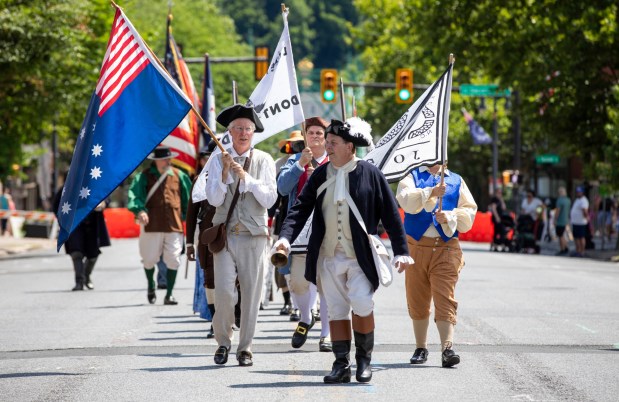 Reenactors walks around Centre Square on Sunday, July 7, 2024, during the annual Easton Heritage Day celebration. (Emma Reed/The Morning Call)
Why the Lehigh Valley?
Even though it may not have as much of a spotlight as some nearby areas, such as Valley Forge, the Lehigh Valley played a significant role in the Revolutionary War, serving as a strategic hub for hospitals and manufacturing, especially after Philadelphia was occupied by the British Army in 1777.
During the occupation, the Liberty Bell was hidden in Allentown at Zion’s Reformed Church.
The Sun Inn in Bethlehem hosted several key figures, including George Washington, Benjamin Franklin and the Marquis de Lafayette. After he was injured in the Battle of Brandywine in 1777, Lafayette was sent to Bethlehem to recover.
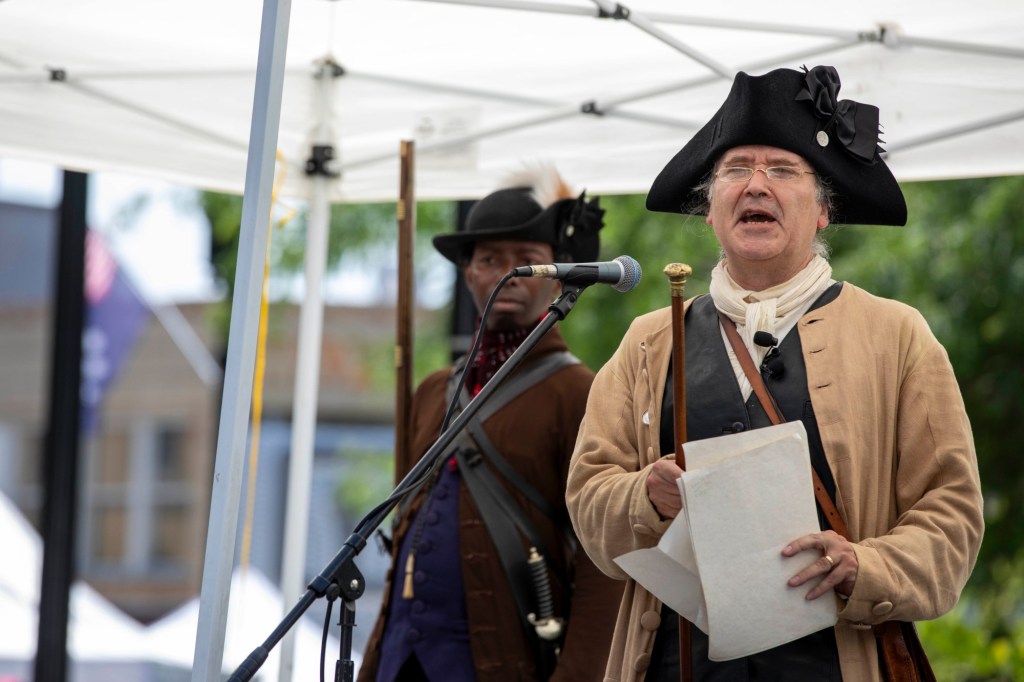
On July 8, 1776, the Declaration of Independence was read for the first time in public at three locations, one of which was Easton. It’s an event that’s reenacted annually.
“When you stand there in a crowd and you’re watching this reenactment happen and people are reading the Declaration of Independence, it’s chilling,” Edris said. “In this day and age, those words really still do mean something.”
To help attract tourists to these and other events, van Ravenswaay said, the group created a hypothetical tourist named “Karen from Ohio” to design accessible programming for a visitor who may not know local history.
Such programming includes a daylong bus tour from Easton that takes tourists to all three Declaration of Independence reading sites, including Philadelphia and Trenton, New Jersey. Another is a virtual map for travelers to find historical sites and local businesses.
There are tie-ins to annual happenings such as Musikfest and the Lehigh Valley IronPigs season.
For educational purposes, a graphic novel is being developed that will be distributed to every eighth grade student in the Lehigh Valley. A team of scholars is also developing stories featuring lesser-known faces from the Revolutionary War era, focusing on underrepresented communities.
There are also several exhibitions and programs ongoing or coming up such as the significant role of brewing, and the Moravian community and how it balanced its pacifism with patriotism.
“I actually think there’s more historical relevance here to our country than Williamsburg,” van Ravenswaay said, referring to Virginia’s colonial capital, which evolved into a tourist attraction. “I just don’t think we’ve talked about it enough, quite frankly.”
Lehigh Valley 250 has hosted state lawmakers on the tourism committee to show them the region’s size and relevance.
“We were not the Philadelphias and Pittsburghs of the world, who are getting [$]10 to 40 million for activities,” Edris said. “For $2 million, we could supply a budget that would allow nearly 50, 60 organizations to pull off programming to bring people here.”
Both van Ravenswaay and Edris emphasized that a commitment to cultural tourism will only add to the Lehigh Valley’s growth. Quality of life was a reason why Eli Lilly and Co. chose to invest $3.5 billion to build a pharmaceutical plant in Upper Macungie Township.
“The reason [companies] choose communities like ours to come to is not simply because we have the space for a warehouse, but because they know that after the work day’s over, their employees will want to be here,” Edris said.
Morning Call reporter Evan Jones can be reached at ejones@mcall.com.