
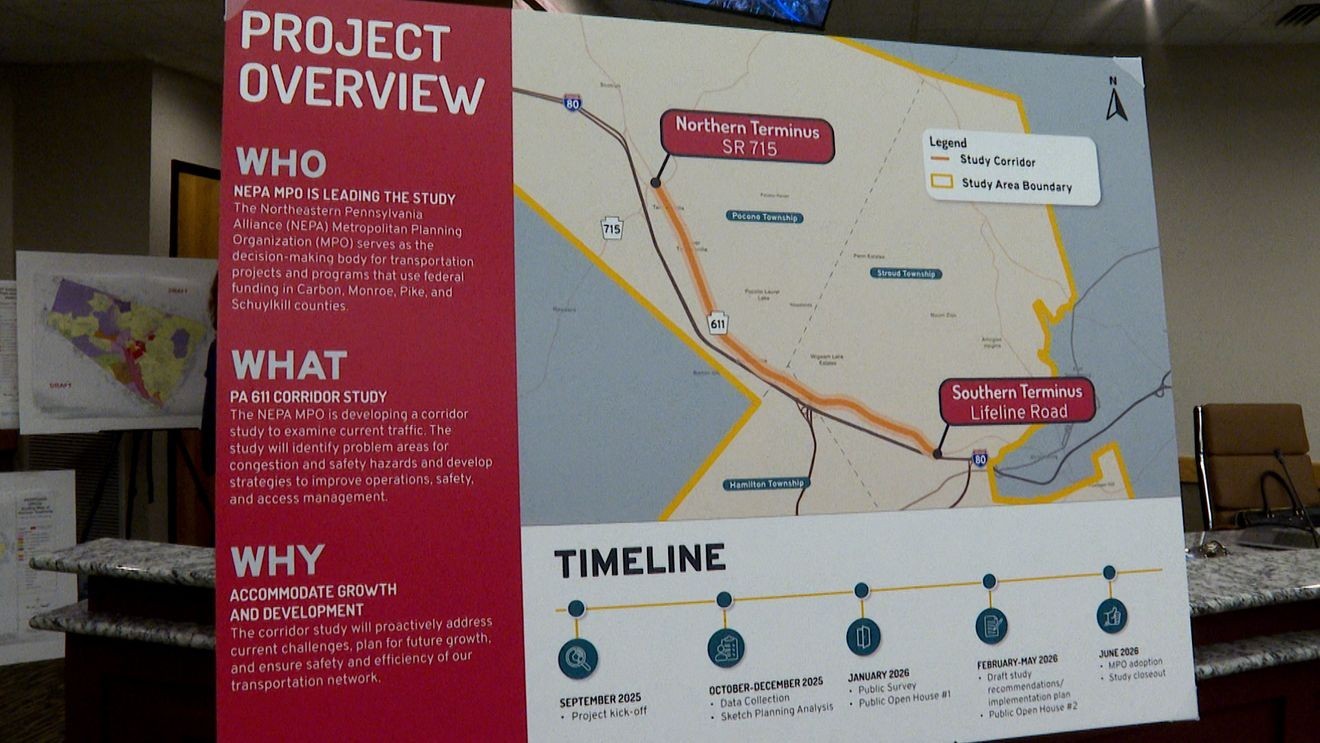
TANNERSVILLE, MONROE CO. (WOLF) — Community members and local residents had the chance to hear updates from officials leading the proposed PA 611 Corridor study, including plans aimed at enhancing safety, easing traffic congestion, and encouraging economic development throughout the area.
The Northeastern Pennsylvania Alliance held its second Corridor Study Open House Wednesday evening at the Pocono Township Municipal Building.
The ongoing study is focused on assessing transportation challenges and potential improvements along Monroe County’s north-south corridor, while also giving residents an opportunity to share their feedback and ideas. Kate McMahon with NEPA Alliance shared more.
“During our first open house back in January, we heard from the public. We also had an online survey. We want to provide some information about what we heard. Also provide some information about the data we collected as part of the study, and walk through some of the solutions,” said McMahon.
Taking a closer look at the Corridor Study, officials are identifying areas for improvement and development while ensuring public input helps shape how the Corridor serves community needs. Senior Transportation Planner Brian Funkhouser at Michael Baker International further explained the study.
“The development potential that exists throughout the corridor, looking at some worst-case scenarios. In terms of how this corridor can continue to develop over time. And if some, what are the ramifications for the roadway itself,” said Funkhouser.
“Look at data that’s available online, or data that’s available from PennDOT. But the MPO believes it’s important to learn from the actual users of the roadway itself. People who live here, and work here, and use the corridor every day. This is an important part of the MPO’s work,” said Funkhouser.
Bringing the vision into focus, Associate Civil Engineer Patrick McTish with Michael Baker International helped develop a sketch plan analysis for the corridor. It’s a high-level traffic study designed to anticipate future growth and transportation needs using projected planning assumptions.
“With that what we’ve been taking a look at is reviewing all planned developments along the corridor. As well as any potential future development as well. Taking a look at vacant parcels, and taking a look at seeing what their currently zoned as. Also, reviewing and assigning trips based on those land uses,” said McTish.
Work on the 611 Corridor study began last summer, with the final draft expected to be presented in June.