

SCRANTON — The controversial data center issue coloring local politics amid pronounced bipartisan opposition drove a contentious Democratic primary debate Thursday between incumbent state Sen. Marty Flynn and political newcomer Jeffrey Lake.
Lake, a mental health and wellness counselor running an insurgent underdog campaign for the 22nd state Senate District seat Flynn’s held since 2021, used data centers as a cudgel, accusing his opponent of supporting “an invasion of data centers” and of generally underdelivering during his tenure in state office.
Flynn, a former pugilist-turned-politician first elected to the state House in 2012 before winning his Senate seat, rejects the charge and touted his record. He noted, for example, his frontline role in galvanizing widespread opposition to precipitous rate hikes sought by Pennsylvania American Water in late 2023 — proposed rates the Pennsylvania Public Utility Commission ultimately slashed in 2024 — and claimed he’s delivered $130 million to the district.
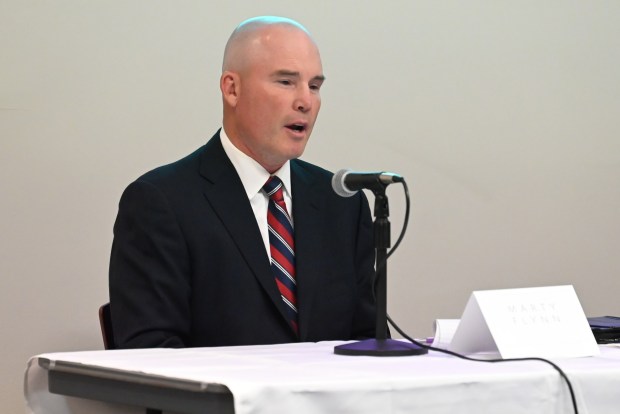 Democratic state Sen. Marty Flynn responds to questions during the Pennsylvania’s 22nd Senate District Democratic Primary Election debate at Brennan Hall on the University of Scranton’s campus in Scranton on Thursday, May 6, 2026. (REBECCA PARTICKA/STAFF PHOTOGRAPHER)
The lone debate between the candidates, hosted by the University of Scranton’s Center for Ethics and Excellence in Public Service, was frontloaded with questions about data centers, a subject Lake steered the discussion back to several times during the roughly hourlong session.
Asked how state Senate policy should balance the need for high-tech economic investment with increasing energy demands and the potential adverse impacts of data centers on local infrastructure and utility rates, Flynn said local control must be maintained.
He identified a pair of legislative proposals by local state Reps. Kyle Mullins and Kyle Donahue, respectively — House Bill 2150, requiring data centers to provide annual reports on water and energy consumption, and House Bill 2151, which would establish an optional model data center zoning ordinance for municipalities to use for guidance — as “good starts.” And he also endorsed House Bill 1834 — which seeks to establish a regulatory framework for data centers and prohibit electric distribution companies from using customers to pay for costs associated with the interconnection, service and load of data centers — noting he’s introducing a companion bill to that legislation in the Senate.
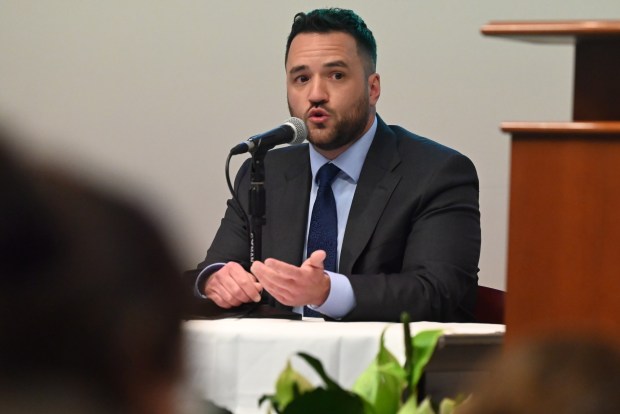 Democratic candidate Jeffery Lake answers questions during the debate at Brennan Hall on the University of Scranton’s campus in Scranton on Thursday, May 6, 2026. (REBECCA PARTICKA/STAFF PHOTOGRAPHER)
While those three legislative proposals have all passed the Democratic-controlled state House, Flynn said he doesn’t see the Republican-controlled state Senate “running those bills.” Nonetheless, he said it’s most important that “we keep local control within local government so that they can’t just shove data centers down (on) the local municipalities.”
Lake immediately criticized Flynn for having previously co-sponsored the bipartisan Senate Bill 939, which aimed to fast-track permitting for data centers while placing limits on local zoning to maintain uniformity across towns. Flynn, who ultimately removed himself as a co-sponsor, told the newspaper in February that he’d vote against the legislation unless language taking away local control was removed.
“The only answer here is that we need a three-year moratorium” on data center development, Lake said. “I’ve been anti-data center since day one. I’ve never changed on that.”
Flynn said he could “see a moratorium for 180 days (or) a year,” but claimed a moratorium wouldn’t stop proposed data center projects that had already begun the application process. He also stressed that he’s never voted for data centers.
“There was never a vote for data centers, yes or no, so how can anybody say how I stand for data centers or attack me on social media?” he asked rhetorically. “I’ve never voted for them, or against them, but I am against 1000% data centers in neighborhoods, period.”
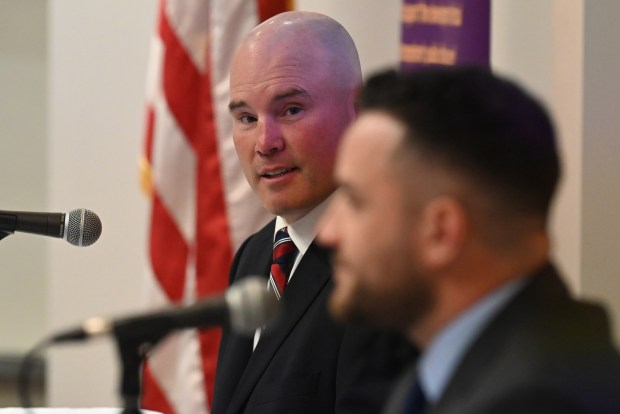 Democratic incumbent Marty Flynn rebuts Democratic candidate Jeffery Lake during the 22nd Senatorial District debate at Brennan Hall on the University of Scranton’s campus in Scranton on Thursday, May 6, 2026. (REBECCA PARTICKA/STAFF PHOTOGRAPHER)
Lake pushed back.
“Marty wants to talk about his stance, and of course there hasn’t been a vote on data centers yet, however, what we do know is … he was, quote, 100% behind SB 939 before reading the details of the bill,” Lake said. “Second, residential areas aren’t the only spot where we have to be worried about.”
The primary election is set for Tuesday, May 19.
Check back for updates.