
Suddenly, I’m in the fifth grade again, wedged into the back seat between cousins during the long drive out of Kolkata to Santiniketan, shepherded by my grandparents, during the height of Indian monsoon season.
The four-hour drive always took six for us.
We stopped at roadside tea stalls for tiny cups of steaming chai in the rain, bought cucumbers — sliced lengthwise and dusted aggressively with rock salt and chili powder before being folded into scraps of newspaper — and pulled over at sweet shops for syrup-soaked roshogullas.
Entering Birbhum’s startling landscape of what I now know are deep rust-colored laterite soils is a core memory. The “red earth” looked all the more vivid against the violent green growth bursting out of everywhere.
Santiniketan is a university town built around the Nobel-prize winning Rabindranath Tagore’s radical vision for art education and cultural exchange. Tagore’s poems were part of the fabric of growing up in Kolkata, from reciting them at school assemblies to being quoted casually by adults.
So when I saw that Sanchayan Ghosh, an artist and educator from Visva Bharati University in Santiniketan, had been commissioned for this year’s Carnegie International, I jolted a little. Of all the places and institutions in the world, this deeply specific corner of eastern India had somehow folded into Pittsburgh. The “international” in Carnegie International stopped feeling like art-world branding and became real.
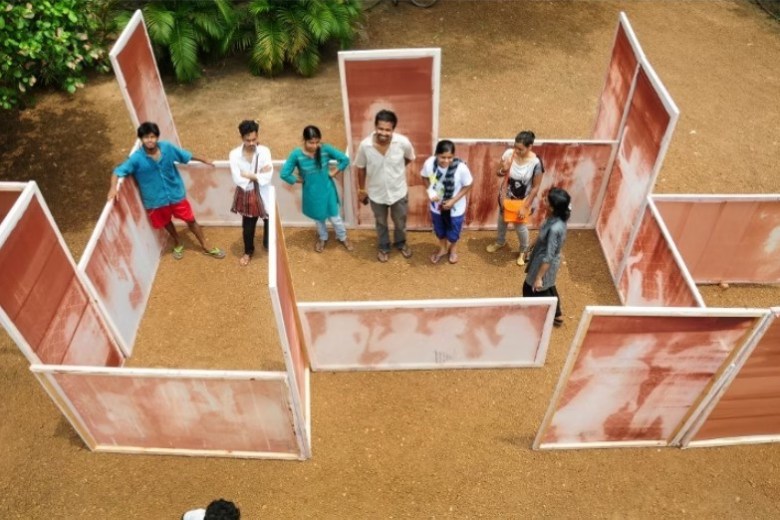 Sanchayan Ghosh, ‘mergEmerge,’ 2004–2014, A 10-year-long shadow casting process with the final-year students of Kala Bhavana Visva-Bharati University, Santiniketan.
This unexpected collision of worlds is what makes this year’s Carnegie International feel unusually alive.
The 59th edition of the Carnegie International, which runs through Jan. 3, 2027, and marks the exhibition’s 130th anniversary, brings together 61 artists and collectives.
The exhibition is not asking Pittsburghers to stay inside the Carnegie Museum of Art. Instead, it spills into four partner institutions across Pittsburgh: the Children’s Museum of Pittsburgh, Kamin Science Center, Mattress Factory and Thelma Lovette YMCA.
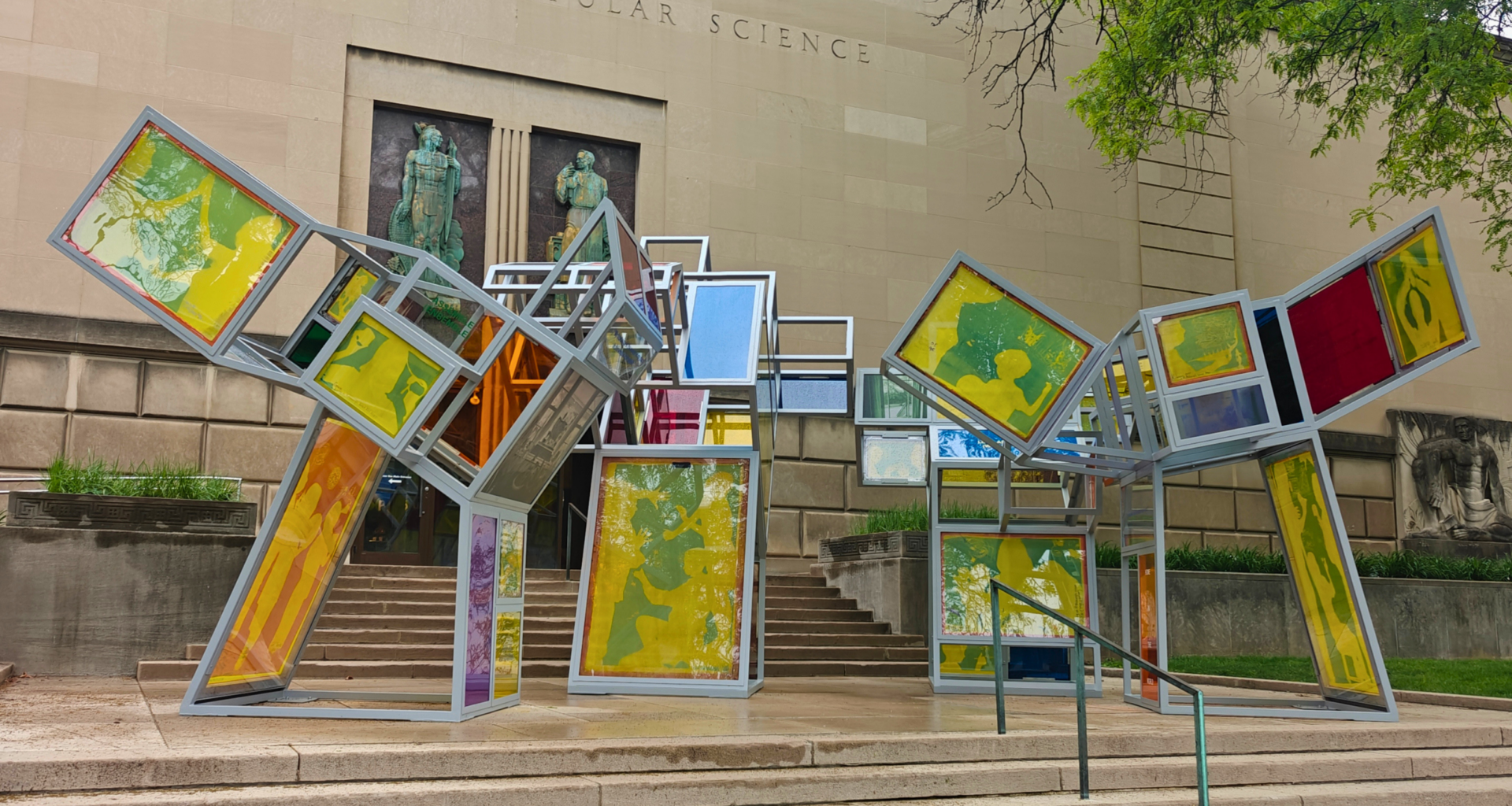
On a recent afternoon outside the Children’s Museum, children ran between colorful clusters of steel structures that caught the light, their shadows briefly merging with translucent screens suspended in geometric frames.
Ghosh has spent months working with the team at the museum and with Pittsburgh families through workshops centered on migration, home and the body.
“My experience in Santiniketan introduced me to engage with site-specific pedagogical practice where the relationship of individual and the collective is explored within an institution,” Ghosh said.
Ghosh traces his practice back to the educational philosophy of Tagore, who envisioned learning as a part of coexistence, nature and collective life. That influence runs through Ghosh’s project for the International, which treats participation itself as the artwork rather than an add-on to it.
For the installation, families and children mapped their homes onto Pittsburgh street grids, drew interior and exterior memories of place and participated in theater-based movement exercises inspired by Bengali playwright Badal Sircar’s “Third Theatre” experiments. Those gestures were later transformed into shadow-like silhouettes through a UV-light exposure process that now forms part of the final installation.
“There were conversations around the recent migrations and the older generational settler who has been living in the city for the last 100 years or more,” Ghosh said. “They reflect moments of congeniality in Pittsburgh, being the host that has embraced multiplicity.”
Ghosh became fascinated by the alignment of the old post office, the Children’s Museum and the former planetarium, seeing them as interconnected systems of communication, play and scientific exploration.
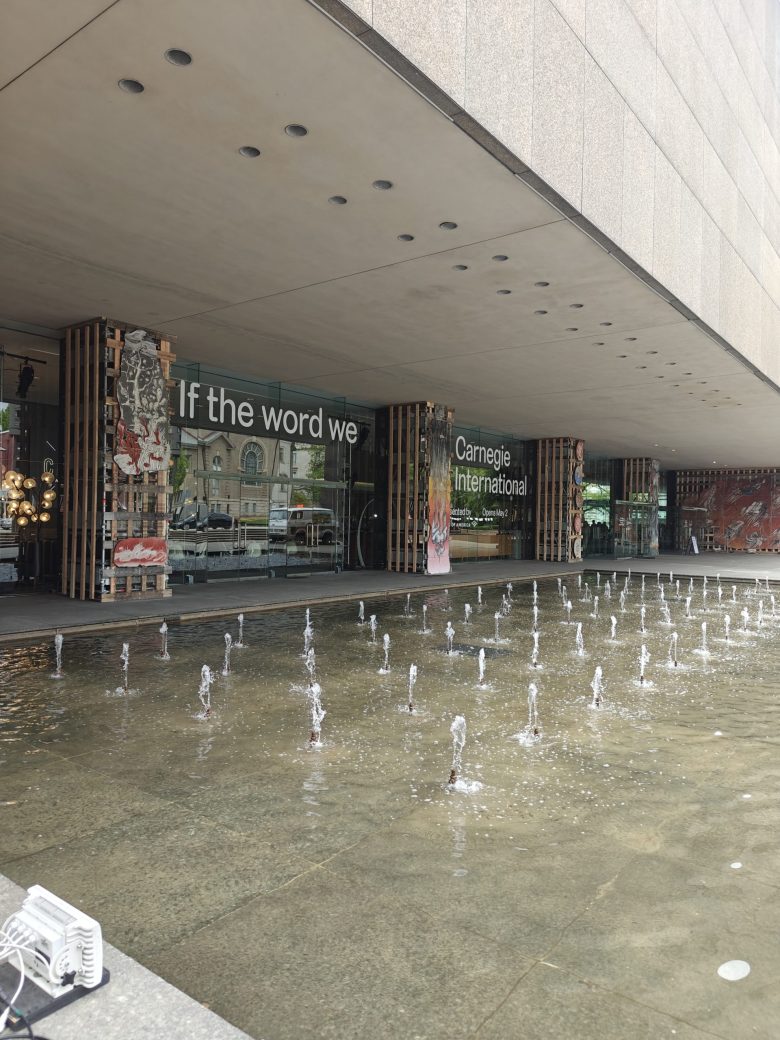 The main entrance of the Carnegie Museum of Art. Photo by Aakanksha Agarwal.
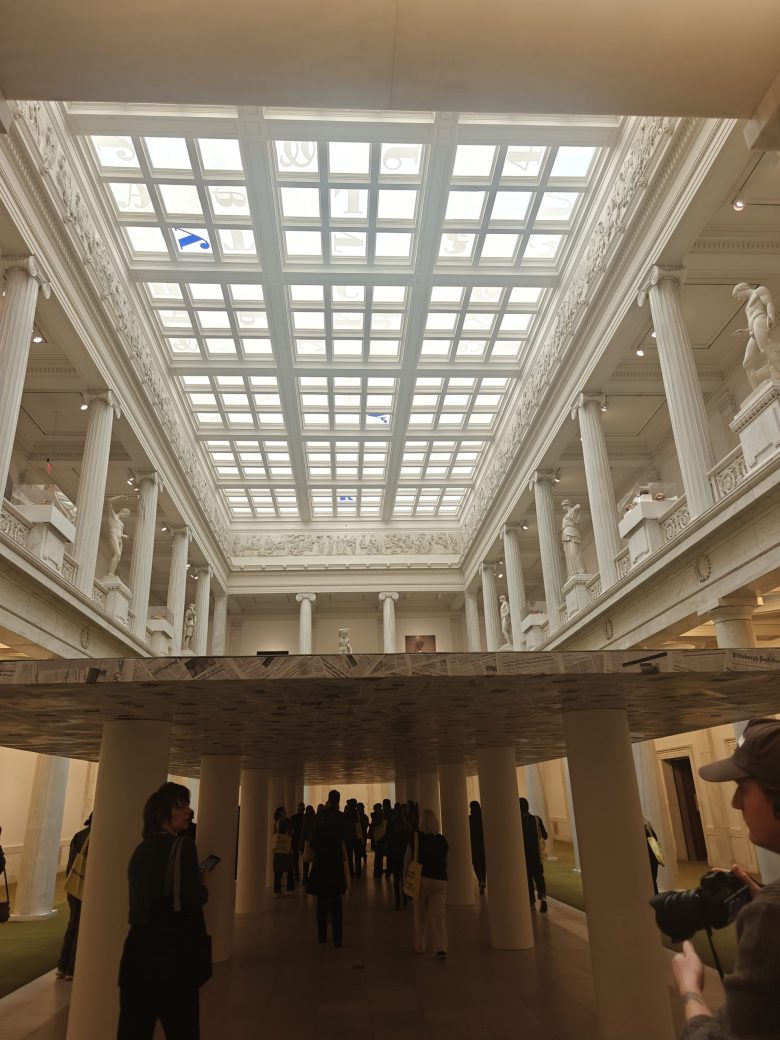 Cinthia Marcelle’s “Green Hall Annex” (2026) on display in the Hall of Sculpture at Carnegie Museum of Art. Photo by Aakanksha Agarwal.
“The choice of situating the installation in front of the entrance of the old Buhl Planetarium is very critical,” Ghosh said. “It situates the work in front of an older idea of the planetarium into this fantastic scientific system of exploring the universe.”
He describes the Children’s Museum as a kind of “neo-site” where participation, gestures and memory become “letters from the citizens of Pittsburgh of multiple cultures and generations towards a future of an integrated whole.”
The installation stretches horizontally across the site in conversation with the neighboring trees and the long lines of the former planetarium building. Ghosh said he became interested in how the work could physically interrupt and respond to the rigid geometry of the architecture around it.
Nearby, beneath the cave-like dome of the Buhl Planetarium at the Science Center, audiences reclined inside a world of seabeds and submerged infrastructure. Artist Torkwase Dyson transforms the Planetarium into an immersive underwater environment with “Tomorrow Was Yesterday.”
The conceptual reversal is striking. While the planetarium traditionally asks audiences to look upward into space, Dyson instead directs viewers downward into submerged industrial systems most people never see.
Amanda Iwaniec, director of visitor engagement at the Science Center, said the collaboration with Carnegie International had been developing for years.
“Typically, the International starts planning far in advance, and from our end, the planetarium immediately came to mind as a really unique environment for an installation like this,” Iwaniec said. “We were really excited by the opportunity to provide a different kind of immersive environment for the piece.”
Integrating the work into the dome required substantial technical coordination. Iwaniec explained that the planetarium uses eight separate projectors layered together to create the final immersive image.
“Working with the artist and their team, we were able to get the content integrated and displayed beautifully on the screen,” Iwaniec said.
The project also aligns surprisingly naturally with the evolving identity of the planetarium itself. Founded in 1939, the Buhl Planetarium began with traditional astronomy shows before gradually expanding into laser concerts, Earth-science programming and immersive storytelling experiences.
“A lot of our current content actually turns the lens back onto Earth,” Iwaniec said. “That immersive environmental perspective connects beautifully with Torkwase Dyson’s work as well.”
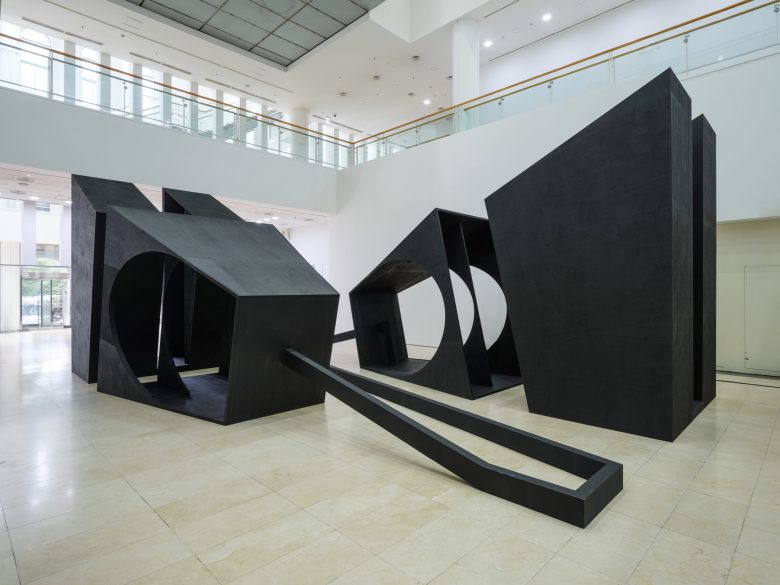 Torkwase Dyson, “I Belong to the Distance 3,” (Force Multiplier), 2023, installation view of the 12th
Seoul Mediacity Biennale THIS TOO, IS A MAP, Seoul Museum of Art, 2023. Courtesy of the Seoul Museum of
Art. Photo: GLIMWORKERS.
The project also creates an entry point for audiences who may never intentionally visit a contemporary art exhibition, Iwaniec said.
“Traditionally, people think of planetariums as astronomy spaces,” Iwaniec said. “What excited me most was continuing that tradition while exposing guests, who maybe aren’t used to seeing contemporary art installations, to something new and curiosity-driven.”
A few miles north, Peruvian artists Arturo Kameya and Claudia Martínez Garay transform 516 Sampsonia Way, a Victorian-era row house, into a sprawling, layered installation exploring colonial memory, Peruvian identity and cultural narratives.
The row house is one of Mattress Factory’s annex buildings that, unlike a traditional gallery, allows artists to take over an entire three-story home.
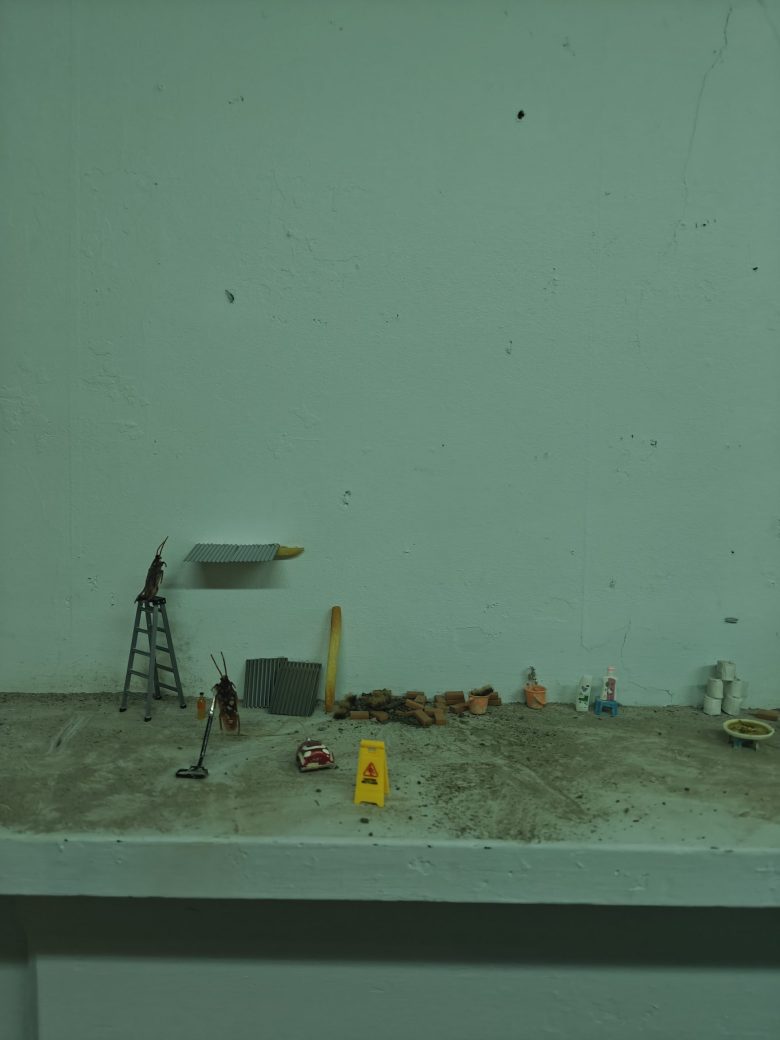 Arturo Kameya and Claudia Martínez Garay on display at The Mattress Factory. Photo by Aakanksha Agarwal.
Anthony Elms, artistic director at Mattress Factory, said the collaboration began when Carnegie International curator Danielle A. Jackson approached the institution about partnering on the project.
“Our building allowed them to play with individual presentations, collaborations, and complex meetings and merging of their two approaches into a baroque series of tableau,” Elms said. “It allows the artists to stretch at an architectural scale.”
Rather than treating the building as neutral gallery space, the artists approached it as what Elms described as “a larger narrative structure with distinct encounters with space.”
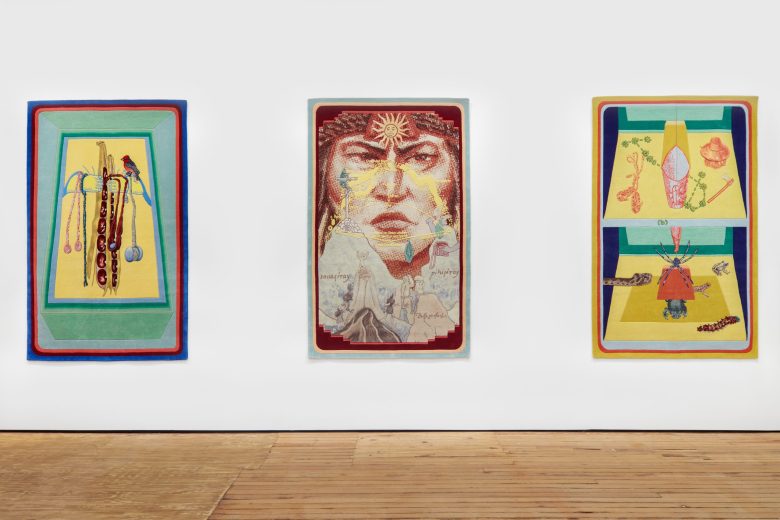 Claudia Martínez Garay, installation view of “Ghost Kingdom,” Sept. 9–Oct.15,
2022, GRIMM, New York. Courtesy the artist and GRIMM, Amsterdam | New York | London. Photo: On White
Wall Studio.
It created an almost haunted narrative environment, with many traces of the building’s previous lives becoming part of the installation itself.
“They used the many conflicting layers of life and renovation in the building to further confuse and blend times, spaces and types of rooms,” Elms said. “It becomes an experience where all details — lighting, room shape, artwork, floor treatment, level of disuse and arrangement — are heightened and questioned.”
The installation deals with colonial legacy, extraction and state power, themes that resonate across several works in the International. But Elms said the goal was not to simplify those histories for audiences.
“Histories are always embodied in the spaces and traditions of our lives and locations,” Elms said. “Art is simply one way to tell these stories and reflect on their ghosts and repercussions.”
The collaboration also carries institutional memory, Elms noted, harking back to major projects developed jointly with the Carnegie International in the 1990s, particularly those involving Ann Hamilton and John Cage, that helped shape the institution’s identity.
At the Thelma Lovette YMCA in the Hill District, “Be Holding” merges poetry, music and performance on a basketball court. Created by Brooke O’Harra alongside poet Ross Gay, composer Tyshawn Sorey and ensemble Yarn/Wire, the piece draws from Gay’s long poem inspired by Julius Erving’s iconic move during the 1980 NBA Finals. Pittsburgh students participate in both performance and production, further blurring the distance between audience and artwork.
That idea of coexistence runs through the entire International, which curators describe as “a shared space of listening” shaped during a moment marked by displacement, political violence and fractured collective life. “If the word we” feels unusually plugged into Pittsburgh itself, encompassing institutions with wildly different energies and audiences.
The exhibition moves across neighborhoods and publics that do not always overlap: children and families, science museum visitors, installation-art audiences, students, performers and longtime Hill District residents.
Ghosh envisions the project as something to continue evolving long after opening weekend.
“The work will respond and evolve as a piece with the changing phenomenon of the environment and the weather,” Ghosh said. “This installation will keep on changing its character and expression with the changing seasons of Pittsburgh and become a new encounter for viewers in different times of the year.”
Ghosh said Pittsburgh ultimately became less the subject of the project and more a meeting point.
“So this is not just a project on Pittsburgh,” Ghosh said. “It situates the context of Pittsburgh as a takeoff point to engage with multiple histories of coexistence and create space for different traditions of cultural memories to come together not as separate entities, but as entanglement in the present.”
That idea of coexistence takes different forms across the exhibition. Each institution changes the work it hosts.
“The offsite venues help give a different temperature to an exhibition which is not only about the inside walls of the Carnegie,” Elms said. “It says that we matter for each other and for the world.”