
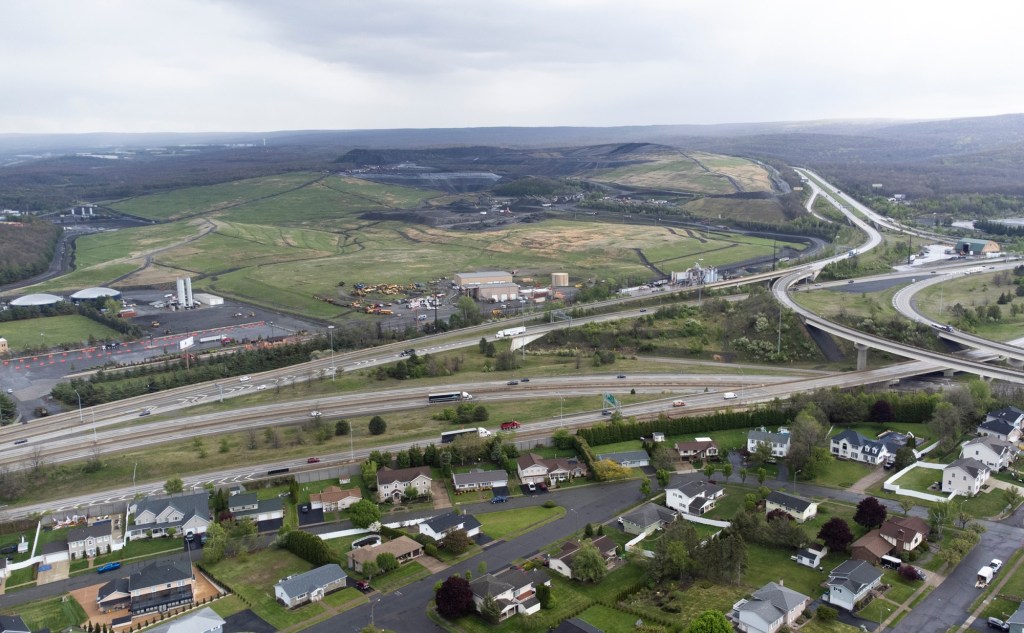
The Keystone Sanitary Landfill will generate more than twice the leachate per day than it once predicted during the peak of its expansion, producing more than 108 million gallons of the garbage-laden liquid in 2033.
The Louis and Dominick DeNaples-owned landfill provided the state Department of Environmental Protection with updated projections for leachate generation in March as part of a 296-page response to a January permit renewal letter from the agency as it reviews the landfill’s operating permit application in light of a pivotal ruling last year. At the height of its leachate generation the landfill in Dunmore and Throop will produce an average of nearly 300,000 gallons of leachate per day in 2033, according to Keystone’s response letter. In total, Keystone would produce about 108.3 million gallons of leachate during its peak, or enough to fill 164 Olympic-sized swimming pools.
Leachate is the liquid that percolates through garbage piles and is a major source of landfill odors.
The response letter also provides an updated timeline for the landfill, pushing back the date of operation for the final stage of its controversial, 40-plus-year Phase III expansion by five years into 2066 while predicting it will continue to produce millions of gallons of leachate annually into the 2070s.
The March 4 response comes amid the DEP’s extended review of the landfill’s operating permit following a ruling last year from the Pennsylvania Environmental Hearing Board that remanded the landfill’s Phase III expansion approval back to the DEP over odor and excessive leachate issues.
The DEP initially granted the landfill’s decadeslong expansion June 3, 2021, giving Keystone the capacity to triple its volume of waste into the 2060s by adding just over 94 million tons of garbage, or about 188 billion pounds. Friends of Lackawanna, the grassroots landfill opposition group that formed in 2014 to oppose Keystone and its expansion, appealed the decision, bringing it before the hearing board.
On April 1, 2025, the panel of environmental judges sent the approval back to the DEP, ruling the department erred by approving the expansion without adequately addressing leachate and odor issues.
The ruling prompted the DEP to extend its review of the landfill’s operating permit application. Operating permits normally expire after 10 years, but the ruling upended that timeline. To give itself more time for the review, the DEP twice extended the landfill’s operating permit, which was initially set to expire April 6, 2025. Two days before it expired, the agency granted a six-month extension through Oct. 6; on Oct. 6, the DEP granted a second temporary extension through Dec. 31, 2026, to give itself more time to monitor Keystone’s odor controls and to reevaluate a harms-benefits analysis.
DEP spokeswoman Patti Monahan said Friday that the landfill’s permit response is under review.
“DEP could reach a decision on the application before the end of 2026,” she said.
In its most recent review letter dated Jan. 5, the DEP addressed the landfill’s leachate generation, its handling of the concentrated waste left behind after leachate is treated on site, odor and gas management, and air quality by recommending another round of comprehensive air monitoring. Environmental Engineering Manager David F. Matcho signed the letter, which was addressed to landfill Site Manager Dominick DeNaples Jr.
Notably, the letter points out that Keystone’s modeling predicts a maximum of 127,644 gallons per day of leachate, but current leachate generation rates already exceed that. The letter also notes that Keystone cites contractual arrangements to haul 9.2 million gallons of leachate offsite per month to comply with storage and treatment requirements, but KSL is only permitted to haul leachate for emergency purposes — not compliance. To haul it offsite for compliance, it would have to revise its leachate management plan, with the additional vehicle traffic being a potential factor in weighing harms and benefits.
Keystone’s March 4 response letter addressed its leachate treatment and storage. The landfill collects leachate in two 2.5-million-gallon glass-lined storage tanks. The treatment capacity is about 360,000 gallons of leachate per day.
The landfill said it based its new leachate estimates on data collected between March 2024 and December 2025, which it selected because it “reflects significant improvements in reducing leachate generation and data accuracy.” It also acknowledged the offsite hauling, saying it would not be revising its plan to seek approval of hauling leachate offsite for compliance.
For 2026, Keystone projects to generate about 204,531 gallons of leachate per day, totaling about 74.7 million for the year. It will peak in 2033 with 296,615 thousand gallons per day on average — with a daily projected maximum of 385,600 gallons — to produce 108.3 million gallons of leachate. Those figures almost entirely remain in the 90-million to low 100-million range through 2052, falling to 85.2 million gallons in 2053 and continuing to trend downward for the next 20-plus years.
The 50-year projection concludes with 2076, where the landfill would still generate an estimated 5.2 million gallons of leachate.
A new timeline also extends the Phase III expansion’s final phase of work. The original dates of operation for pad 16, the final area of the expansion, span from June 2050 through February 2061, but under the revised timeline, pad 16 will now be operational from July 2056 until November 2066.
Attempts to reach landfill consultant Al Magnotta were unsuccessful Friday.
Pat Clark, a leader of Friends of Lackawanna, is wary of the new projections. He believes the DEP should produce a new harms-benefits analysis on the landfill, and with the new information available, use it to deny the expansion.
“This issue with leachate, just like odors in the past, and just like the overall amount of trash they can take in, is the landfill’s pattern,” Clark said. “They minimize the problem, assure the DEP and public it’s under control, then they come back asking for expanded systems, revised projections, additional capacity and new infrastructure once their original assumptions are almost always proven insufficient.”
Clark said Friends of Lackawanna has long argued the landfill’s projections will continue to grow, requiring more infrastructure and more treatment systems to handle it.
“You can look no further than the data centers and our landfills … as the scale of those operations grow, so too do the scale of the problems,” Clark said. “Give them an inch, and they’ll take a yard. Give them a gallon, and they’ll take a swimming pool.”