
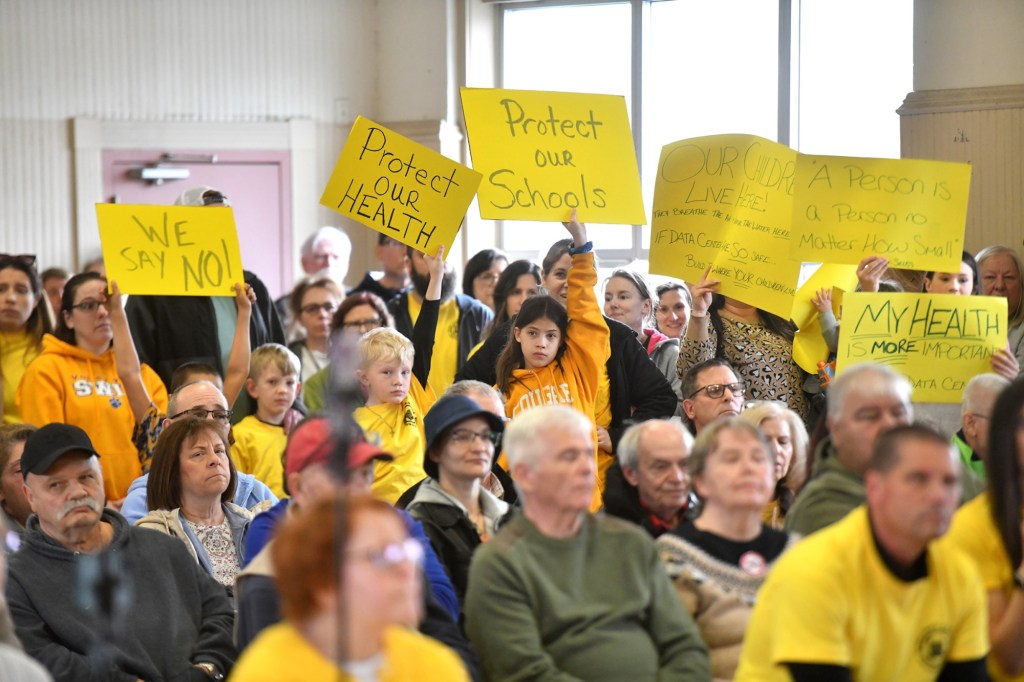
Only a fraction of more than a dozen Lackawanna County data center campuses proposed in the last 16 months will actually materialize, one of the industry’s leading advocacy groups believes.
“It is going to depend on the individual players themselves, but I do think you can safely say the ones that will come to fruition will likely be 25% or less,” said Dan Diorio, vice president of state policy for the Data Center Coalition.
The industry’s rise could reshape Northeast Pennsylvania as developers site campuses across thousands of acres. The land is often undeveloped, and some plans would place data centers near homes, parks and schools. There are at least 13 campuses proposed in Lackawanna County, totaling about 90 individual data centers, in Archbald, Clifton and Covington townships, Dickson City, Jessup, Newton Twp., Olyphant and Ransom Twp.
The majority of those buildings are in Archbald, which has six proposed projects amounting to 51 individual data center buildings. More than half of those are confined to a 1-mile corridor along Eynon Jermyn Road.
Elsewhere in the region, there are at least nine campuses proposed in Luzerne County in West Hazleton and Dorrance, Hazle, Hollenback, Nescopeck, Salem and Sugarloaf townships, and one in Kline Twp., Schuylkill County.
With Northeast Pennsylvania’s available land, easy access to high-tension power lines and high-speed fiber optic internet lines, the region has captured the attention of the data center industry, both from developers with previous data center experience and “new entrants” who blur the lines between speculation and development.
Representing many of the major players in the data center industry, the Data Center Coalition, or DCC, is a membership association that “empowers and champions the data center community through public policy advocacy, thought leadership, stakeholder outreach, and community engagement.” The organization’s membership roster features household names such as Amazon Web Services, Google, Microsoft, Meta and OpenAI.
As part of the data center industry, Diorio sees Pennsylvania as an emerging market.
In a recent phone interview, Diorio weighed in on the state of data centers in Northeast Pennsylvania, ranging from misconceptions about the industry to challenges posed by speculative newcomers entering the market.
‘Very attractive’
Although individual developers weigh criteria differently when selecting sites for data centers, they all have at least one factor in common: time to market, Diorio said.
“What is your ability to get up and running and get operational,” he said.
To move quicker, data centers look for available and affordable land, power and fiber-optic internet infrastructure with low latency, the tax and regulatory climate, and whether there’s a workforce to construct, maintain and operate data centers, Diorio said.
“All of those factors are weighed, and I think you’re seeing some of those factors come into play in northeastern Pennsylvania,” Diorio said. “Having the infrastructure available there, having the land and certainly having the workforce is going to make that particular area of the state very attractive.”
Diorio also pointed to Pennsylvania’s commitment to energy infrastructure. Last year, PPL Corporation announced a joint venture with Blackstone Infrastructure to build, own and operate natural gas power plants throughout the state to power data centers.
Addressing the proliferation of local data centers, including multiple campuses proposed on adjacent parcels of land in Archbald, Diorio explained the industry also tends to cluster.
“There’s value in having buildings being able to talk to each other, having campuses being able to talk to each other, working off similar infrastructure and the connectedness of the industry in and of itself,” he said. “That is a common theme throughout the country, no matter what market you’re in.”
While artificial intelligence is a key growth driver within the industry, the majority of data centers are being built for the cloud, Diorio said. He described the cloud as “the underpinning of the entire 21st-century economy.”
Microsoft, through the website for its cloud computing platform Azure, defines the cloud as “a vast online storage space where people and businesses store their files and applications, accessible from anywhere with an internet connection.” The cloud provides on-demand access to computing resources and services over the internet, according to Microsoft. Essentially, if someone uploads photos or videos to a cloud service like Apple iCloud or Google Drive, they are stored somewhere in a data center.
More broadly, Diorio said the cloud is used for services like electronic healthcare records, banking and finance, telehealth and online classrooms.
‘Very challenging’
Diorio expects less than a quarter of data centers will materialize, though it depends on individual developers and other factors.
Factors include longer and longer timelines to secure power, a lack of available materials and “new entrants” in the industry making it more difficult to determine whether a project is real or speculative, Diorio said.
“I will admit that we are very challenged in the data center industry by what I diplomatically term ‘new entrants’ to the marketplace,” Diorio said. “I’m fortunate enough to represent leading data center owners and operators. These are companies that have been building data centers for decades. They know how to do this. … But there are others, these new entrants to the marketplace, that don’t have that level of experience and insight, and that can be very challenging.”
While some data center developers in Northeast Pennsylvania tout prior experience with the facilities, other companies’ proposed campuses represent their first ventures into the industry.
“We see these new entrants to the marketplace that are coming into these clusters, and they don’t necessarily have the level of experience or sophistication that that our members do,” Diorio said.
Established firms with decades of experience understand how to develop data centers, how to ramp up the facilities as they come online, and they are “constantly calibrating to the demand that they’re seeing, to ensure that they’re building out their infrastructure appropriately,” Diorio said. New entrants may lack that expertise.
“It’s hyperbolic, but it’s not too far off to say sometimes these were companies that were building residential homes six months ago, and now they’re trying to be data center developers,” he said. “That presents a challenge, because there are inherent frictions that come in with a company that’s not as sophisticated in knowing how these things ramp. They’re looking at the marketplace saying, ‘I need to get in and sell this land off. I need to get power and then sell this land off to a known developer,’ and that skews the marketplace.”
It’s also a challenge when forecasting how much water and electricity the campuses use, Diorio said.
“How can utilities and regulators effectively evaluate who is proposing these projects? Do they have a history of development? Have they built a data center before?” he said. “How well capitalized are they so that utilities and regulators can really risk these projects appropriately, or de-risk these projects appropriately? Are they moving through the permitting process so that they can accurately know which projects are real and which projects are perhaps more speculative?”
Companies with development experience for projects like commercial office buildings and industrial sites bring with them more experience and a better skillset when approaching public stakeholders, Diorio said.
“It’s the bad examples that get held up as the symbols of the industry, not necessarily the best examples that we have where we see investment in the community that has transformed the local budget, that has transformed the local schools, that has helped reduce taxes for others, that has created significant amounts of new skilled trade jobs within the community,” he said.
‘Troubling optics’
Data center developers absolutely have to engage with the public and hold stakeholder meetings, Diorio said.
“It’s important to do broad education on what the project is and what the project isn’t, how it’s going to use resources wisely, how it won’t increase your energy bill, how it will be one of the most water-efficient industries throughout the economy, and ultimately, what it means for local budgets and affordability questions in the community, and how it will invest in jobs,” he said. “It really is incumbent upon the industry to continue to do that robust stakeholder engagement.”
Asked about his perspective on large clusters of data centers near parks, homes and schools, such as the 30 proposed data centers along the Eynon Jermyn Road corridor in Archbald, Diorio acknowledged projects can present “troubling optics.”
“I do think it’s important to point out that data centers follow every applicable law and regulation from the federal, state and local level — they don’t get a free pass on development,” he said, later adding about Archbald, “That is troubling optics. There’s no question about that, and I think in many ways, it can be be hard to defend and just say, ‘We follow the laws that that we are required to follow, just like any large development would.’”
Data centers seek out sites with the infrastructure to support them, like high-voltage power lines and fiber-optic lines, and locations with that infrastructure tend to be industrial, he said.
“It’s hard to say that a data center shouldn’t be developed in a place where it’s legally allowed to do so, but of course, I think it’s incumbent upon the company to work very closely with the local leadership to address the unique concerns that that individual parcel may have, whether it be proximity to certain residential areas or schools or parks or those types of things, to ensure that the project itself is not going to be a detriment or not a responsible partner in those areas,” Diorio said.
‘Worst-case scenario’
Diorio also believes there are misconceptions about the industry, including surrounding utility use and projections.
Water and electricity demands represent two of the major concerns surrounding data centers.
Diorio stressed that when data centers have extremely high water estimates, they plan not only for their peak use, but also worst-case scenarios.
“I think that’s where the alarmist portion of it comes in, which is, they may use up to this amount in a single day, but that really reflects the worst-case scenario,” he said, explaining actual water usage is “virtually always” less.
Electric utilities have to have the power generation available first to ensure continuity of power before supplying a data center. The DCC sees timelines for power delivery moving further out in large markets like Virginia, with projects waiting up to seven years before receiving power, Diorio said.
“You have to serve the customer, but certainly you don’t have to provide power to the customer until you reasonably can — until you have the infrastructure to serve them,” he said.
One of the challenges with new entrants, Diorio said, is that they come in with high power demands, and they want the power immediately.
“That is just very much not how the industry works,” he said.
Data centers don’t require peak power immediately, Diorio said. Instead, loads ramp up over time as buildings come online and customers move in.
Water and electricity also have inverse relationships, where using less water for cooling requires more electricity and vice versa, he said.
It’s difficult to predict daily water consumption, but the industry has been actively implementing water-efficient technologies for years, he said.
“What we see is data centers use less water than semiconductor manufacturing, than food and beverage production,” Diorio said.
‘Real need’
As remnants of Northeast Pennsylvania’s coal mining heritage still mar the local landscape, elected officials and residents routinely draw parallels between the coal industry and data centers. Just like culm dump that lingers decades after a colliery shut down, critics of data centers question what will happen to the structures when they close. Proposed data centers are often two stories with footprints exceeding 130,000 square feet.
The data center industry isn’t seeing buildings hitting their end of life, Diorio said.
“If anything, data centers are taking, or have taken over, older buildings and refurbishing them into a data center,” he said.
As technology continues to improve and become more efficient, the DCC expects data centers to remain operational for the long term, with buildings having potential lifetimes of 30-plus years, he said.
“These are buildings for the long haul,” he said. “As long as demand continues to increase, which there’s no signs of it slowing, there’s going to be a need for data centers.”
‘We’re getting crushed’
Presiding over the borough council in Lackawanna County’s data center hotspot, Archbald council President Louis Rapoch praised the notion of only a fraction of data centers materializing.
“Wouldn’t that be nice?” he said. “We’d have some people in this town actually happy.”
If most data centers don’t come to fruition, though, he questioned what will happen to the land between Eynon Jermyn Road and Business Route 6 where developers already cut down large swaths of trees.
“What about all the properties that they ripped apart?” he said. “What are they going to do with them? Leave them like that?”
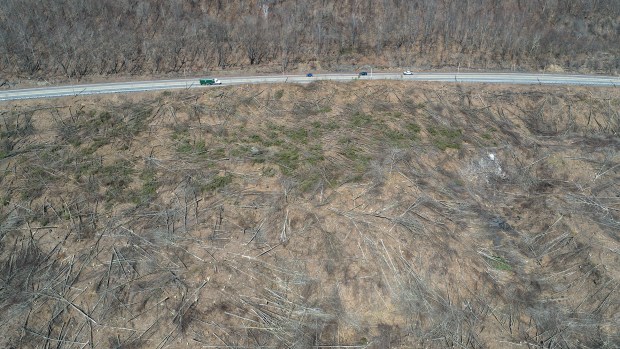 Vehicles pass a clearing of trees along Business Route 6 in Archbald Tuesday, March 24, 2026. (SEAN MCKEAG / STAFF PHOTOGRAPHER)
With data center projects proposed to more than 2.4 square miles of his entire borough’s land, or about 14% of Archbald, including near parks, homes and schools, Rapoch contends developers care about money — not the community.
“We’re getting crushed, and we don’t know which way to turn to fight this one, that one, the other one,” he said.
Several of the proposed data center projects in Archbald fall into conditional use designations, giving council the power to approve or deny their applications. Rapoch stressed that he has to consider the applications neutrally. If a data centers meet all of the conditions that the borough established for the industry, Archbald would have to allow it, though Rapoch doesn’t expect every proposal to meet them. Pennsylvania requires municipalities to allow for every lawful land use somewhere within their borders.
If data centers do materialize in Archbald, Rapoch reiterated concerns about their lifespan and decommissioning.
“We can make museums out of them: ‘This is what data centers did to ruin our population,’” he said.