
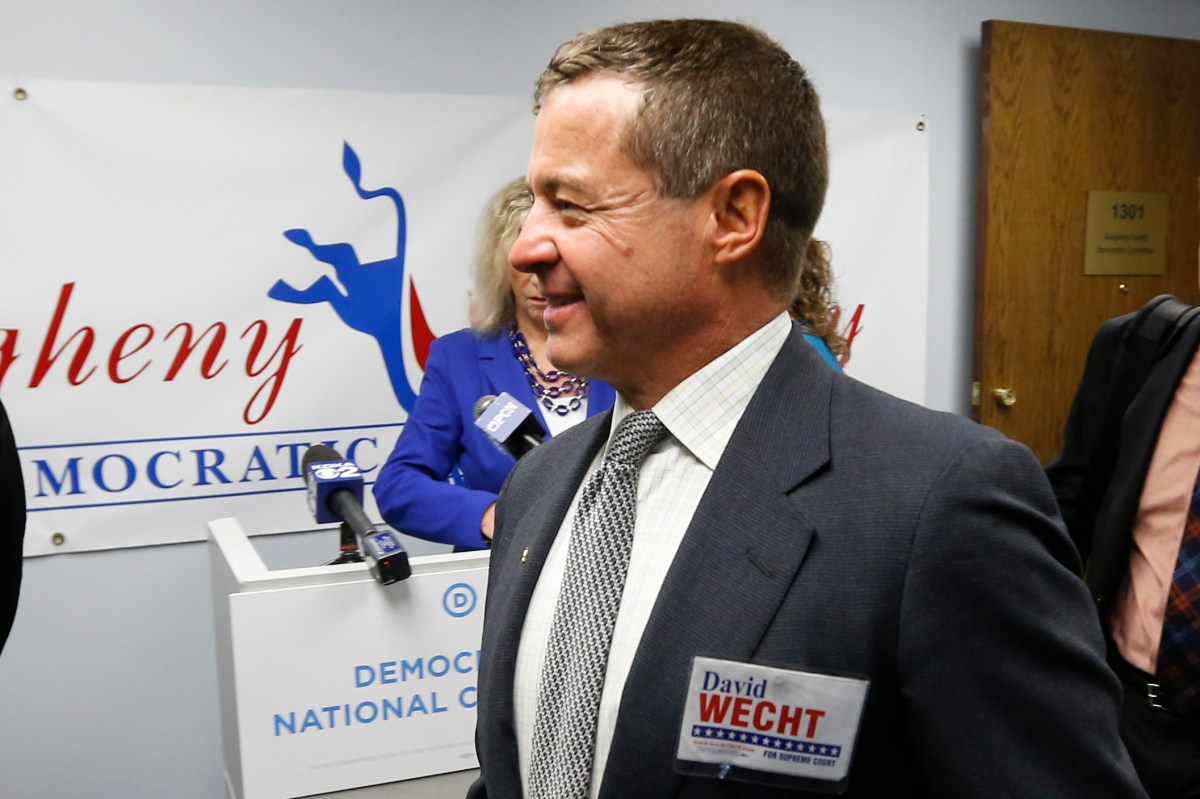
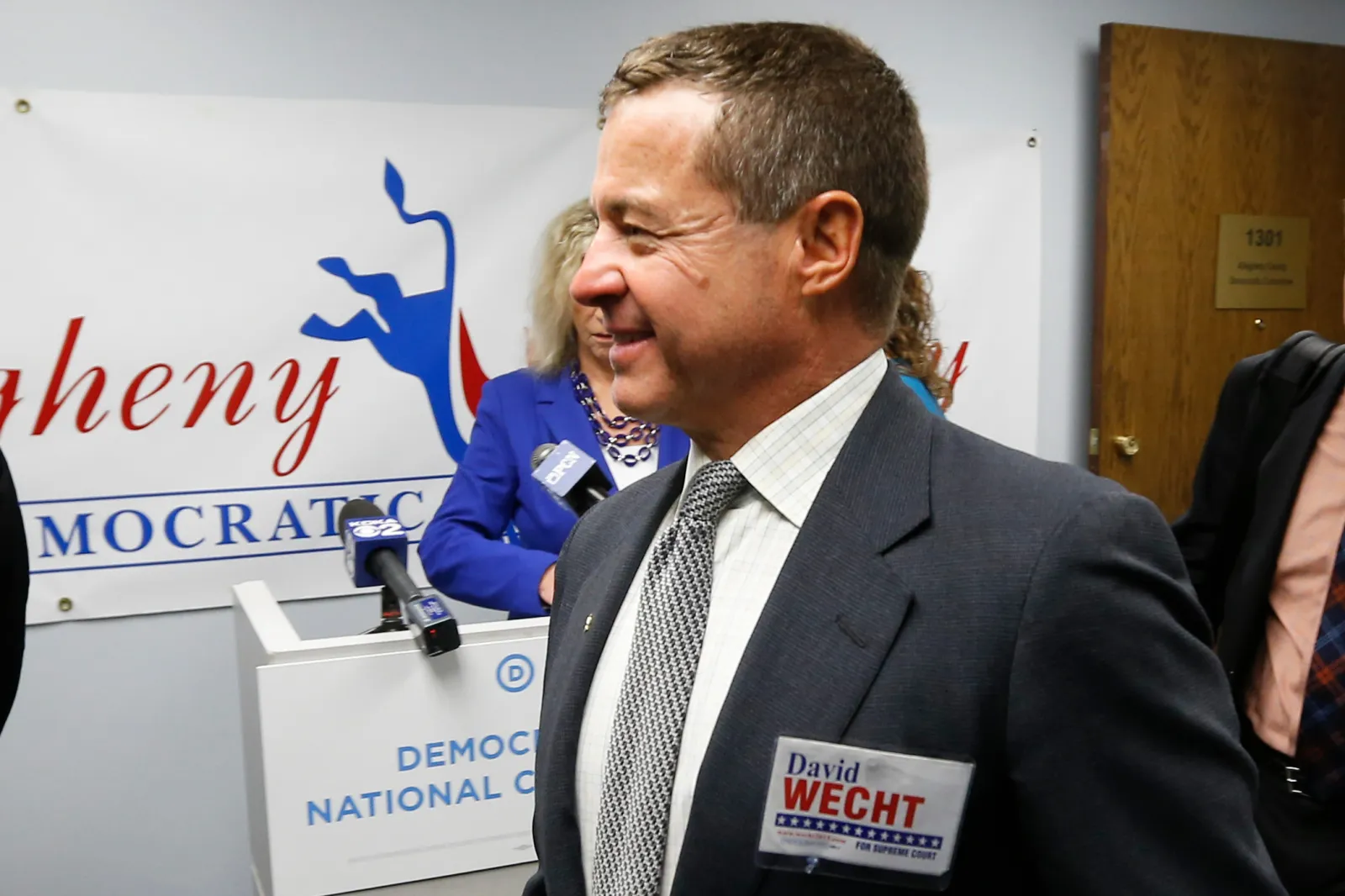
Pennsylvania Supreme Court Justice David Wecht announced Monday he is leaving the Democratic Party and registering as an independent, citing what he described as rising antisemitism.
In a statement distributed through the state court system, Wecht said, “Acquiescence to Jew-hatred is now disturbingly common among activists, leaders and even many elected officials in the Democratic Party.”
The move highlights internal tensions within the party and adds to the broader political debate over how leaders are responding to antisemitism. Wecht will remain on the state’s high court, but his switch shifts the partisan balance in the critical swing state from a 5–2 Democratic majority to 4 Democrats, 2 Republicans and 1 independent, underscoring potential political fallout ahead.
Newsweek reached out to the Pennsylvania Democratic Party for comment.
What To Know
Wecht, who was first elected to the court as a Democrat in 2015 and retained last year for another 10-year term, said antisemitism has, in his view, increasingly taken root on the left since the 2018 Tree of Life synagogue massacre in Pittsburgh. That attack, which killed 11 worshippers, occurred at the synagogue where Wecht and his wife were married and where he once served on the board.
“In the years that have followed, that same hatred has grown on the left. Increasingly, it has moved from the fringe to the mainstream. It is the duty of all good people to fight this virus, and to do so before it is too late,” he wrote.
In his statement, Wecht cited examples of conduct he says has been minimized or ignored by Democratic leaders, including “jihadist chants, intimidation and attacks at synagogues,” as well as “Nazi tattoos” and other antisemitic imagery.
While he did not name specific Democratic officials, Graham Platner, a Democratic U.S. Senate candidate in Maine, disclosed last year that he had previously obtained a tattoo later identified as resembling a Nazi-linked Totenkopf symbol. Platner has said he was unaware of its meaning at the time and has since covered it up. The controversy drew national attention after prominent Democrats continued to support his candidacy despite condemnation from Jewish advocacy groups.
Newsweek reached out to Platner for comment.
Wecht’s departure adds to a public debate within Democratic circles over how aggressively the party should address antisemitism, particularly amid party infighting following the Israel–Hamas war. Pennsylvania Senator John Fetterman, a Democrat who has sided with Republicans at times and fueled speculation that he could become an independent, wrote on X in response to Wecht’s announcement that “The Democratic Party must confront its own rising antisemitism problem.”
I know David and his legendary father, Cyril. As I’ve affirmed, I’m not changing my party—but I fully understand David’s personal choice,” Fetterman said.
The Pennsylvania Republican Party celebrated Wecht’s announcement in a post on X.
“A sitting Pennsylvania Supreme Court justice, David Wecht, just left the Democratic Party, warning that antisemitism has moved from ‘the fringe to the mainstream.’ This is a literal sitting State Supreme Court Justice saying he can’t stand to be a part of the Democratic party because of the extreme antisemitism their party promotes,” they wrote.
Prominent Jewish Democrats, including Pennsylvania Governor Josh Shapiro, have raised concerns about what they view as the rise of antisemitism on the left.
“I think antisemitism is a very real problem in both the Democratic Party and the Republican Party. Please don’t clip my words there. It is a problem on the political left and the political right, and there should be no place for it when someone like JD Vance allows a Nick Fuentes to have a platform to speak or Tucker Carlson to have a platform to speak, and doesn’t condemn it,” Shapiro said in a February interview with the Associated Press.
An American Jewish Committee poll of 2,056 adults from October 10-November 25, 2024, found that 72 percent of respondents believed antisemitism is a problem in the U.S and that 59 percent believed it had increased over the past five years. It had a margin of error of plus or minus 3 percentage points.
List of Democrats Who Have Left Party Since Trump’s Election
Party switches are historically rare, but numerous Democrats across the country have left the party since Trump’s election in 2024.
South Carolina state Representative Lucas Atkinson (Became a Republican)Florida state Representative Hillary Cassel (Became a Republican)Hawaii state Representative Elle Cochran (Became a Republican)North Carolina state Representative Carla Cunningham (Became an independent)New Hampshire state Representative Dale Girard (Became a Republican)North Carolina state Representative Nasif Majeed (Became an independent)South Dakota state Representative Peri Pourier (Became a Republican)Florida state Representative Susan Valdes (Became a Republican)Kentucky state Senator Robin Webb (Became a Republican)
The two most recent switches came from North Carolina, where state Representatives Carla Cunningham and Nasif Majeed both left the party after losing their primaries against more progressive Democrats.