
Lackawanna County Commissioner Bill Gaughan launched an anti-data center ad campaign Tuesday, blasting messaging across local TV stations and online to encourage residents to fight back against an industry that could drastically reshape the region.
With Lake Scranton as his backdrop, the Democratic county commissioner, who has been a vocal opponent of the data center industry, appears in a 30-second clip telling residents he has an urgent message on data centers.
“It’s not too late to join the fight,” Gaughan said in the ad, referencing proposed campuses throughout Lackawanna County and their potential impacts on air quality, water and electricity. “They want us to think it’s too late, but not if we show up together. Go online, go to meetings, join me and say, ‘No.’ “
The ad features a Lackawanna County map depicting more than a dozen proposed data center campuses, headlines from national media about the inundation of local data centers, and a video illustrating Lake Scranton’s water levels rapidly falling. Lake Scranton is a proposed water source for multiple data center projects.
The video concludes with a URL to Gaughan’s newly launched ShowUpLackawanna.com, which summarizes the most common concerns surrounding data centers and provides links to more than a dozen local community groups and resources addressing the industry.
The campaign comes as Lackawanna County communities hold public hearings on data center proposals almost every week. So far, there are at least 13 proposed data center projects across the county, totaling about 90 individual buildings spanning Archbald, Clifton and Covington townships, Dickson City, Jessup, Newton Twp., Olyphant and Ransom Twp. Archbald has the highest concentration of any community with six projects and 51 data centers. Data center developers also proposed one power plant in Archbald and at least three in Dickson City.
Gaughan routinely attends those public hearings to testify against the campuses, including in Archbald and Dickson City.
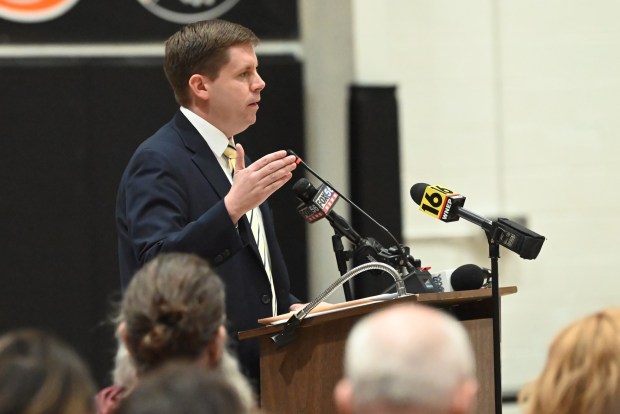 Lackawanna County Commissioner Bill Gaughan speaks during the public hearing on a zoning ordinance to regulate data centers in Dickson City at the Dickson City Civic Center on Thursday, Feb. 12, 2026. (REBECCA PARTICKA/STAFF PHOTOGRAPHER)
In a phone interview Tuesday, he said he launched the campaign after frequently receiving the same question from residents: “Is it too late?”
“The developers and these big corporations are banking on people in Lackawanna County just becoming complacent and drawing this thing out so long that people kind of just give up,” Gaughan said. “I think that the best way to get the message out there that it’s not too late, and get as much information out there in the public sphere, is to put it out there myself.”
To do that, Gaughan used about $30,000 of his campaign funds to finance the campaign, with the commercial and website credited as, “Paid for by Friends of Bill Gaughan.” The ads will run through the middle of next week, he said.
The website covers the most frequent concerns raised about data centers, ranging from deforestation to high water and electricity demands.
“The companies involved here have massive resources,” Gaughan said. “Ordinary residents in this county deserve somebody who’s willing to amplify their concerns and really try to unify the entire county.”
The issues aren’t confined to the communities where data centers are located, he said.
“This is an issue for the entire county,” he said. “What happens in Archbald is going to affect everybody in Scranton, and vice versa.”
Residents are looking for leadership and advocacy from their public officials, Gaughan said.
“This is what representation looks like,” he said. “It’s standing with your constituents when they feel overwhelmed by powerful outside interests, which in this case, there’s a lot of powerful outside interest coming into the county.”
With nearly 100 data centers proposed in Lackawanna County alone, Gaughan contends they will negatively transform the region if they move forward, but that residents still have the power to determine their future.
“There’s nothing more powerful than that — the belief and the hope that we can actually defeat these things and not let them come and destroy the entire county and destroy our way of life and our environment,” he said. “That is the driving force behind the fight to make sure that these things don’t come to fruition.”
Janessa Bednash is a Jermyn resident, but seeing the rise of data centers in neighboring Archbald, she became one of the original members of the Stop Archbald Data Centers movement, which now boasts more than 11,000 members on Facebook. Bednash frequently speaks at Archbald meetings in opposition of the industry.
She called the new campaign “fantastic.”
“It really does show how the entire valley needs to come together for this,” Bednash said. “The problems don’t stop at the Archbald Borough lines.”
As a core member of Stop Archbald Data Centers, which uses fundraising from a GoFundMe campaign, T-shirts, signs and lemonade stands to fund a legal defense against the industry, Bednash said Gaughan’s campaign lays out important information on data centers, and she lauded him for linking various community pages on the website.
“It really just feels like a hostile takeover at this point,” Bednash said of the industry. “So I think it’s fantastic that he’s putting this out there for everybody to really get some information.”
Tamara Misewicz-Healey founded Stop Archbald Data Centers in October with her husband, Justin, and since then, the mother of three has been an outspoken opponent of data centers in Archbald, joining every zoning hearing as a party in order to cross examine each data center representative who testifies.
Gaughan’s messaging is exactly what’s needed, she said. Data centers are a regional issue, and as a county commissioner, Gaughan looks at the industry from a county perspective without hyper-focusing on one town, she said.
As an industrial hygienist, Misewicz-Healey said data centers’ impacts on water, air quality, electricity, noise and traffic cross municipal borders. The silver lining of the data center industry’s local rise is the sense of community and identity it has created among residents, she said.
“It takes a community to save a community,” Misewicz-Healey said.