
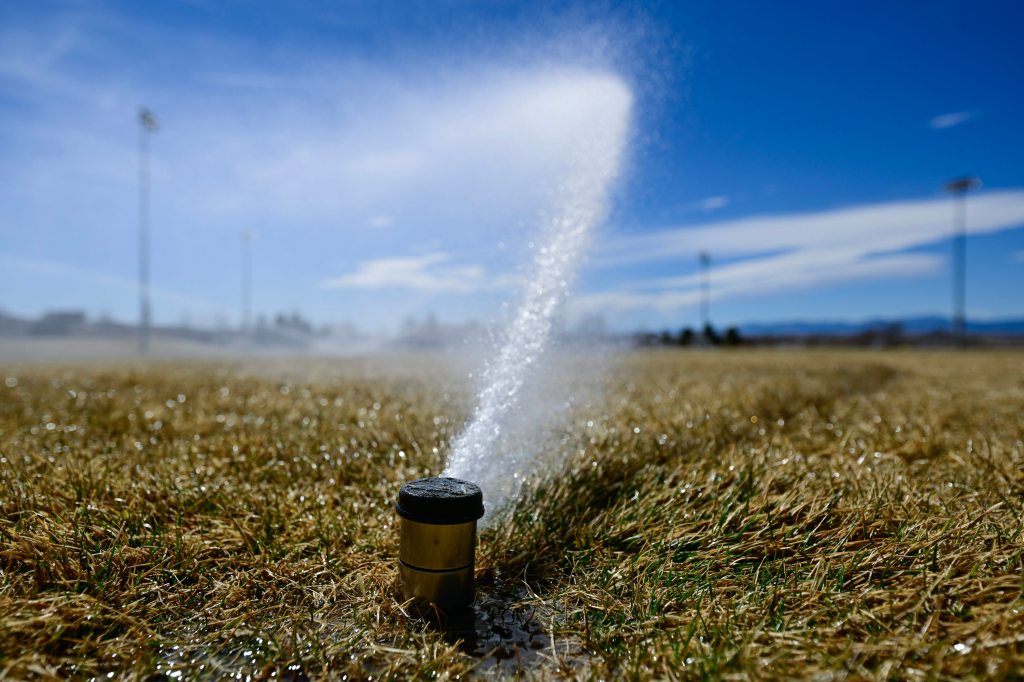
As Colorado endures one of its driest and warmest stretches in recent memory, the town of Erie has officially entered Stage 2 drought response with the Town Council’s unanimous approval of a declaration aimed at reducing outdoor water use.
Erie Utilities Director Todd Fessenden framed the declaration as a “proactive” step designed to curb water demand early rather than waiting until hotter summer months make conservation more difficult.
The Tuesday declaration from the council formalizes Erie’s already-recommended voluntary two-day-per-week watering schedule, which the town had encouraged residents to follow in early April after a water shortage directive issued on March 20 — urging the public to keep sprinklers off — was lifted.
Erie is continuing to ask even-numbered addresses to water on Monday and Thursday, and odd-numbered addresses to water on Tuesday and Friday. An optional third watering day on weekends would be announced if town staff determine additional watering is necessary based on weather conditions.
Town officials have reiterated that watering should occur only between 8 p.m. and 8 a.m.
“We did not officially enter Stage 1,” town spokesperson Gabi Rae said, adding: “We are entering Stage 2 directly because we believe the conditions warrant it.”
‘Proactive’ water conservation
Town officials say Erie is not facing an immediate water supply crisis.
“While the current water shortage index may not independently trigger a Stage 2 declaration, observed conditions including a historically low snowpack, expected high irrigation demand, as well as regional conditions and actions warrant the Stage 2 declaration,” Fessenden wrote in a memo to the Town Council.
Erie’s water rights portfolio remains “strong,” his memo says. But, it adds: “If we wait until summer to react, the ability to meaningfully reduce peak demand is limited. Once irrigation timers are set, it’s more difficult to change.”
Dylan King, a sustainability and water conservation specialist for Erie, said the Stage 2 declaration, as defined by the town’s Drought and Water Supply Shortage Plan, includes outreach and conservation measures aimed at some of Erie’s largest water users.
The town’s staff plans to work with homeowners associations, school districts, landscapers and facilities such as Colorado National Golf Club to encourage voluntary reductions and improve irrigation efficiency, King told the council during a Tuesday presentation. Town staff also plans to contact high residential water users — specifically those billed under Tier 3 and Tier 4 usage levels — to encourage conservation and offer free water audits.
Erie’s Parks & Recreation Department “has already committed” to reduce its irrigation use on “heavily used” athletic fields and park spaces by 20% compared with averages from recent years, according to town staff.
“I think all of our residents understand all of Colorado, and a lot of the West, is going through the same challenges,” Councilmember John Mortellaro said prior to the council’s vote on Tuesday evening. “In a voluntary stage … if we all volunteer and we do the right things, hopefully we can stay out of Stage 3.”
Erie’s primary water source is the Colorado-Big Thompson Project, which is delivered via pipeline from Carter Lake. Windy Gap is a secondary water source, which is delivered to the town of Erie from the Northern Colorado Water Conservancy District.
In March, a spokesperson for the water district told the Daily Camera that community water portfolios across the Front Range will “certainly see impacts” from a warm winter with low snowfall.
The public can see information explaining Erie’s stages of drought response at erieco.gov/1991/Drought-Information.