
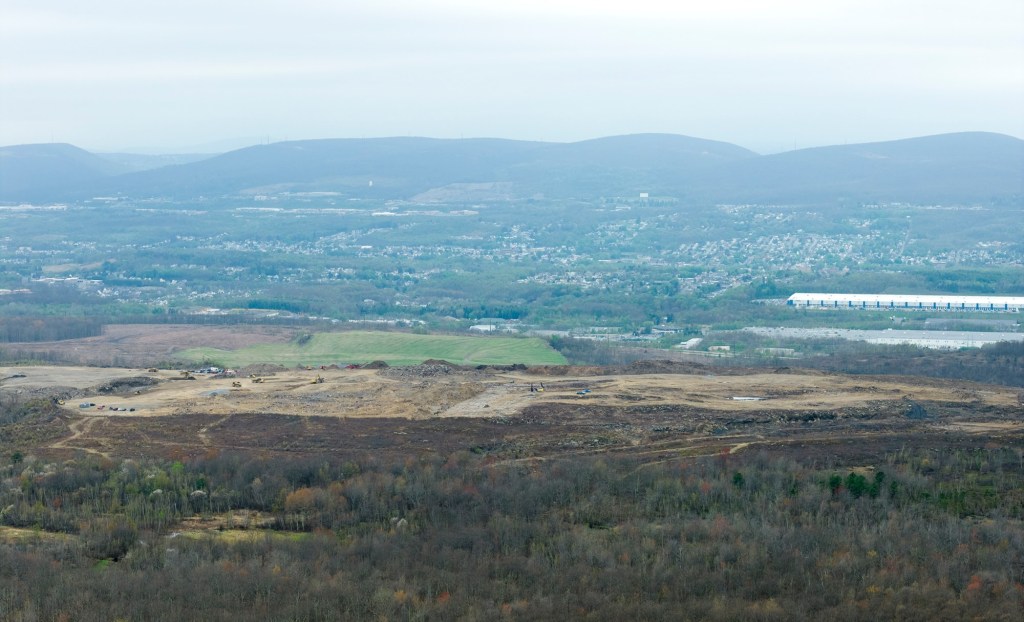
Companies tied to a Missouri-based developer and Charles DeNaples recently applied to build 16 data centers in Olyphant east of the Casey Highway, proposing the developments as Olyphant navigates the aftermath of a procedural debacle in April when some council members sought to buy the borough an additional six months to regulate data centers by invalidating their own zoning.
In a chain of events now being challenged in court, Olyphant Borough Council initially voted 4-3 on April 14 to adopt a zoning ordinance regulating data centers, followed by a revote that rejected the ordinance with another 4-3 decision amid pushback and clamor from residents filling the council chambers.
Council subsequently voted to declare its zoning ordinance substantively invalid because it excluded data centers and to pursue a curative amendment addressing them. Officials in favor of the move backed the curative amendment as a way to buy Olyphant an additional six months to regulate the industry rapidly spreading through Lackawanna County.
However, by voting down its initial data center zoning ordinance, which borough officials spent seven months drafting, Olyphant could have lost its protection under a legal rule known as the “pending ordinance doctrine” that applies forthcoming zoning standards to applications received while the legislation is underway.
Municipalities in Pennsylvania are required to allow for every type of lawful land use somewhere within their borders, from data centers to landfills. Failing to do so exposes a municipality to legal challenges over exclusionary zoning. As a remedy to an excluded use, property owners can file curative amendments putting forward their own zoning standards, effectively ceding control from the municipality. Municipalities can also seek their own curative amendments against themselves when they recognize exclusionary zoning — the strategy members of borough council relied on last month.
Last month, Olyphant council had considered a data center zoning amendment that defined data centers and associated uses while restricting them as conditional uses across 1,000 acres in the borough’s “large scale mixed commercial/manufacturing district,” or CM-2 zone. The zone encompasses the current sites where developers propose the 16 buildings.
The data center zoning ordinance initially passed with a 4-3 vote, with council members Jimmy Baldan, Beth Frushon, Eric Hartshorn and Bob Hudak voting in favor of it, and Joseph Collarini, Michael Abda and Dina Harrington voting against it.
The vote drew immediate pushback from residents in the crowd who opposed data centers. Amid the uproar, Bill Shigo, Olyphant’s zoning officer who was standing in as the secretary, suggested a revote due to the noise. Council voted a second time, and Frushon changed her vote to make it a 4-3 denial. Council then voted to invalidate its zoning and seek a curative amendment.
Council voted 7-0 on Tuesday on a resolution for that curative amendment, interim borough Solicitor John Brazil said Wednesday. Brazil replaces Olyphant’s longtime solicitor, attorney C.J. Mustacchio, who died Saturday, according to his obituary. Mustacchio also served as Olyphant’s borough manager.
Within days of the initial April 14 vote, Olyphant received a land development plan from Triboro Commerce Park to develop seven data centers, borough engineer Lou LaFratte said Wednesday. Triboro’s land encompasses just over 400 acres on the western portion of the roughly 1,000-acre CM-2 zone in the middle of the Casey Highway, Route 247 and Marshwood Road. Charles DeNaples, the son of Keystone Sanitary Landfill co-owner Dominick DeNaples, is the managing member of Triboro Commerce Park LLC.
On May 4, Olyphant received a zoning application from ERCOR Triboro — a limited liability company under St. Louis-based Sansone Group — to change its land use from four warehouses to nine data centers, LaFratte said. The campus spans about 500 acres, he said. Sansone’s property is adjacent to DeNaples’ land.
ERCOR Triboro LLC and Triboro Commerce Park LLC most recently recorded an easement agreement with Lackawanna County on Jan. 13 to allow the commerce park to build an access road on Marshwood Road and through part of ERCOR’s property. Nicholas G. Sansone signed on behalf of ERCOR Triboro. DeNaples signed as the managing member of Triboro Commerce Park.
DeNaples also challenged Olyphant’s decision to invalidate its zoning in a land-use appeal filed April 21 in the Lackawanna County Court of Common Pleas. The appeal asks the court to overturn Olyphant’s decision to invalidate its zoning, and to honor the initial 4-3 vote that would have regulated data centers. Brazil said the borough is going to move forward and see if it can get a court hearing for that determination, which will affect the direction of the borough’s data center zoning.
“Regardless of that case, it doesn’t hurt to have the curative amendment process in case, just so you can have some protection,” he said.
Citing case law and the Pennsylvania Municipalities Planning Code, which provides the legal framework for municipal zoning, Brazil doesn’t believe the curative amendment gives Olyphant what is effectively a six-month data center moratorium like some proponents contend. It does, however, protect the borough from anyone else filing a curative amendment, Brazil said.
“We don’t anticipate any more applications for land development, but a curative amendment covers the whole borough,” he said. “We want to have some protection.”
Brazil also believes Olyphant lost out on its pending ordinance doctrine status last month when council voted down the data center zoning amendment, with Olyphant now operating under the standards from its 1999 zoning ordinance.
A similar scenario played out in Archbald last fall. Borough council was poised to vote on a zoning ordinance regulating data centers on Oct. 3, but amid massive pushback from residents who urged the borough to place additional restrictions on data centers while reducing the number of locations they allowed them, council decided to let the motion die without a vote. Less than three weeks later, a developer applied to build 22 more data centers across two campuses.
Archbald council subsequently adopted the same ordinance the following month, though the decision faced resistance from the community.