
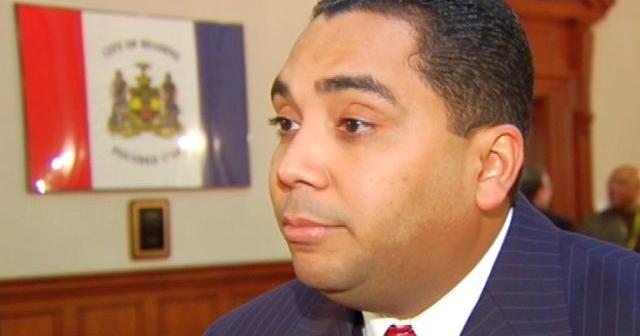
Weeks after an FBI raid of Reading City Hall, the city council’s president has stepped down after admitting he took a bribe to repeal the city’s ethics law, according to federal prosecutors.
Francis Acosta pleaded guilty Wednesday to conspiracy to commit bribery offenses, U.S. Attorney Zane David Memeger announced. The plea carries with it a maximum sentence of five years in prison, a fine of up to $250,000 and three years of supervised release.
Acosta, a Democrat who has served on council since 2010 and as its president since 2012, also submitted his letter of resignation Wednesday.
“Elected officials have an obligation to provide their constituents with honest services,” Memeger said. “When officials sell their services, particularly to repeal anti-corruption legislation, as Acosta admitted here, they do tremendous damage to the integrity of our governmental system.”
Acosta, 39, admitted in court that he conspired in the spring of 2015 with a person identified by federal prosecutors as “public official #1” to repeal a law that puts limits on campaign contributions to candidates seeking public office in Reading, said Memeger, noting that “public official #1” is a person who “had the power to sign into law ordinances that had been passed by City Council.”
Memeger declined to name “public official #1,” but he did say the person was a candidate in the Democratic primary election in May.
“Public official #1” offered Acosta an $1,800 “loan” to the campaign committee of Acosta’s ally, identified by prosecutors as “public official #2, which would be “forgiven” upon Acosta successfully orchestrating a repeal of the ethics law, Memeger said.
Acosta accepted the payment on April 10, 2015, and then, three days later, introduced legislation to eliminate certain restrictions in the Code of Ethics, specifically repealing Section 1012, which establishes limits on campaign contributions to candidates, and nullifying Section 1006(H)’s prohibition on awarding “no-bid contracts” to certain donors, according to federal prosecutors.
Acosta attempted to persuade other Reading City Council members to pass the repeal bill before the primary election by falsely asserting that he was motivated solely by the best financial interests of Reading and by concealing that he had received the $1,800 bribe check, Memeger said.
To conceal his participation in the scheme, Memeger said “public official #1” sought to finance any campaign contributions to “public official #2” with funding from third parties and also sought to offer Acosta additional funding for the campaign committee of “public official #2” as a reward for Acosta successfully orchestrating the bill’s repeal.
When Acosta took possession of the $1,800 “bribe check,” he agreed not to deposit it until a later date as a way of avoiding scrutiny of his agreement with “public official #1,” Memeger said.
In an interview with FBI agents investigating the bribery scheme on April 21, Acosta denied that he had accepted a bribery offer from “public official #1” and that he had ever possessed the bribe check, when, in fact, he still had possession of the check at the time of his false statements, Memeger said.
Within 24 hours of that interview, Memeger said Acosta took steps to withdraw from the conspiracy without alerting “public official #1” and “public official #2” to his interview with the FBI.
“When government officials agree to sell their services, they betray their constituents who rightfully expect high ethical standards,” said FBI Special Agent-in-Charge William F. Sweeney. “The FBI will continue to aggressively investigate allegations of public corruption, and work with our partners to ensure that those who violate their obligation to the public are held accountable.”
Reading City Council unanimously defeated Acosta’s bill, with Acosta absenting himself from the vote, according to prosecutors.
After accepting Acosta’s guilty plea, U.S. District Court Judge Juan R. Sanchez scheduled a sentencing hearing for Nov. 18. Acosta faces up to five years in prison, a fine of up to $250,000 and three years of supervised release.
The U.S. attorney’s office declined to say why the people identified as “public official #1” and “public official #2” have not been charged for their alleged role in the scheme.
Acosta on Wednesday also submitted his letter of resignation as president Reading City Council, whose other members released the following statement:
“The members of Reading City Council deeply regret the resignation of Council President Francis Acosta. The remaining six council members continue to pledge to move forward and work in a diligent manner, in compliance with the city’s Home Rule Charter. The council president position will be filled within the time period prescribed by the charter. In the interim, council Vice President Jeffrey Waltman will assume the duties of the council president.”
Acosta was elected to council in November 2009 as a representative of Reading’s first district. He was sworn in the following January and became council president in 2012 after then-President Vaughn Spencer resigned to serve as mayor.
“The majority of council clearly felt why is this happening now,” said Councilwman Donna Reed. “I will tell you the mayor sat in all those meetings. I always thought there was pressure on our council president for that to occur.”
Acosta’s guilty plea comes nearly four weeks after FBI agents raided Reading City Hall and the home of Mayor Vaughn Spencer on July 10 and removed boxes of documents from both locations. Federal authorities have not said whether that raid is related to the case against Acosta.
Spencer was on vacation Wednesday and unavailable to comment on the latest developments, city officials said.
FBI agents carried out a similar search of Allentown City Hall on July 2.