
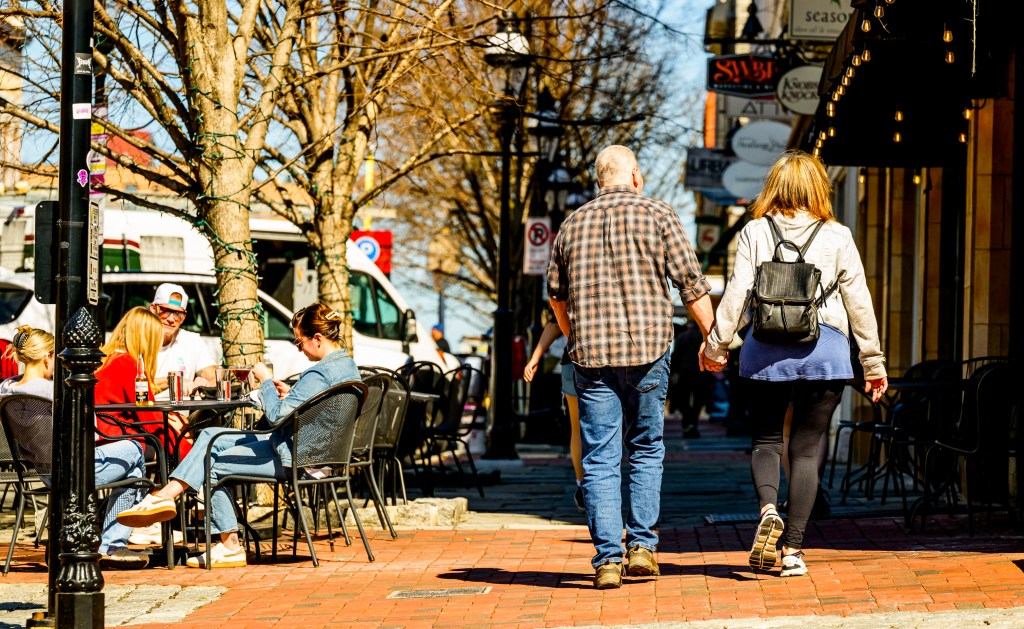
Friends, I am not an expert in housing, environment or zoning laws. I am simply a neighbor trying to make sense of my struggles and the pain I have witnessed in my community — which makes me wonder: what happens when a city grows faster than its ability to protect what makes it worthy?
On paper, Bethlehem tells a beautiful story. The Christmas City — a UNESCO World Heritage Site, a Tree City USA. Cranky old houses, ancient trees and narrow alleys leading to the best Main Street in America. Home to a Climate Action Plan that acknowledges the risks bearing down on our most vulnerable neighbors. Reading those words, you feel seen by a city that understands what is at stake. But walk through the South Side — where that same plan warns that “highly developed areas lacking vegetation and green space” have resulted in “some of the hottest parts of the city” and asthma rates for schoolchildren are three times the national average. Walk in west Bethlehem, where the same pattern is already repeating. Sit with the homeowner sacrificing everything for one house to hand down, hoping to break the cycle of intergenerational poverty. With the elderly woman watching construction shake the home equity she is counting on for long-term care. And with the families gentrification has already pushed out.
Paradoxically, as these inequities are recognized, the proposed solution is to keep building — mostly expensive units that end up attracting buyers and renters with purchasing power that local wages cannot match. Like adding a lane to a congested highway, more supply does not relieve the pressure. It attracts it. And nowhere is the cost of that pressure more visible than in the communities that can least afford it. On Rauch Alley, a mature big leaf linden tree we call the Gentle Giant, and on Eighth Avenue, a massive willow we call Will.O — both registered Pennsylvania Big Tree Program champions — are fighting for their lives. Proposed developments could sever their root systems slowly and invisibly, until their inevitable death. For now, they filter air in a valley the American Lung Association ranked among the most polluted in the nation. Decades of free health and financial infrastructure — now at risk of disappearing forever to make way for growth.
Much of this growth arrives requiring zoning variances — exceptions granted only when a property owner proves genuine hardship. Under Pennsylvania’s Municipalities Planning Code, that means unique physical conditions of the land itself must make strict conformity impossible — and five independent findings must all be satisfied. In most proposals, the land already has options — rent the existing property or build at permitted scale. A variance was never meant to be a tool to maximize profit. Neighbors keep wondering: if you buy land knowing its limits and draw a blueprint that ignores them — how is that not self-created? The hardship is not the land. It is the blueprint. And when that threshold is not met, the hardship gets transferred to the community — in utility bills, in vulnerable foundations and in air that worsens every time a mature tree comes down. If the purpose of zoning is to promote public health, safety and general welfare, then every land development decision must be treated as a public health decision.
Some might argue that raising expectations will discourage growth. But Bethlehem will always be a desirable location. The question is what kind of growth we choose to welcome — hopefully the kind that builds around century-old trees, integrates into our deeply rooted neighborhoods instead of erasing them, and leaves a block better than it found it. For that to happen, variances must be granted only for true hardships — and represent the minimum modification necessary to afford relief. Every development plan should require a formal appraisal of existing trees and green spaces — because once we know the true cost of what disappears, it becomes much harder to justify anything less than enforced root protection zones and environmentally responsible construction as conditions of approval.
Just as important — let us protect people’s ability to afford to remain in their homes, instead of allowing new development to encroach on their foundations, their air and their financial security. If we must build, let us build sustainably and for local salaries. Developers should be held to that standard — specifically those receiving public tax incentives, who should contribute meaningfully to genuine affordability, a commitment proportional to what the public is giving away.
Long before the first zoning code, the Lenape tended this land with a wisdom the Moravians also carried — that what you take from the soil, you take from each other, and what you are given, you hold in trust for the next. Let us be the generation that did not separate progress from humanity — the one that rose alongside every tree, every family and every living thing, and chose not to pave over what makes this city worth loving.
This is a contributed opinion column. Daiyana Rodriguez is a west Bethlehem resident and Spanish teacher at Liberty High School. She may be contacted at rodriguezdaiyana83@gmail.com. The views expressed in this piece are those of its individual author, and should not be interpreted as reflecting the views of this publication. Do you have a perspective to share? Learn more about how we handle guest opinion submissions at themorningcall.com/opinions.