
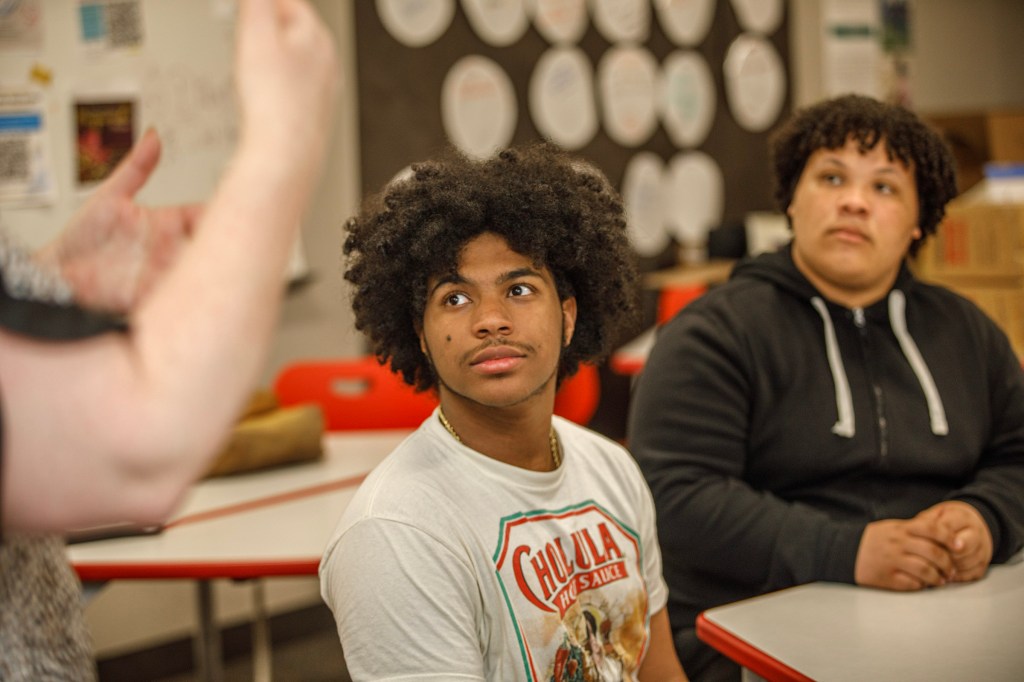
A senior spring packed with exams, proms and graduation preparations is about to get even busier for the approximately 130 students from seven Lehigh County high schools who will be working the polls this Election Day, serving both as clerks and interpreters.
For Tuesday’s primary election, the participating schools (all of which are Lehigh County schools because this particular branch of the state student poll worker program is run through the Lehigh County Board of Elections) are Allen High, Bridgeview Academy, Dieruff High, Emmaus High, Executive Education Charter Academy, Southern Lehigh High and Whitehall High.
Pennsylvania’s election laws are designed to have five poll workers per precinct: a judge of election, majority inspector, minority inspector, clerk and machine inspector. The first three are elected positions. Short-staffed polling places are allowed to operate with only three workers: judge of election, clerk and machine inspector.
Alexandra Sierra, the alternate language coordinator and community outreach liaison for the Lehigh County Voter Registration Office, has worked to leverage the skills and enthusiasm of Lehigh County students by signing up volunteer poll workers, including those who can serve as interpreters.
Interpreters can be additional volunteers at a precinct or can simultaneously serve as one of the designated poll workers.
High school students who meet the requirements of the student poll worker program can start volunteering at age 17. They are paid for their time, and experienced poll workers make an effort to welcome these young volunteers into the fold.
“Judges of Elections often organize potluck-style meals so that everyone can contribute and have snacks and food available throughout Election Day,” Sierra said in an email.
Sierra, who coordinates the student poll worker program, said November elections typically have a larger level of participation, with more than 200 students involved.
“Some students are unable to participate in the May election due to testing requirements and graduation-related commitments,” Sierra said.
Aiding with interpretation
Sierra works hard to recruit students whose language skills are fluent enough to serve as interpreters at the polls.
Many of the Bridgeview Academy student poll workers fall into that category. For example, Carlos Medina, 18, is working his third election. His first was the May 2025 primary and he also worked the polls in November.
Although Medina started his volunteer experiences as a clerk, he became an interpreter in his second election, putting his Spanish skills to work aiding voters at the Ramos Elementary polling station in Allentown.
Medina estimated that about 25% of the voters who came to that polling station needed some kind of language support.
When some voters see Medina’s button that identifies him as an interpreter, they ask, “Do you speak Spanish?” and when he says, “Yes,” he said the voters immediately seem more comfortable having a Spanish speaker explain the logistics of the polling station to them.
Medina said he’s made friends and formed stronger connections with his neighbors by working the polls, saying his favorite part of being a volunteer is “the community around you and meeting new people.”
“Also, it’s a great opportunity for me to experience what it is to vote and how the process is,” Medina said.
Part of that process for Medina has been helping his neighbors understand that their poll workers come from that neighborhood as well.
“Seeing the new people around your place, like your neighbors, actually meeting them — because some people, they’re shy and stuff, but when you actually see them in person and you get to meet them, get to make new connections — you can say to them, ‘Oh, I live right next to you, I live around you,’ ” Medina said.
Learning election logistics
Christopher Rhodes, a 17-year-old Bridgeview Academy student, worked as a clerk in the fall 2025 election, stationed at an Allentown Fairgrounds polling station.
Being a poll worker was “not as scary” as he thought it would be, Rhodes said. He was one of three volunteers who handled the election machinery at that polling place, tasks that included typing voters’ names into an iPad to confirm they were at the right polling station, helping voters sign in, giving them ballots and reminding voters that ballots are double-sided.
Rhodes also learned how to feed ballots into voting machines so that he could help voters if they had difficulty.
He said he observed a range of emotions from voters, some of whom seemed happy to be bringing their children to see a polling place and others who presented a more stoic front as they cast their ballots.
During his down time, Rhodes said he got to chat with the other poll workers. Overall, the atmosphere was “very calm.”
Registering voters
Bridgeview Academy’s senior capstone program is designed to push students to complete a project “with authentic impact” and the lens of civic engagement, instructor Shannon Salter explained.
This school year, 18-year-old Luis Alvarez made voter registration his capstone project.
At Bridgeview, voluntary voter registration is largely conducted during class as part of the capstone course. Alvarez’s job was to make sure that his fellow students completed their registrations, mainly done online, and got all their questions answered, such as: What does it mean that Pennsylvania is a closed primary state? What are the advantages and disadvantages of registering with a party? What happens if you want to switch your affiliation later?
No one from the school tracks what party students register with or if they decide to register as an unaffiliated voter. The school simply records how many students successfully complete their voter registration.
Bridgeview’s approximately 95 seniors had until May 4 to register, if eligible, for the primary election. The final percentage of eligible students who registered to vote was 90.6%.
That number is not an anomaly for Bridgeview, as Salter has shepherded voter registration efforts that have seen the school earn honors from the Pennsylvania Department of State, whose Governor’s Civic Engagement Award recognizes schools with a high percent of eligible students who register to vote.
Nearly every year that Bridgeview, Allentown’s newest high school, has had seniors in the building, it has earned a Gold ranking (at least 85% of eligible students registered to vote), only slipping into the Silver category (at least 65% of eligible students registered to vote) during the 2020-21 school year when registration efforts had to be conducted remotely due to the pandemic.
Alvarez, who is in his second year as an Election Day volunteer, also encourages students to become poll workers. When they ask how challenging the job is, he said he tells them it’s not as difficult as they might think, as the training sessions Sierra organizes are good preparation for Election Day.
“It’s very straightforward, very good training,” Alvarez said.
Overall, he said working the polls is one of the most effective ways students can meet their civic engagement goals.
“It’s easily one of the best things we could do as a starting position, working,” Alvarez said.