
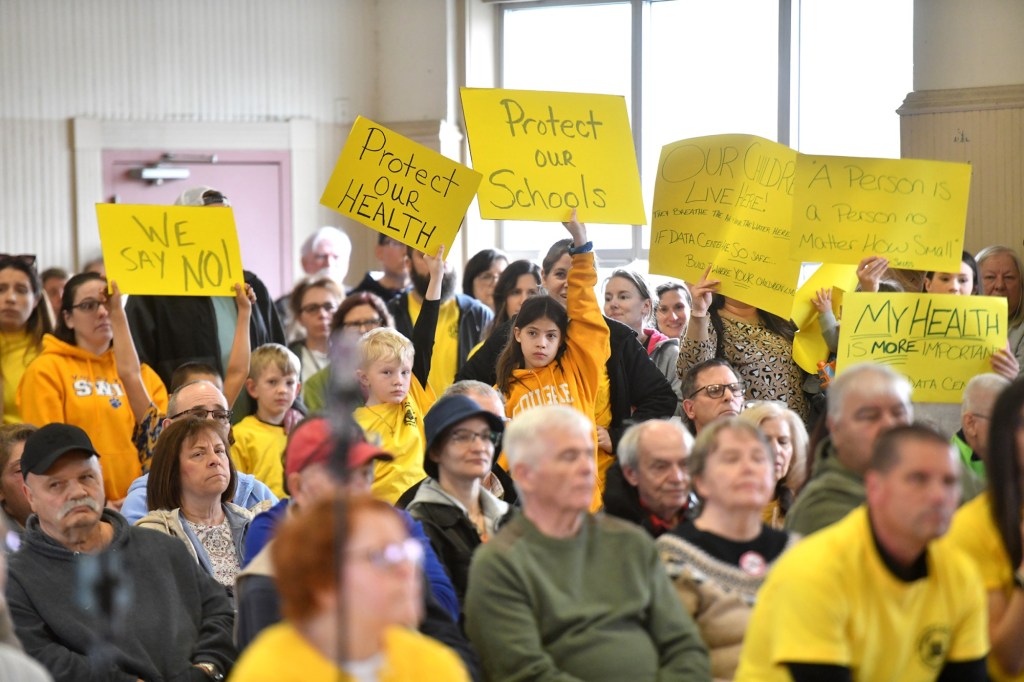
The Valley View School District joined the intensifying battle against data centers on two fronts Monday night in an attempt to keep the industry away from its schools in Archbald.
The board of education voted Monday to adopt a two-part motion targeting data centers. The board sided with Archbald in one legal battle against the developer trying to build the18-data-center Project Scott campus on Eynon Jermyn Road, while simultaneously challenging the validity of the borough’s data center zoning via a curative amendment, according to a recording of the meeting that the district uploaded to YouTube early Tuesday.
Directors voted 7-0 to move forward with the legal battles. President Laurie Marino, who attended via phone, Vice President David R. Valvano and Directors John Evans Sr., James Addley, Joseph Farrell, Dominick Perini and James Rodway voted for the motion. Director Tracy Grant was absent, and Director Thomas “Bear” Owen, who had been attending by phone, was no longer on the call during the vote.
The data center industry’s interest in Lackawanna County has escalated over the past 18 months, with Archbald emerging as the hotspot for development. There are six proposed data center projects totaling 51 buildings in Archbald. The majority of those are clustered into a roughly 1-mile corridor along Eynon Jermyn Road, where developers propose 30 data centers — including one that’s 620,000 square feet — and a 400-megawatt natural gas-fired power plant in the vicinity of Valley View’s intermediate, middle and high schools.
The motion authorizes law firm Joyce, Carmody & Moran PC, to intervene and oppose Archbald I LLC in its “deemed approval” lawsuit against Archbald; and to prepare and file a substantive validity challenge under the Pennsylvania Municipalities Planning Code to “attempt to prevent data center development near the high school and intermediate school, for the protection of the health, welfare and safety of the students and the school community.”
Farrell suggested the motion after pointing to similar efforts led by Lackawanna County Commissioner Bill Gaughan to explore whether the county has legal standing to intervene against data centers proposed in Archbald near a county housing authority property and Aylesworth Park.
Farrell attributed it to two concerns: the health and safety of students, and the potential budget implications if data centers reduce district property values.
“If we run into a situation where the bottom falls out of the real estate market in our district, we’re going to have a serious problem,” he said. “More importantly than that, the concern should be placed on the health and welfare of the students in the district.”
He encouraged his colleagues on the board, “Now is the time to get involved.”
“We have a duty to ensure the district has a seat at the table,” Farrell said.
Citing impacts to students’ physical and mental health, air quality and cancer concerns, Farrell especially worried about the proposed 400-megawatt Essential Energy LLC natural gas power plant — which would be about half a mile from the Valley View Intermediate School — and the fleets of diesel generators needed at every data center campus to provide emergency power during an outage. The diesel generators have become a core concern among Archbald residents, with hundreds of generators proposed at individual campuses, each required to be fired up monthly for testing and maintenance.
Solicitor Larry Moran Jr. said during Monday’s meeting that Lackawanna County’s solicitor contacted him about the county’s plans to intervene. Moran suggested two options: intervene in the deemed approval lawsuit or seek a substantive validity challenge of Archbald’s zoning with a curative amendment.
School directors went with both of those options.
Before voting on the motion, to satisfy Pennsylvania’s Open Meetings Law, directors voted to amend their agenda to add the data center motion.
At one point, Rodway asked about paying for the legal battles, pointing out the district’s financial struggles.
Farrell replied, “If we’re going to put a price on the health and safety of the kids of this district, I don’t want to be part of this board, quite honestly.”
Curative amendment
The Pennsylvania Municipalities Planning Code, or MPC, which provides the legal framework for municipal zoning, allows property owners to challenge the validity of a municipality’s zoning ordinance, providing their own amendment to “cure” the defects.
By seeking a curative amendment, the Valley View School District will argue that Archbald’s zoning for data centers is unsafe and unlawful because it allows them too close to homes and schools, according to Moran.
According to the MPC, when a governing body considers a curative amendment, it must consider “the impact of the proposal upon roads, sewer facilities, water supplies, schools and other public service facilities.”
Archbald amended its zoning in November to define and regulate data centers, though the legislation received substantial pushback from the community. Residents at the time urged council to apply additional restrictions to data centers while reducing the number of locations the borough planned to conditionally allow them, with a push to limit the industry to land east of the Casey Highway and away from residences.
Prior to directors’ voting, Moran explained that if the board moves forward with the zoning challenge, he will argue, “It’s too much, you’re too close to homes and schools, it’s unsafe, it’s unlawful.”
“I throw everything at them with our own curative amendment and our own proposed ordinance, saying put it somewhere else,” he continued.
He suggested that the curative amendment would limit data centers to the east side of the Casey Highway. If they lose the curative amendment challenge, the district could request, alternatively, that Archbald gives Valley View’s property the same light industrial zoning designation as the neighboring Lockheed Martin plant to give the district “the chance to monetize our reality in the future.”
Moran referenced remarks he made to Archbald Borough Council in November and an accompanying letter asking the borough to rezone the entirety of Valley View’s property on Columbus Drive from residential to light industrial.
“The community was saying, ‘The worst would be if we were surrounded by data centers.’ How would we get out?” Moran said. “The plan that we were talking about would be sticking a for-sale sign in this property, as one option, and appealing to our data center developer neighbors about what the market would be for this 180 acres — the high school and the middle school.”
Archbald conditionally allows data centers in four overlay districts:
• Hundreds of acres along Business Route 6 and Route 247, which are zoned for conservation and medium/high-density residential uses. This is the site of the Wildcat Ridge Data Center Campus.
• The wooded area immediately north of the Archbald Pothole State Park and Staback Park along Business Route 6 and Eynon Jermyn Road. This is Archbald I LLC’s 18-building data center campus that Valley View is now fighting.
• A narrow L-shaped band on the outskirts of Stavola Silverbrook Land LLC’s mining land along the Casey Highway near Aylesworth Park. This is Project Green Mountain.
• Industrial land along Power Boulevard and in the Valley View Business Park.
If Valley View’s curative amendment limits them to land east of the Casey Highway, it would remove the first two areas.
Deemed approval
Archbald is embroiled in a legal battle with a Dallas, Texas-based data center developer that stems from a procedural issue that prevented the borough from holding a hearing within a legally allotted timeframe. The developer, Archbald I LLC, argues because of that procedural issue, its plans are automatically approved to build 18 data centers between Eynon Jermyn Road and Business Route 6.
Valley View will now intervene on Archbald’s behalf in the legal battle.
Archbald received a conditional use application for the data center campus Dec. 16 when Provident Realty Advisors of Dallas, Texas, which operates as Provident Data Centers, applied for 18 data centers, each up to 90 feet tall with a 154,850-square-foot footprint across about 400 acres. The nearest data centers would be just over 200 feet from Archbald’s Staback Park.
The MPC requires that municipalities hold the first hearing on a conditional use application within 60 days and subsequent hearings within 45 days. Failing to meet those deadlines results in deemed approval of an application. Council abided by the timeline, holding its first hearing Feb. 11. Due to time constraints, the borough only heard testimony from two of the developer’s five planned witnesses. The borough and developer agreed to reconvene the following month.
At the conclusion of the Feb. 11 meeting, Archbald Solicitor Jay O’Connor announced the next hearing would be March 19, which satisfied the state’s requirements for public notices by announcing it on the record during the hearing. The following day, attorney Jeffrey Esch McCombie of Harrisburg-based McNees Wallace & Nurick LLC, who represents Archbald I, emailed O’Connor that project manager Nick Farris, the director of acquisitions and director of data center development at Provident who testified in February, had a planned family vacation the week of March 19 that he could not reschedule.
“I understand that this creates some procedural due process and planning hurdles for you,” Esch McCombie wrote.
Archbald rescheduled the hearing to March 23, and because of that, the borough had to advertise the new hearing date. The MPC requires that public notices are advertised in the newspaper of general circulation — in this case, The Times-Tribune — for two consecutive weeks. O’Connor’s law office submitted public notices to run March 8 and 15, but the day of the hearing, the borough discovered that due to a clerical error at the newspaper, the notices were not published, preventing them from holding the hearing.
In response, O’Connor emailed the data center attorney asking if his client would agree to an extension. Esch McCombie declined, writing, “Applicant declines to be strong-armed into agreeing to an extension.”
In a bid to prevent the deemed approval, council held a special meeting March 27 to deny the conditional use application, acknowledging in its written decision that it supports remanding the decision back to council to complete the record, or to hold evidentiary hearings in court.
Last month, Archbald I LLC took two steps toward securing that deemed approval by publishing a public notice in The Times-Tribune and filing a notice of appeal in Lackawanna County Court.
Archbald I LLC most recently filed a mandamus lawsuit in county court Thursday, which asks the court to order Archbald to recognize its deemed approval.