
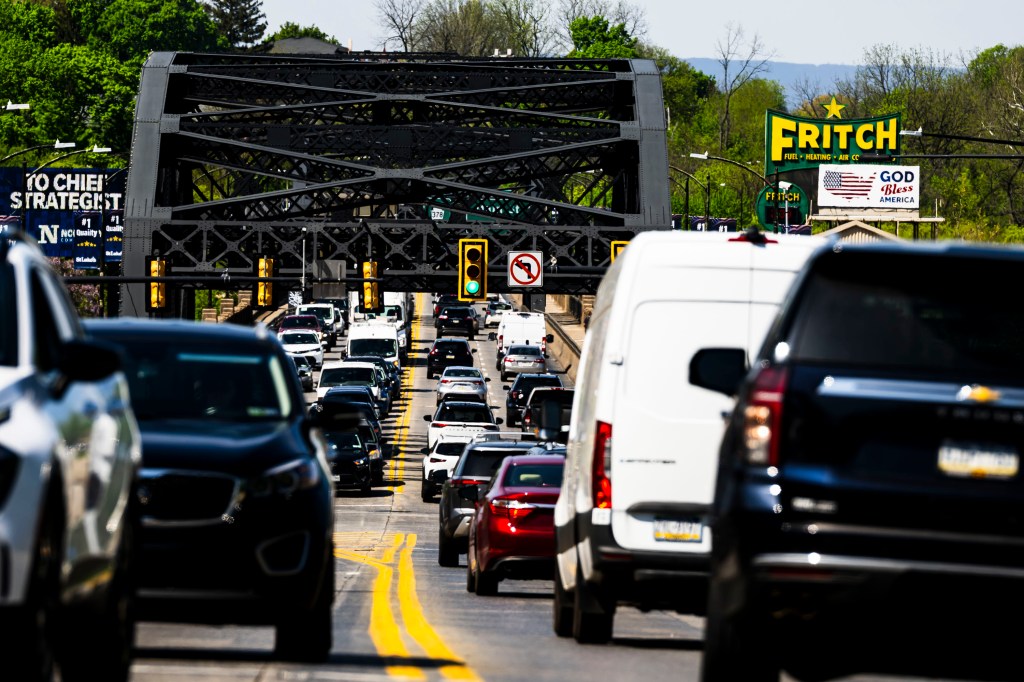
For motorists tired of getting stuck in traffic on the Hill to Hill Bridge in Bethlehem, the good news is the project you’ve all been waiting for should be getting started this summer.
The bad news is it will continue until 2030.
An engineering consultant for PennDOT updated the Lehigh Valley Transportation Study’s Technical and Coordinating committees Wednesday about the $92.8 million project to widen the bridge that carries Route 378 and improve traffic flow for one of the region’s main choke points.
“We’re still on schedule,” said Brian Teles, Pennsylvania area manager with GFT Infrastructure. “We’re trying to meet the August date so that we can start construction this year. It’s about 3.5 years worth of construction. We are still finalizing construction schedules, but that’s our estimate.”
PennDOT estimates about 55,000 vehicles use the 102-year-old bridge on a daily basis, moving between the North and South sides of Bethlehem. Besides gumming up the works for commuters, backups on the bridge routinely leave ambulances carrying patients to St. Luke’s University Hospital in Fountain Hill stuck in traffic.
Widening the road while maintaining turn lanes for the Second Street ramp will require building a second bridge parallel to the current structure’s southern end, where it passes over the Lehigh River.
The new Hill to Hill span will look like the current bridge and carry northbound traffic about to where the Fritch Inc. sign is located. The older span will carry southbound traffic and allow a second left-turn lane onto the Second Street ramp.
Other improvements include adding a slip ramp to allow traffic traveling north on Second Street to make a direct turn onto the ramp for Route 378 north, and a dedicated right-turn lane from Route 378 south to West Third Street — that intersection will also be “smoothed out” to get rid of awkward angles.
The new signals at the Second Street ramp and Third Street will have emergency vehicle preemption that allow ambulances to trigger green lights.
For pedestrians and cyclists, the new span will have a 10-foot mixed-use path, and a reconstructed crosswalk at the southern entrance will feature pedestrian refuge islands.
Of course, getting those improvements will require years of construction. Teles said the goal is to maintain four lanes throughout the project, though it won’t always be possible.
“As much as we would love to maintain four lanes of traffic all the time during construction, it’s virtually impossible to work on a four-lane bridge without impacting traffic,” Teles said. “What we are trying to do in most of the traffic work is maintaining four-way traffic during the weekday peak hours.”
He said that during one stage, there will be only one lane northbound and two lanes southbound to get some tie-in work done with the new span.
Teles said there will also be construction blackout periods during some of Bethlehem’s bigger events, such as Musikfest and the Celtic Classic.
Earlier in the meeting, both LVTS committees approved an additional $18.7 million for the project, supplementing the previous estimate of $74 million, as an amendment to the Transportation Improvement Program.
It is needed because of an increase in construction costs and to accelerate construction.
Funding will be diverted from the Route 309 and Tilghman Street interchange project ($3.4 million), the Route 22 and Fullerton interchange project ($7.6 million), and other projects and reserve LVTS line items.
Morning Call reporter Evan Jones can be reached at ejones@mcall.com.